[Haoyu Wang, Yuta Michimura]
Using the s+p total power at POP and POS when the arms are locked and unlocked, Xarm and Yarm round-trip loss was measured to be the following:Xarm loss from POS: 48 +/- 10 ppm
Yarm loss from POS: 63 +/- 10 ppm
Xarm loss from POP: 51 +/- 8 ppm
Yarm loss from POP: 58 +/- 11 ppm
Background:
- We did the arm cavity round-trip loss measurement taking into account of ITM birefringence in 2022, but the result was not very consistent between POP measurements and POS measurements (klog #21965).
- We suspected that this might be from clipping (gate valve was closed and POP RBS1 was 1inch) and beamsplitters used in the optical tables having different R:T for s-pol and p-pol.
- Now we are repeating the measurement with gate valves opened and POP RBS1 replaced to 2inch, and all the beamsplitters swapped to non-polarizing BS (klog #30821).
Method:
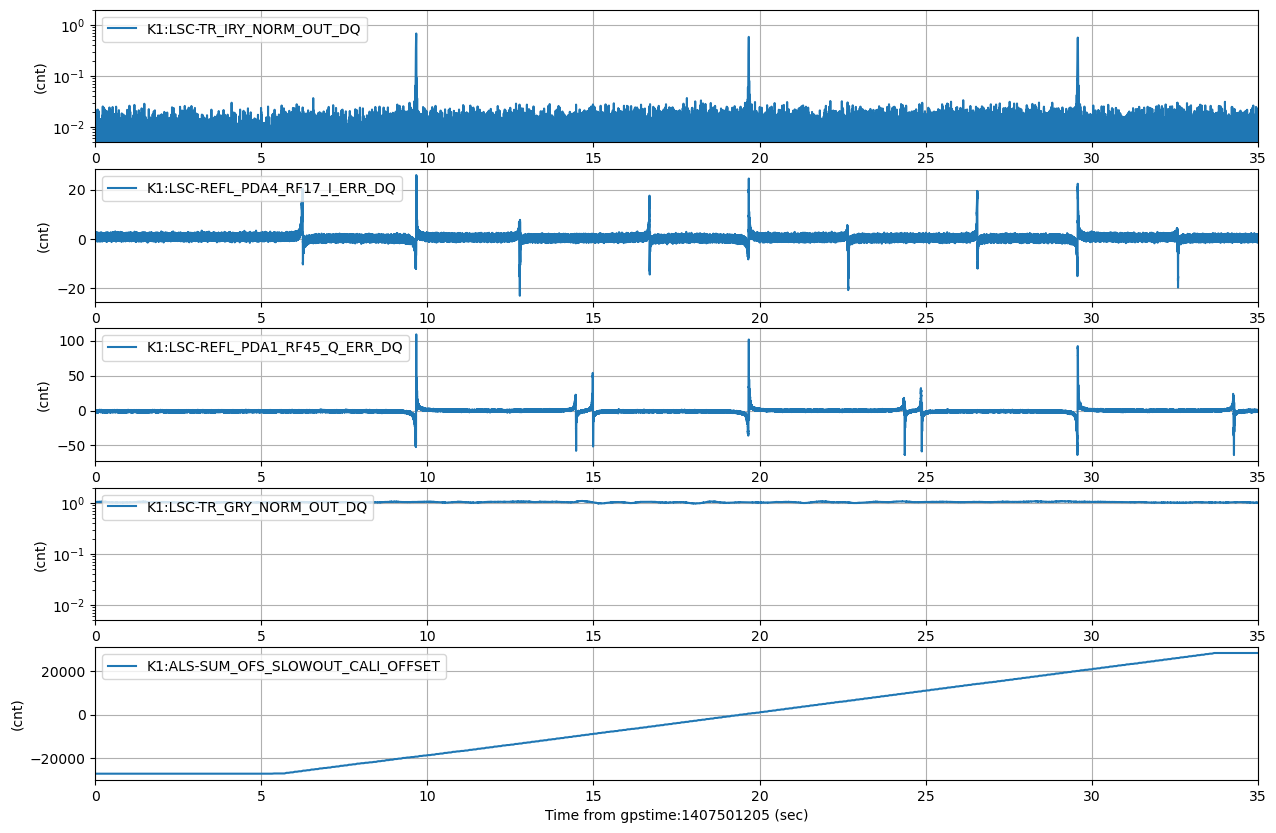
- First, we did Xarm and Yarm cavity scan to check the mode-matching using the method described in klog #30820 and klog #27767. Basically, we locked green to the arm with VCO, and the feedback signal was also sent to lock main laser frequency via ALS CARM with some offset at summing node CMB (K1:ALS-SUM_OFS_SLOWOUT_CALI_OFFSET). We confirmed that the mode-matching is (suspiciously) pretty good (more than 93% by eye; highest HOM peak is smaller than 0.03). See Attachement #1 and #2 for the result of the cavity scan for X and for Y.
- We then measured power at POP s/p-pol, POS s/p-pol and REFL (s-pol) with ITMX single bounce, ITMY single bounce, Xarm locked, Yarm locked. We checked that all the PDs for POP and POS are 40dB settings and whitening filters were off before the measurement (klog #30821). We also zero-ed the offsets using respective OFFSET values (we need to turn on OFFSET for POP filter bank).
- Using RTL = 1/(1-alpha)*T_ITM/4*(1-P_locked/P_single+T_ITM), round-trip loss was estimated. Here, T_ITM=0.44% for ITMX and 0.48% for ITMY, P_locked and P_single are power in arm locked and ITM single bounce, respectively, and alpha is mode-mismatch. We assumed that alpha=0 from the cavity scan results. When calculating P_locked/P_single using s+p, our suspended BS having R:T=0.2:0.8 for p-pol was taken into account.
- Statistical uncertainty was estimated from the standard deviation of the data (all the uncertainties in this klog are statistical ones).
Results:
- Attachment #3 is the data from PDs. Note that the numbers for K1:LSC-POP_SPOL_DC_OUT16 in the plot is multiplied by 2, as number of BS for s-pol is one more than that for p-pol.
- p-pol content calculated with p/(s+p) were the following (R:T=0.2:0.8 for BS for p-pol taken into account):POS ITMX Single 6.01 +/- 0.03 % (1407503584)
POS Xarm Locked 0.64 +/- 0.02 % (1407503662)
POS ITMY Single 8.49 +/- 0.04 % (1407503776)
POS Yarm Locked 1.65 +/- 0.08 % (1407503884)
POP ITMX Single 7.22 +/- 0.03 % (1407503584)
POP Xarm Locked 1.19 +/- 0.08 % (1407503662)
POP ITMY Single 9.30 +/- 0.08 % (1407503776)
POP Yarm Locked 3.23 +/- 0.17 % (1407503884)
- RTL measured using the s+p total power were the ones stated above. If we use s-pol power only, the result will be the following. RTL will be minus (and bogus), because of the Lawrence effect (JGW-T2011633).Xarm loss from POS in s-pol: -13 +/- 11 ppm
Yarm loss from POS in s-pol: -22 +/- 11 ppm
Xarm loss from POP in s-pol: -18 +/- 10 ppm
Yarm loss from POP in s-pol: -19 +/- 12 ppm
Xarm loss from REFL in s-pol: -31 +/- 11 ppm
Yarm loss from REFL in s-pol: -36 +/- 14 ppm
Discussions and next steps:
- The results from POP and POS are consistent within the uncertainty.
- The systematic uncertainty coming from using alpha=0 is less than 7% (+/- 4 ppm in RTL), because the modematching was more than 93%. This is much smaller than the statistical uncertainty we have.
- p/(s+p) ratio estimated using POS and POP are not very consistent, especially for locked cases.
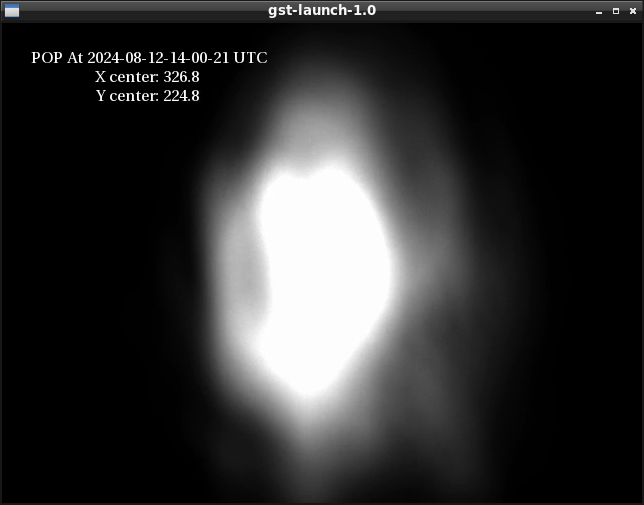
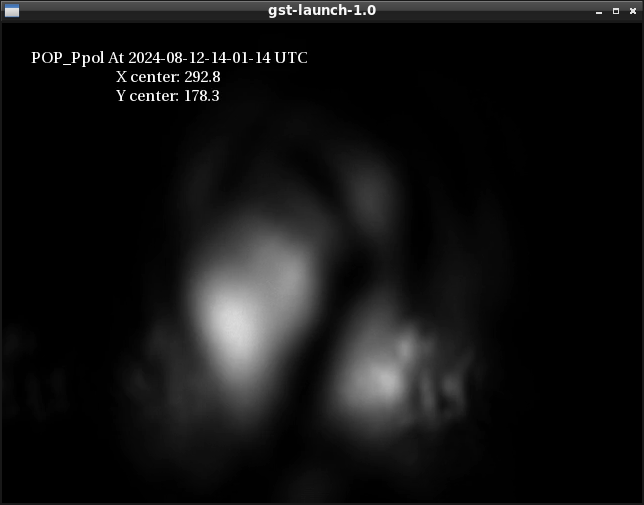
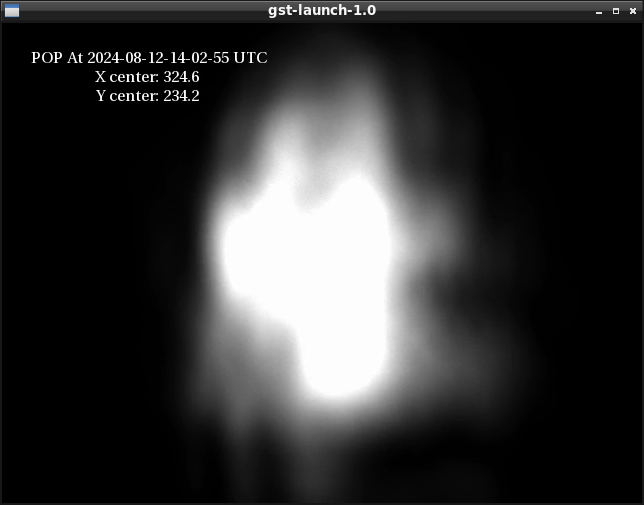
- Beam shape for s-pol for single bounce seems uglier than before in 2022 (especially ITMY). See Atttachment #4, #5, #6, #7 for POP s-pol and POP p-pol in ITMX single bounce and in ITMY single bounce.
- Although we have replaced BS at optical tables to non-polarizing ones, they still have imbalance in R:T (more like 55:45?). The systematic effect needs to be estimated.
- We should cross-check with other RTL estimates (e.g. from power-recycling gain measurments).






I believe it is just a writing miss: "1420" for the X arm and "1300" for the Y arm.
According to the arm cavity round-trip estimate in O4a, RTL was estimated to be 72 ppm for Xarm and 78 ppm for Yarm, using measured PRG of 14.5 and finesse of 1300 for Xarm and 1420 for Yarm 1420 for Xarm and 1300 for Yarm [edited on Apr 9; thanks Miyoki-san for the comment] (see JGW-G2415589).
There is a mystery that this is not consistent with the measurement at POP and POS (klog #30823). From this measurement, it was 50(7) ppm for Xarm and 61(7) ppm for Yarm (taking average between consistent POP and POS measurements).
In the POP/POS measurement, it was assumed that BS has R:T=0.2:0.8 for p-pol. Changing this ratio to R:T=0.17:0.83 or 0.23:0.77 will result in the measurement from POP and POS inconsistent by ~10ppm. This means that POP and POS measurements are pretty robust and BS having R:T=0.2:0.8 for p-pol is valid within this range (and this is consistent with in-situ measurement in klog #29279, while measurement for s-pol is not really 0.5:0.5).
Inconsistency between estimate from PRG could be attributed to ITM birefringence. In the estimate from PRG, it is assumed that arm loss is calculated from RTL*arm gain, but there is also loss from birefringence. If loss from birefringence is 3% (which is rougly consistent with previous measurements in the presence of Lawrence effect; see klog #30823), 30ppm inconsistency can be explained. 3% also can come from mode mismatch, as single arm modematching is 97(1)% for Xarm and 94(1)% for Yarm (klog #33306). Mode mismatch can be created with inhomogeneous birefringence.