[Fujimoto, Komori(online), Sugioka]
Abstract:
According to klog37833, MICH signal appears in REFL135Q.
We therefore investigated the potential of taking MICH3f signal from REFL135Q.
Details:
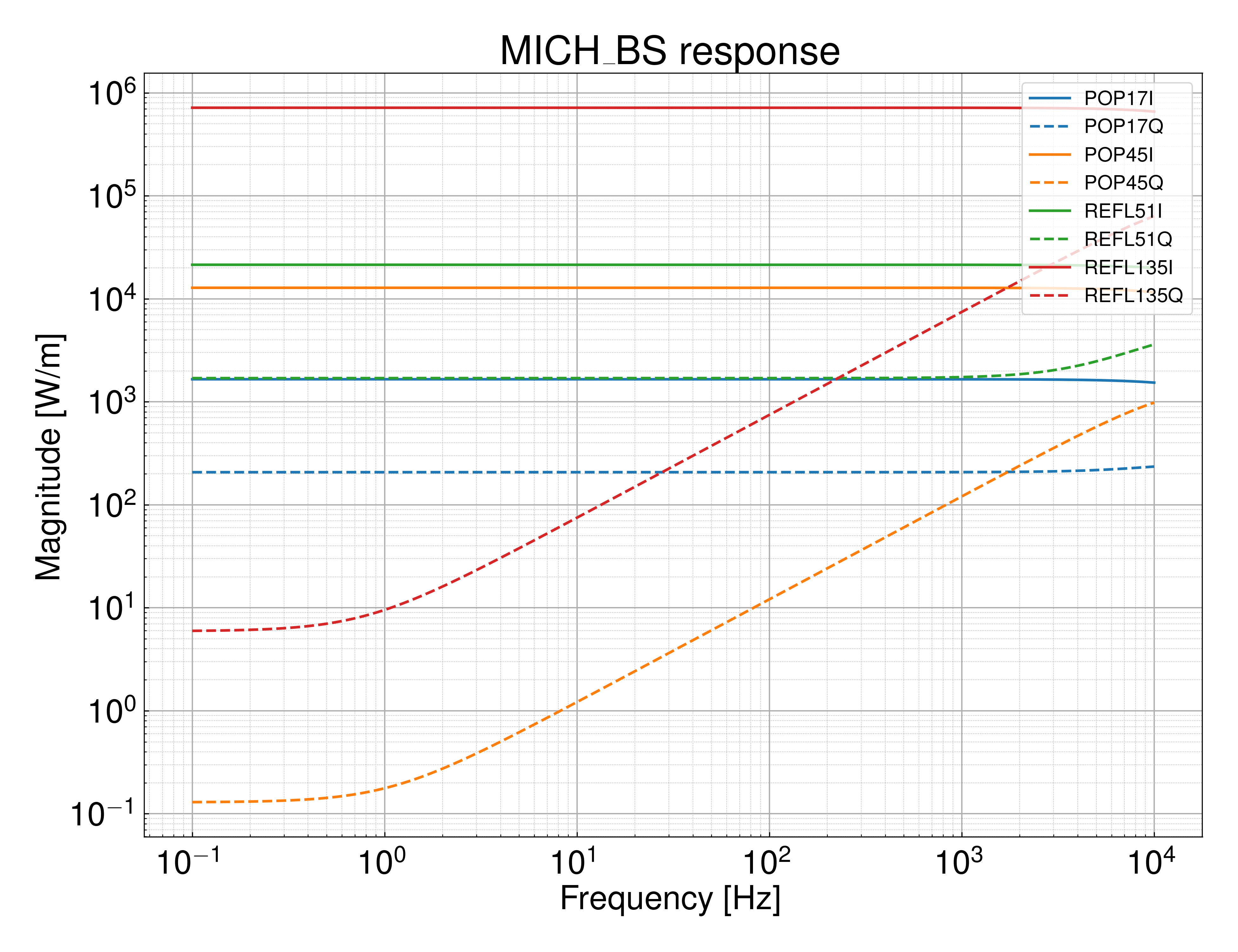
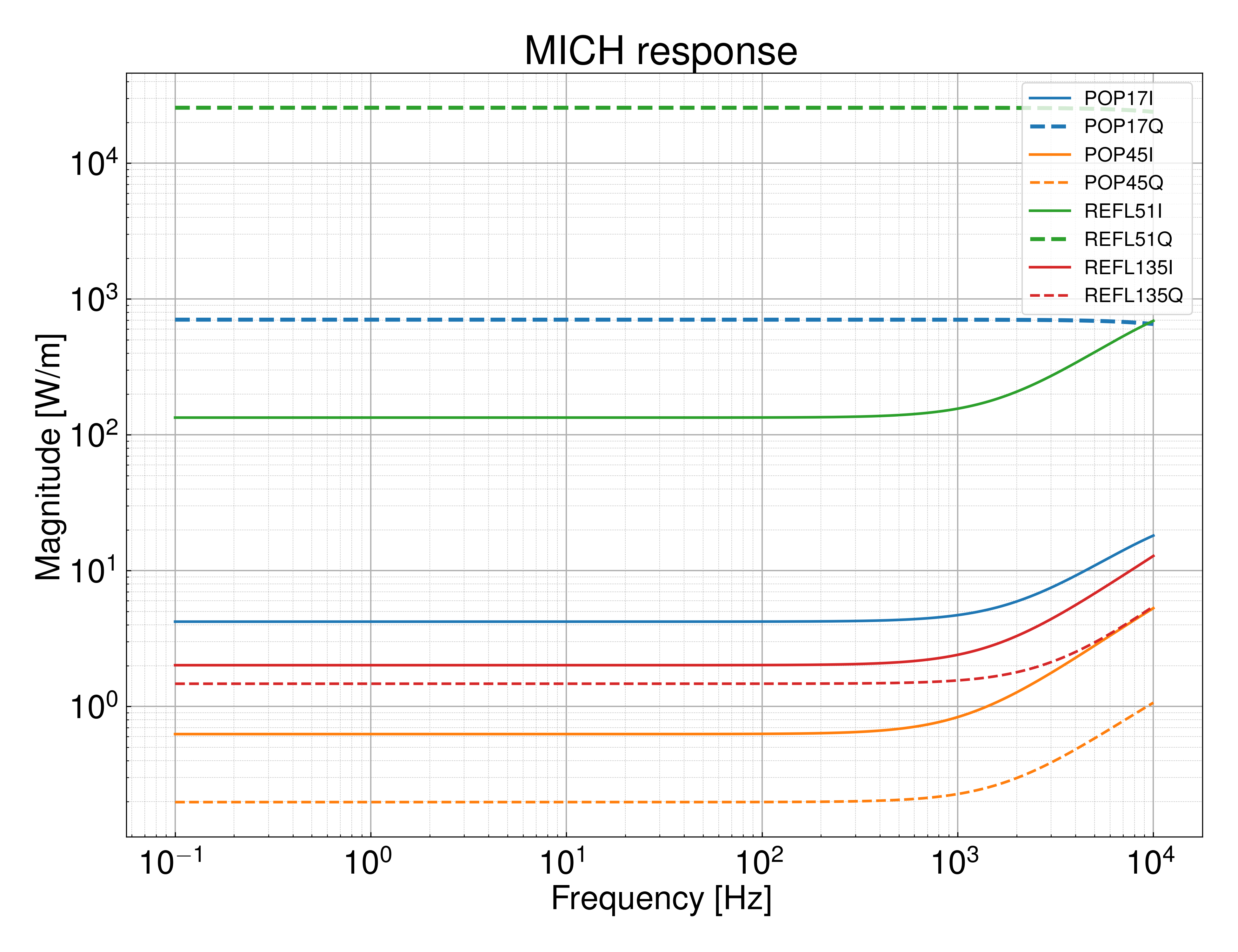
We measured the response of each PD signal to MICH/PRCL/SRCL in the same manner as klog37832 while DRMI1f locked(Figure.1,2,3).
Although we minimized the PRCL signal in REFL135Q by phasing(klog37829), REFL135Q is approximately 4 times more sensitive to PRCL.
Simply using REFL135Q for MICH signal thus seems difficult.
Furthermore, since an inexplicably large MICH signal is present in REFL51I and REFL135I, we suspected that these signals are originate from MICH actuator coupling.
Although we previously performed MICH actuator compensation to avoid changing PRCL and SRCL(klog37812, klog37816), imperfections in MICH actuator decoupling might still remain.
Then we estimated how much this actuator coupling causes the 'false MICH signal' in each PD siganl by measuring the MICH IN1-to-PRCL/SRCL IN1 TFs and PRCL/SRCL-to-REFL135/51 I/Q TFs.
Since there should be two coupling paths for each PD signal- one is via PRCL and the other is via SRCL- we estimated the coupling factor of all of these coupling paths.
For example, in the case of REFL135Q, the TF gain for the first path is the product of MICH-to-PRCL gain(~-26dB) and PRCL-to-REFL135Q gain(~-15dB), while for the second path, it is the product of MICH-to-SRCL gain(-6dB) and SRCL-to-REFL135Q gain(~-40dB).
The total coupling TF gain is thus estimated to be approximately -37dB.
Likewise, MICH-to-REFL135I, -REFL51I and -REFL51Q are estimated to be approximately -5dB, -13dB and -34dB respectively.
These results roughly agree with the measured MICH-to-REFL135/51 I/Q values.
In particular, MICH-to-REFL135I and -51I exhibit high coherence (>0.9), and the estimated values match the measurements well (within ±2 dB).
If the unmeasured REFL135 demodulation phase response of SRCL peaks around -90°, this coupling picture becomes consistent with the REFL135 demodulation phase response of MICH (klog37833).
In this case, the contribution from the SRCL path would be maximized at 135I with a demodulation phase of -119°, while that of the PRCL path would peak at a demodulation phase of around -90°, resulting in the largest overall response at a demodulation phase of around -100°.
A REFL135 demodulation phase sweep should be performed to test this hypothesis. (We actually carried out this measurement using Hirose-san's scripts, but somehow we could not find the saved data file.)
If this hypothesis proves correct, it implies that the genuine MICH signal in REFL is too faint to be used for the MICH sensor, meaning new approaches to extracting the MICH signal from other ports may be necessary.