Reports 1-1 of 1 Clear search Modify search
MIF (General)
yuta.michimura - 1:29 Thursday 29 January 2026 (36242) Print this report
PRX and PRY power recycling measurements

[Kenta, Michimura]

Power recycling gains were measured in PRX and PRY configurations.
The power recycling gains were rougly 0.3 for both PRX and PRY, but the power measured at POP is rougly two times higher for PRX case, compared with PRY.
This natively suggests that the BS T:R ~ 0.6:0.4, which in turn does not explain the measured PRG.
Birefringence effects could be contributing, but seems hard to explain the whole story.

Background:
 - The motivation was to calibrate the POP90 signal into actual power recycling gain for sidebands to aid optical loss measurements (klog #36231).
 - We also wanted to measure BS transmision and reflectivity in-situ to compare the result with klog #29284.

Locking and data taking:
 - We first zero-ed the relevant PD offsets by closing the shutters.
 - Locked PRX or PRY using K1:LSC-REFL_PDA2_RF135_I_ERR on carrier or sidebands by changing the sign.
 - Confirmed the alignment and error signal offsets to maximize the power recycling gain.
 - Took data for at least 100 seconds.
 - We also took the same data with ITM single bounce configurations, PRM mis-aligned to estimate the power recycling gain.

Data used:
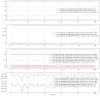
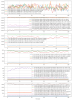
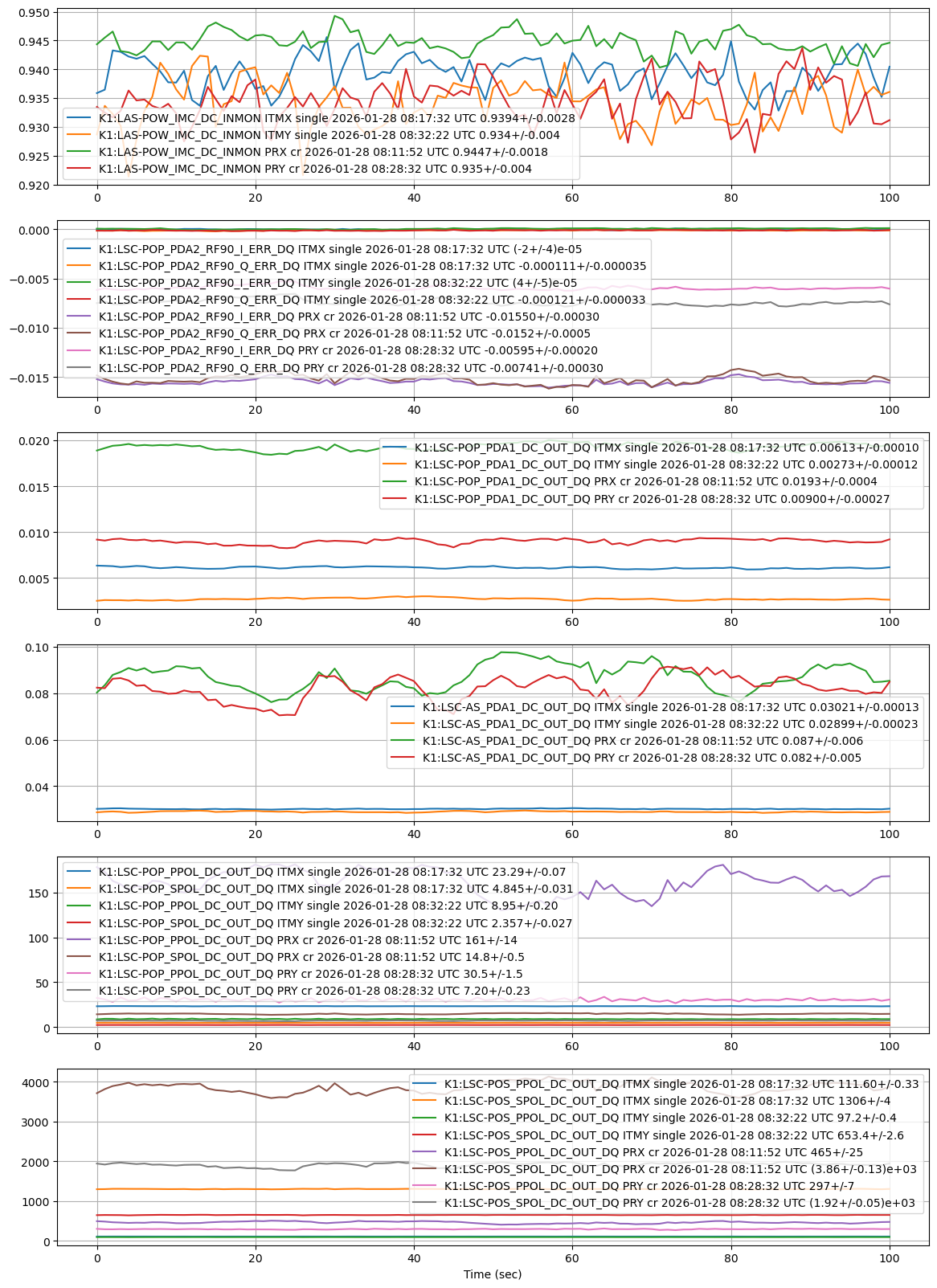
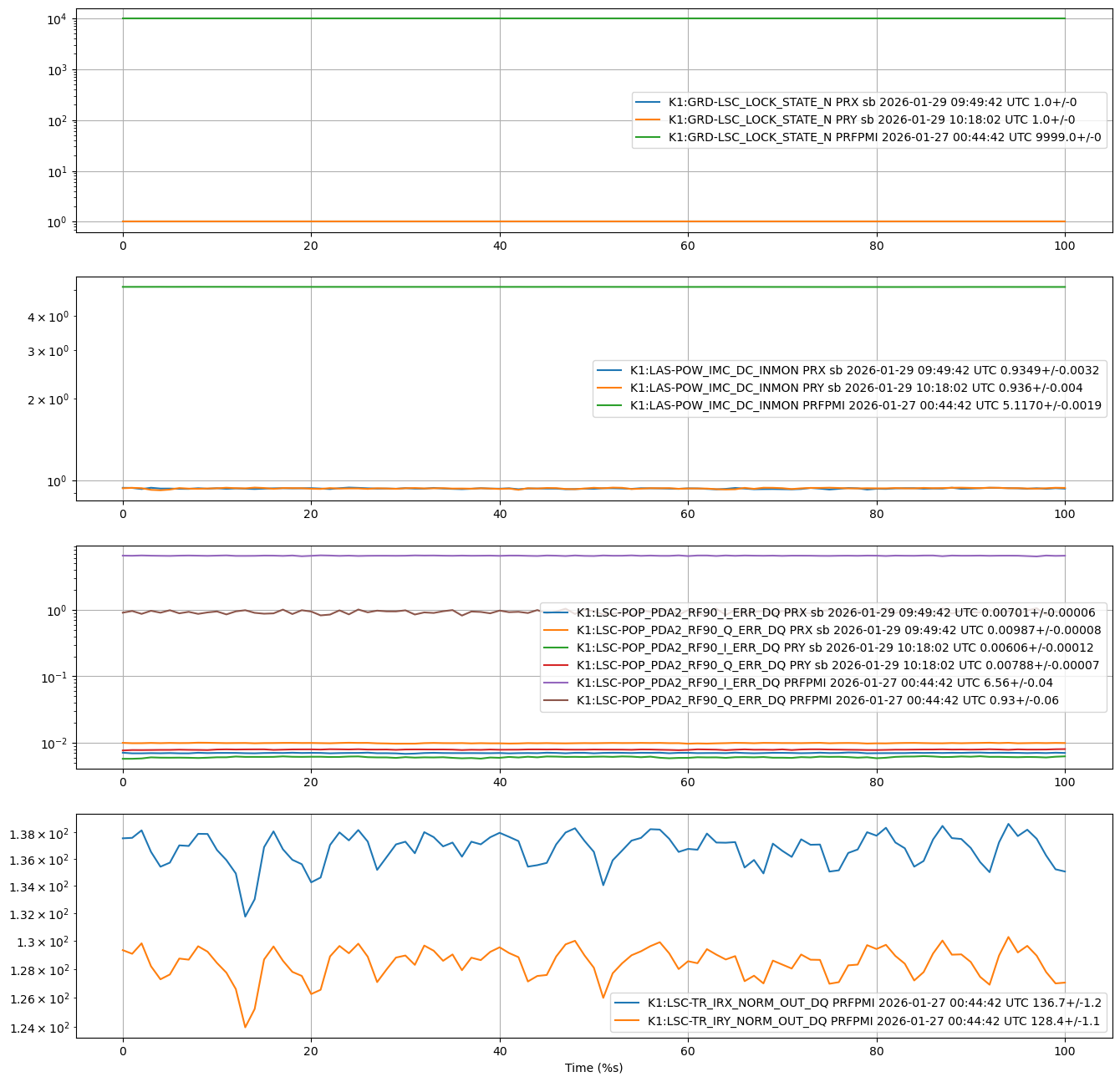
 - The raw data for PRX/PRY carrier (attachment #1) and sidebands (attachment #2) are attached. For the sideband lock, the data for PRFPMI 5W we took last night is also plotted for comparison.
 - The summary table for the carrier lock and ITM single bounce is as follows:
                                ITMX single             ITMY single             PRX carrier             PRY carrier
K1:LSC-AS_PDA1_DC_OUT_DQ        0.03021+/-0.00013       0.02899+/-0.00023       0.087+/-0.006           0.082+/-0.005
K1:LSC-POP_PDA1_DC_OUT_DQ       0.00613+/-0.00010       0.00273+/-0.00012       0.0193+/-0.0004         0.00900+/-0.00027
K1:LSC-POP_SPOL_DC_OUT_DQ       4.845+/-0.031           2.357+/-0.027           14.8+/-0.5              7.20+/-0.23
K1:LSC-POP_PPOL_DC_OUT_DQ       23.29+/-0.07            8.95+/-0.20             161+/-14                30.5+/-1.5
K1:LSC-POS_SPOL_DC_OUT_DQ       1306+/-4                653.4+/-2.6             (3.86+/-0.13)e+03       (1.92+/-0.05)e+03
K1:LSC-POS_PPOL_DC_OUT_DQ       111.60+/-0.33           97.2+/-0.4              465+/-25                297+/-7

 - As you can see, somehow X is always roughly two times higher, except for AS_DC and POS_PPOL.
 - Although POS_SPOL should be essentially the same as AS_DC, the behaviour is very different. It actually seems like POS_SPOL and POP_PPOL are swapped. But for now, we assume that they are not swapped.
 - Increase from single bounce to PRX/PRY are roughly a factor of 3, except for POP_PPOL in PRX case (in red).

Carrier power recycling gain estimates:
 - Power recycling gain can be estimated from taking the power ratio (PR locked)/(ITM single bounce) and multiplying it by PRM power transmission TPRM.
 - Below are the results. Although there are variations, PRX and PRY seems to be consistent. They are smaller than naive estimates from measured BS T and R (klog #36231).

Carrier PRG for PRX from POP_PDA1_DC    0.326+/-0.008
Carrier PRG for PRX from AS_PDA1_DC     0.298+/-0.019
Carrier PRG for PRX from POP_SPOL_DC    0.316+/-0.011
Carrier PRG for PRX from POP_PPOL_DC    0.72+/-0.06
Carrier PRG for PRX from POS_SPOL_DC    0.306+/-0.011
Carrier PRG for PRX from POS_PPOL_DC    0.431+/-0.023
Carrier PRG for PRX from all    0.399+/-0.012
Carrier PRG for PRY from POP_PDA1_DC    0.342+/-0.018
Carrier PRG for PRY from AS_PDA1_DC     0.293+/-0.019
Carrier PRG for PRY from POP_SPOL_DC    0.316+/-0.011
Carrier PRG for PRY from POP_PPOL_DC    0.352+/-0.019
Carrier PRG for PRY from POS_SPOL_DC    0.304+/-0.008
Carrier PRG for PRY from POS_PPOL_DC    0.317+/-0.008
Carrier PRG for PRY from all    0.321+/-0.006

Beam splitter ratio estimates and X/Y assymetry estimates:
 - POP being different between X and Y, but not for AS suggests BS T and R assymetry.
 - First, by taking the ratio (ITMX single)/(ITMY single) for AS_DC, ITM reflectivity ratio for s-pol can be estimated as follows.

ITM reflectivity ratio X/Y for s-pol from AS_PDA1_DC    1.042+/-0.009
                                                                                                                                                                                                                           
 - This is not conistent with PhysRevApplied.14.014021, which gives 1.000352+/-0.000028. But not very important.
 - By taking the ratio (ITMX single)/(ITMY single) for POP_SPOL, (TBS_s/RBS_s)**2*RITMX_s/RITMY_s can be estimated. Using the ITM reflectivity ratio above, BS T and R for s-pol are:

BS T/R ratio for s-pol from POP_SPOL    1.405+/-0.011
BS T for s-pol  0.5841+/-0.0019
BS R for s-pol  0.4159+/-0.0019

 - This is also not consistent with klog #29284, and not consistent with PRG measurements for PRX and PRY being almost the same, as it naively gives the following PRG. Another possibility for explaining X having more power could be clipping only in BS-ITMY or something similar, but this is also not compatible with PRG measurements. Clipping between BS-POP only for Y due to uglier beam or something like that? (See, also the background in klog #30823).

PRX PRG for s-pol 0.518+/-0.004
PRY PRG for s-pol 0.2816+/-0.0017

 - By taking the ratio of the ratio (ITMX single)/(ITMY single) for POP_PPOL and POS_PPOL, (TBS_p/RBS_p)**2*(TBS_s/RBS_s) can be estimated. Then, by using the estimated BS T/R for s-pol above, T/R for p-pol can be estimated as follows:

BS T/R ratio for p-pol from POP_PPOL and POS_PPOL       1.271+/-0.016
BS T for p-pol  0.5596+/-0.0031
BS R for p-pol  0.4404+/-0.0031

 - This is also not consistent with klog #29284. This could be due to POS_SPOL and POS_PPOL swap.
 - Finally, by taking the product of the ratio (ITMX single)/(ITMY single) for POP_PPOL and POS_PPOL, (RITMX_p/RITMY_p)**2*(TBS_s/RBS_s) can be estimated, where RITMi_p is the p-pol conversion factor on ITM reflection. Then, by using the estimated BS T/R for s-pol above, this p-pol conversion factor can be estimated as:

ITM p-pol conversion ratio X/Y from POP_PPOL and POS_PPOL       1.459+/-0.018

 - This is actually reasonable, compared with simulations and previous measurements (PhysRevD.110.082007).

Sideband power recycling gain:
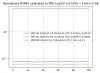
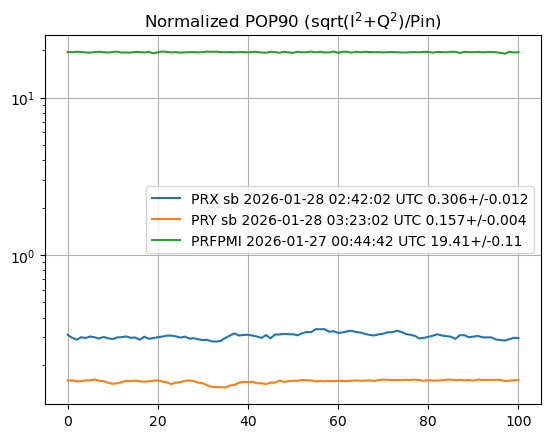
 - To estimate the power recycling gain for the sideband lock, we have plotted sqrt(I^2+Q^2)/Pin, where I is K1:LSC-POP_PDA2_RF90_I_ERR_DQ, Q is K1:LSC-POP_PDA2_RF90_Q_ERR_DQ, and Pin is K1:LAS-POW_IMC_DC_INMON. The quadrant sum was necessary to make sure to catch all the signal. See attachment #3.
 - Simply multiplying this by 15 would give PRG of 0.3 for PRX. For PRY, the power is somehow half, as usual. Since this is a lock for sidebands, Schnupp asymmetry or PRCL not consistent with current f2 frequency are not relevant.
 - If we believe in this calibration, sideband PRG for PRFPMI is 19. This could well be the case, if losses in PRC for sidebands are ~4% (see klog #36238 and klog #36233).
 - Actually, I and Q were almost the same for PRX and PRY case, but the most of the signal were in I for PRFPMI case. See attachment #2.
                                                                                                                                                                                                                           
Next:
 - Check if POS_SPOL and POS_PPOL are not swapped.
 - Check if polarization monitor PDs are aligned.
 - Check the beam shape for ITMX and ITMY single bounce.
 - Make a polarization monitor MEDM screen
Images attached to this report
Comments to this report:
yuta.michimura - 11:21 Friday 30 January 2026 (36249) Print this report

[Kenta, Michimura]

We found that the PRG measurements done yesterday (klog #36242) was bogus since the misalignments of ITMs where not sufficient.
By applying sufficient amount of ITM misalignments, PRG for carrier PRX and PRY, BS T and R, ITM reflectivity for s-pol and ITM p-pol conversion ratios are found to be the following:

Carrier PRG for PRX from POP_DC and AS_DC       0.341+/-0.006
Carrier PRG for PRY from POP_DC and AS_DC       0.330+/-0.009
ITM reflectivity ratio X/Y for s-pol from AS_DC and POS_SPOL   1.039+/-0.005
BS T/R ratio for s-pol from POP_SPOL    0.998+/-0.012
BS T for s-pol  0.4995+/-0.0030
BS R for s-pol  0.5005+/-0.0030
BS T/R ratio for p-pol from POP_PPOL and POS_PPOL       4.025+/-0.031
BS T for p-pol  0.8010+/-0.0012
BS R for p-pol  0.1990+/-0.0012

ITM p-pol conversion ratio X/Y from POP_PPOL and POS_PPOL       0.663+/-0.005

They are all consistent with our expectations. Asymmetry in ITM reflectivities for s-pol is probably due to birefringence asymmetry, and measured PRG suggests that losses in PRC is ~10% for PRX and ~15% for PRY.

We have also successfully estimated the PRG for sidebands in PRX, PRY and PRFPMI, and average PRC length as follows.

Sideband PRG for PRX           0.0730+/-0.0013
Sideband PRG for PRY           0.0599+/-0.0011
Sideband PRG for PRFPMI   7.30+/-0.11
Average PRC length      66.525+/-0.006 m

The measured PRCL is shorter from the design (66.591 m) by 6.6(6) cm.
If we are to keep the current f2 modulation frequency (44.9946924104 MHz), PRCL needs to be shortened by 10.3(6) cm.
Pretty low sideband PRG for PRFPMI suggest 13.4(2)% losses in PRC, consistent with PRX and PRY.
 

POP and POS PD checks:
 - We confirmed that SPOL and PPOL PDs at POP and POS are not swapped by blocking the beams in front of these PDs.
 - We found two beams in front of POS_SPOL PD even with ITMX in aligned state and ITMY in MISALIGNED state. We found that one of them was actually from ITMY, and was hitting on the PD.
 - We confirmed that by misaligning both ITMX and ITMY with MISALIGNED_BF, all the relevant PDs listed below will be zero.
 - The measurements done yesterday can be explained by X measurements seeing both beams and Y measurements seeing only Y beam.
 - With eyeballs, we confirmed that the beam is hitting on the SPOL PDs (for PPOL, it was dark and hard to see).
 - POP_SPOL PD had gain of 10 dB, while POP_PPOL, POS_SPOL and POS_PPOL PDs had 40 dB.

Data used:
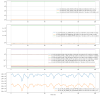
 - The raw data for PRX/PRY carrier (attachment #1) and sidebands (attachment #2) are attached. For the sideband lock, the data for PRFPMI 5W we took on Jan 27 is also plotted for comparison.
 - The summary table for the carrier/sideband lock and ITM single bounce is as follows:
                                ITMX single        ITMY single          PRX carrier             PRY carrier         PRX sideband        PRY sideband
K1:LSC-AS_PDA1_DC_OUT_DQ        0.03009+/-0.00014  0.02871+/-0.00017    0.0944+/-0.0014         0.0889+/-0.0015     0.01553+/-0.00009   0.01507+/-0.00009
K1:LSC-POP_PDA1_DC_OUT_DQ       0.00313+/-0.00008  0.00273+/-0.00007    0.01079+/-0.00015       0.0089+/-0.0004     0.00178+/-0.00009   0.00135+/-0.00009
K1:LSC-POP_SPOL_DC_OUT_DQ       2.252+/-0.029      2.18+/-0.04          7.45+/-0.25             7.24+/-0.24         1.148+/-0.027       1.243+/-0.025
K1:LSC-POP_PPOL_DC_OUT_DQ       16.66+/-0.07       6.25+/-0.04          98+/-8                  18.5+/-1.4          11.66+/-0.09        3.52+/-0.05
K1:LSC-POS_SPOL_DC_OUT_DQ       672.2+/-2.4        653.2+/-2.4          (2.02+/-0.05)e+03       (1.94+/-0.07)e+03   356.5+/-1.5         353.2+/-1.5
K1:LSC-POS_PPOL_DC_OUT_DQ       16.08+/-0.07       97.6+/-0.4           103+/-6                 295+/-19            11.01+/-0.10        53.6+/-0.5
K1:LSC-POP_PDA2_RF90_I_ERR_DQ   (3+/-4)e-05        (-3.9+/-3.5)e-05     -0.00676+/-0.00014      -0.00578+/-0.00034  0.00701+/-0.00006   0.00606+/-0.00012
K1:LSC-POP_PDA2_RF90_Q_ERR_DQ   (3+/-4)e-05        (3.3+/-2.6)e-05      -0.00956+/-0.00019      -0.00760+/-0.00028  0.00987+/-0.00008   0.00788+/-0.00007
POP90 sqrt(I^2+Q^2)             (4+/-4)e-05        (5.1+/-3.2)e-05      0.01171+/-0.00017       0.00955+/-0.00030   0.01210+/-0.00007   0.00994+/-0.00009

 - X and Y are consistent, except for POP_PPOL and POS_PPOL, probably due to the amount of birefringence difference in ITMX and ITMY. p-pol from ITMX and ITMY can be seen more at POP and POS, respectively, due to high BS p-pol transmission.
 - For POP90, Y measurements are higher by 22(2)%. This is due to f2 not matching with PRCL. Even with the sideband lock, 2*f2 might not be on resonance if f2 is detuned for PRCL. When PRX length and PRY length are equally detuned, we won't see the POP90 difference. Since X gives larger POP90, PRX length is less detuned for f2. See following discussions.

Carrier power recycling gain estimates:
 - Power recycling gain can be estimated from taking the power ratio (PR locked)/(ITM single bounce) and multiplying it by PRM power transmission TPRM.
 - Below are the results. Although there are variations, PRX and PRY seems to be consistent. PRG estimated using PRX POP_PPOL_DC and POS_PPOL_DC is higher. This can be explained because BS is not very lossy for p-pol. To derive the PRG given above, average of measured PRG using POP_DC and AS_DC are used.

Carrier PRG for PRX from POP_PDA1_DC    0.357+/-0.011
Carrier PRG for PRX from AS_PDA1_DC     0.325+/-0.005
Carrier PRG for PRX from POP_SPOL_DC    0.342+/-0.012
Carrier PRG for PRX from POP_PPOL_DC    0.61+/-0.05
Carrier PRG for PRX from POS_SPOL_DC    0.310+/-0.008
Carrier PRG for PRX from POS_PPOL_DC    0.67+/-0.04
Carrier PRG for PRY from POP_PDA1_DC    0.339+/-0.017
Carrier PRG for PRY from AS_PDA1_DC     0.321+/-0.006
Carrier PRG for PRY from POP_SPOL_DC    0.344+/-0.013
Carrier PRG for PRY from POP_PPOL_DC    0.306+/-0.023
Carrier PRG for PRY from POS_SPOL_DC    0.307+/-0.011
Carrier PRG for PRY from POS_PPOL_DC    0.313+/-0.021

Beam splitter ratio estimates and X/Y assymetry estimates:
 - Using the same method described in klog #36242, the parameters given above are derived.
 - It seems like BS T and R measurements done in klog #29284 had ~2% systematic errors.
 - With these parameters, estimated carrier PRG for s-pol without additional losses be the following. To explain the measured PRG, losses in PRC are estimated to be ~10% for PRX and ~15% for PRY. This ratio is consistent with the measured ITM p-pol conversion ratio (0.663).
PRX PRG for s-pol with no loss 0.373+/-0.004
PRY PRG for s-pol with no loss 0.374+/-0.004

Sideband power recycling gain and f2 detuning:
 - Sideband power recycling gain measued with POP90 can be estimated by

Gprsb = Gprcr / (1+(2*Fpr*delt/FSRprc)**2)

where Gprcr is the power recycling gain for carrier, Fpr is the PRX/Y finesse, delt is the f2 frequency detuing and FSRprc is PRC (average) FSR. Ideally, delt is the same for PRX and PRY by FSRprc*Las/2/Lprc, where Las is the Schupp asymmetry. This is an approximation for Las/Lprc << 1 (which is not so true for KAGRA due to large Las). However, in reality, there is a slight difference due to f2 detuning from PRC FSR (~2.25 MHz) times 20. This can be estimated by taking the ratio of Gprsb for PRX/PRY estimated from the POP90 ratio during PRX and PRY sideband lock.

 - Using the measured Schnupp assymetry (3.36(1) m from klog #14560) and designed PRCL 66.591 m, this detuning can be estimated as

Estimated f2 detuning of PRC    0.070+/-0.004 MHz

 - With this value, sideband PRG in PRX and PRY can be estimated as follows:

Sideband PRG for PRX    0.0730+/-0.0013
Sideband PRG for PRY    0.0599+/-0.0011

 - Also, from f2 detuning and the current f2 value of 8*5.6243365513 MHz, average PRCL can be estimated as follows. This is consistent with the design within 6.6(6) cm.

Average PRC length      66.525+/-0.006 m

 - Then, using the estimated sideband PRGs for PRX and PRY, POP90 can be calibrated into sideband PRGs. The calibration factor for sqrt(I^2+Q^2)/Pin will be 5.64(8), and sideband PRG for PRFPMI is 7.30(11). See attachment #3.
 - Pretty low PRG suggest 13.4(2)% losses in PRC, which is consistent with PRX and PRY measurements. This is similar to the scenario shown in klog #36238. Note that this loss includes the effect from f2 detuning.

Discussions:
  - Measured f2 detuning suggests that, if we are going to keep the current f2 modulation frequency (44.9946924104 MHz), PRCL needs to be shortened by 10.3(6) cm. We can also shorten the IMC length by similar amount and retune f2. Presice amount depends on how well current f2 is aligned with IMC FSR. 
  - The reason why we have higher carrier PRG from TRX (currently ~13.6) and TRY (currently ~12.8) could be from p-pol. Since BS T:R=8:2 for BS, the most of the s-pol is in between PR-ITMX cavity, rather than PR-ITMY cavity. This hypothesis can be tested by measuring carrier PRG using SPOL/PPOL PDs at arm transmission (we need to remove or adjust HWP for this).
  - During PRFPMI, carrier PRG gives the total of losses in PRC and arm cavity, and they are degenerate. Since ITM reflectivity is also chaning (klog #36238), it would be nice if we can occasionally measure the arm cavity round-trip losses from REFL power locked/unlocked,  together with the finesse measurements. Or any ideas for measuring both independently during PRFPMI?

Next:
 - Measure finesse with the current situation to check carrier PRG in PRFPMI, and to estimate current ITM reflectivity and arm round-trip loss. Measure carrier PRG in PRFPMI using SPOL/PPOL PDs at the arm tranmission to see if PRG assymetry measured with TRX/TRY is from polarization issues. Carrier PRG in PRFPMI can also be estimated from POP (and SPOL, PPOL PDs there).
 - Measure IMC FSR again to see if current f2 is aligned with IMC FSR.
 - Decide if macroscopic PRC length tuning (or IMC length tuning) is necessary before RSE commissioning.

Images attached to this comment
Search Help
×

Warning

×