In the previous study, I assumed that the losses in PRC (TPRC) are the same for carrier and sidebands.
If this is different due to, e.g., Michelson Schnupp asymmetry and Lawrence effect, estimated PRC losses for sidebands will be different.
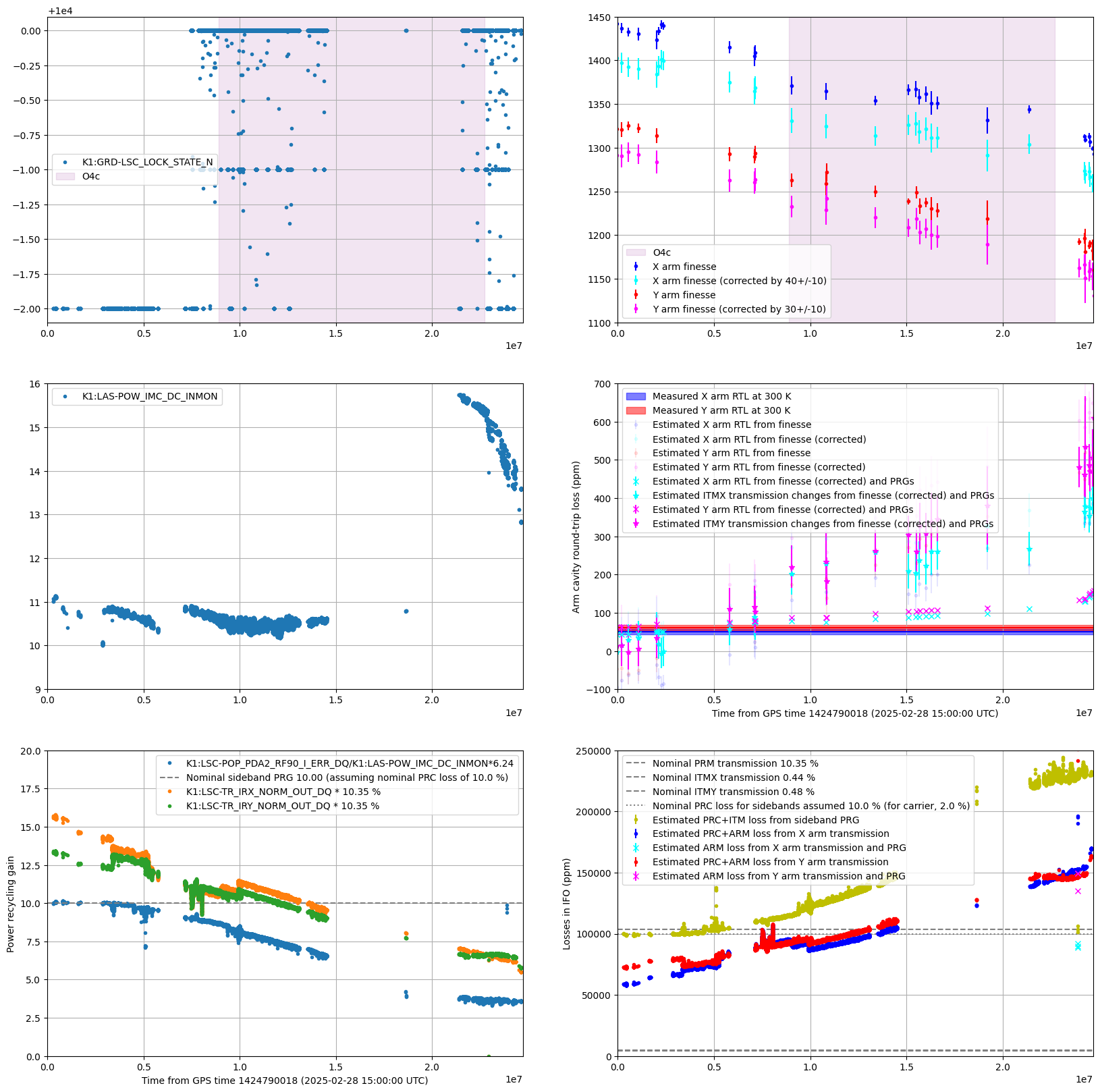
To demonstrate this, I have plotted the case where initial PRC loss for sidebands being 10% (roughly the same as single bounce loss to p-pol due to ITM birefringence; JGW-G1910369) and PRC loss for carrier being 0.2 of that for sidebands (this gives initial loss of 2% for carrier, to get the consistent arm cavity round-trip loss with klog #30823).
In this scenario, Tarm was estimated using A-0.2*B.
This also well explains the measured arm cavity finesse drop and power recycling gain drop.
Increase in the optical loss inside the PRC will be 10% to 23% (can be anything), and increase in the ITM transmission stays to be ~500ppm.
Estimate of the increase in the ITM transmission is robust since we cannot attribute the main cause of the finesse drop to round-trip loss increase (see klog #36231).
This senario may be the most plausible scenario.
Next:
- Calibrate POP90 with expected sideband power recycling gain for PRX (or PRY). For PRX or PRY, expected sideband PRGs are dominated by losses from BS, and are the following.
Gprx=(tp/(1-rp*tBSs*tBSs))**2
Gpry=(tp/(1-rp*rBSs*rBSs))**2
PRX sideband PRG 0.400 +/- 0.004
PRY sideband PRG 0.344 +/- 0.003
Here, I used the following measured BS transmission and reflectivity (klog #29284).
tBSs**2=51.9 +/- 0.2 (stat.) +/- 0.2 (sys.) # for s-pol
rBSs**2=47.7 +/- 0.2 (stat.) +/- 0.2 (sys.) # for s-pol