Reports 1-1 of 1 Clear search Modify search
MIF (ITF Control)
Hiroki Fujimoto - 3:40 Thursday 14 May 2026 (36891) Print this report
Further investigation of carrier buildup/reduction in SRY

[Takano, Tanaka, Fujimoto]

Summary

We measured the carrier buildup factor (ratio of on-resonance to off-resonance power) and the carrier reduction factor (ratio of off-resonance to single-path power) for the four SRY transmission ports: REFL, POP, POS, and AS.
In particular, the measured carrier buildup factors were:

  • Design value: 7.3
  • REFL: 5.0
  • POP: 1.3
  • POS: 1.6
  • AS: 5.0

The REFL and AS values are somewhat lower than the design value, and POP and POS show significantly larger mismatches.
These mismatches could be caused by additional losses inside the SRY or optical offsets in the PD signals.
One possible origin is s-pol to p-pol conversion caused by birefringence in the ITMY substrate.

Details

As described in our previous klog (#36881), the true reflection port of the SRY is the port transmitted toward the ITMX side, while the interferometer REFL port acts as a transmission port for the SRY. Therefore, the currently available transmission ports for monitoring the SRY carrier buildup are REFL,POP, POS and AS.
For these ports, we performed:

  • Measurement of the carrier buildup factor (ratio of on-resonance to off-resonance)

  • Check for offsets in the PD outputs

  • Measurement of the carrier reduction factor (ratio of off-resonance to single-path)

We also discussed the discrepancies between the measured values and the design values.

Measurement of carrier buildup

Fig. 1 shows the DCPD time-series data for each transmission port (REFL, POP, POS, AS) of the freely swinging SRY.
From these data, the carrier buildup factor (ratio of resonant to non-resonant power) for each transmission port was obtained.
The measured values are:

  • Carrier buildup factor:
  • REFL: 5.0
  • POP: 1.3
  • POS: 1.6
  • AS: 5.0
  • Design value: 7.3 (considering R_{BS}=0.5, R_{IY}=0.996, R_{SRM}=0.85)

Check of PD offsets

Fig. 2 shows the PD outputs with the laser shutter closed and no laser injected into the interferometer.
The offsets of all PDs are nearly zero compared to the on-resonance and off-resonance signals, indicating that they do not contribute significantly to the underestimation of the carrier buildup factor.

Measurement of carrier reduction

Fig. 3 shows the time-series data when the SRM was misaligned and the carrier entered each transmission port (REFL, POP, POS, AS) through a single path.
The cursors in the figure indicate the on-resonance and off-resonance levels.
From these data, the carrier reduction factor (ratio of off-resonance to single-path power) for each transmission port was obtained.

  • Measured carrier reduction factor:
  • REFL: 0.55
  • POS: ~1
  • POP: ~1
  • AS: 0.57
  • Design value: 0.47

Discussion

First, the carrier buildup/reduction factors observed at AS and REFL are generally consistent with each other. However, they still show discrepancies from the design values.

One possible explanation is additional losses inside the SRY.
Additional loss decreases the carrier buildup factor while increasing the reduction factor, which is consistent with the observed trend.
Additional loss can be estimated from the measurement results as follows. The buildup factor b and reduction factor q are given by:

b = ((1+r)/(1-r))^2
q = 1/(1+r)^2

where r is the product of all amplitude reflectivities inside the cavity.
Using the measured values and these equations, the additional loss can be estimated.
However, for the AS results, the additional loss estimated from the buildup factor is 31%, and that estimated from the reduction factor is 50%, which seem too large and also are inconsistent with each other.
Therefore, the discrepancy from the design value cannot be explained solely by additional cavity loss.

Another possible explanation is some offset in the PD outputs.
From the present measurements, we confirmed that there is no significant PD offset when no laser is injected into the interferometer.
However, if there exists an offset that appears only when the laser is injected, it would lead to underestimation of the buildup factor and overestimation of the reduction factor.
As a possible source of such an offset, Tanaka-san pointed out p-pol. light generated by birefringence in the ITMY substrate.
The p-pol. light generated inside the SRY does not interfere with the main s-pol. carrier and can therefore appear as a PD offset.
Moreover, this p-pol. light directly enters the POS and POP ports, while it is rejected at AS and REFL by the OFI and IFI, respectively.
This could also explain why the mismatches observed at POS and POP are particularly large.

This hypothesis can be tested by placing PBSs at POS and POP to remove the p-polarized light and checking whether the buildup/reduction factors improve.
A similar effect should also appear in the PRY, so investigating the buildup/reduction factors at the PRY POS and POP ports may also be useful.

Images attached to this report
Comments to this report:
satoru.takano - 0:02 Tuesday 19 May 2026 (36910) Print this report

[Fujimoto, Takano]

Summary

The buildup degradation on POP/POS is almost explained by the recombination of the beam from another ITM that is not misaligned enough.

Detail

After observing this weird beam shape, we investigated the possibility that the misalignment of one of the ITMs, which is not used for SRC, is insufficient, and the beam from its reflection reaches the POP/POS table. Unfortunately, that is probably true (this investigation will be reported by me, Hiroki, or Shun, later). This indicates that the power measured by the PDs on POP/POS is not only from the SRC transmission but also from the reflection from the misaligned ITM (the 'cavity reflection' in the normal sense).

I simulated the power budget using Finesse in the following configuration:

  • ETMX, ETMY: misaligned
  • ITMX: misaligned, ITMY: aligned → SRY cavity
  • PRM: misaligned
  • Sidebands modulation index: 0.1 (from this post)
  • No interference between the main and the ghost beam (we see the sum of these two purely)

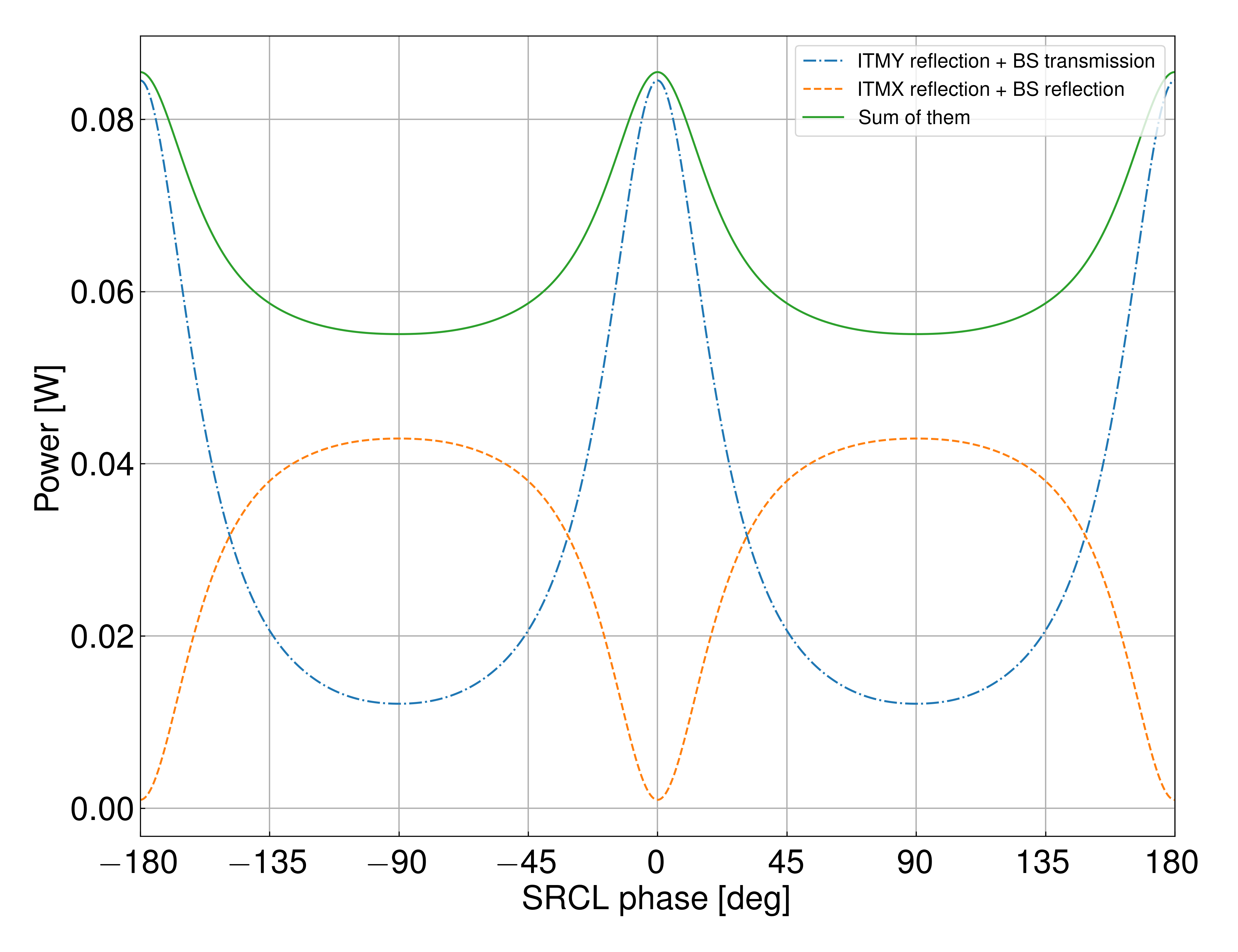
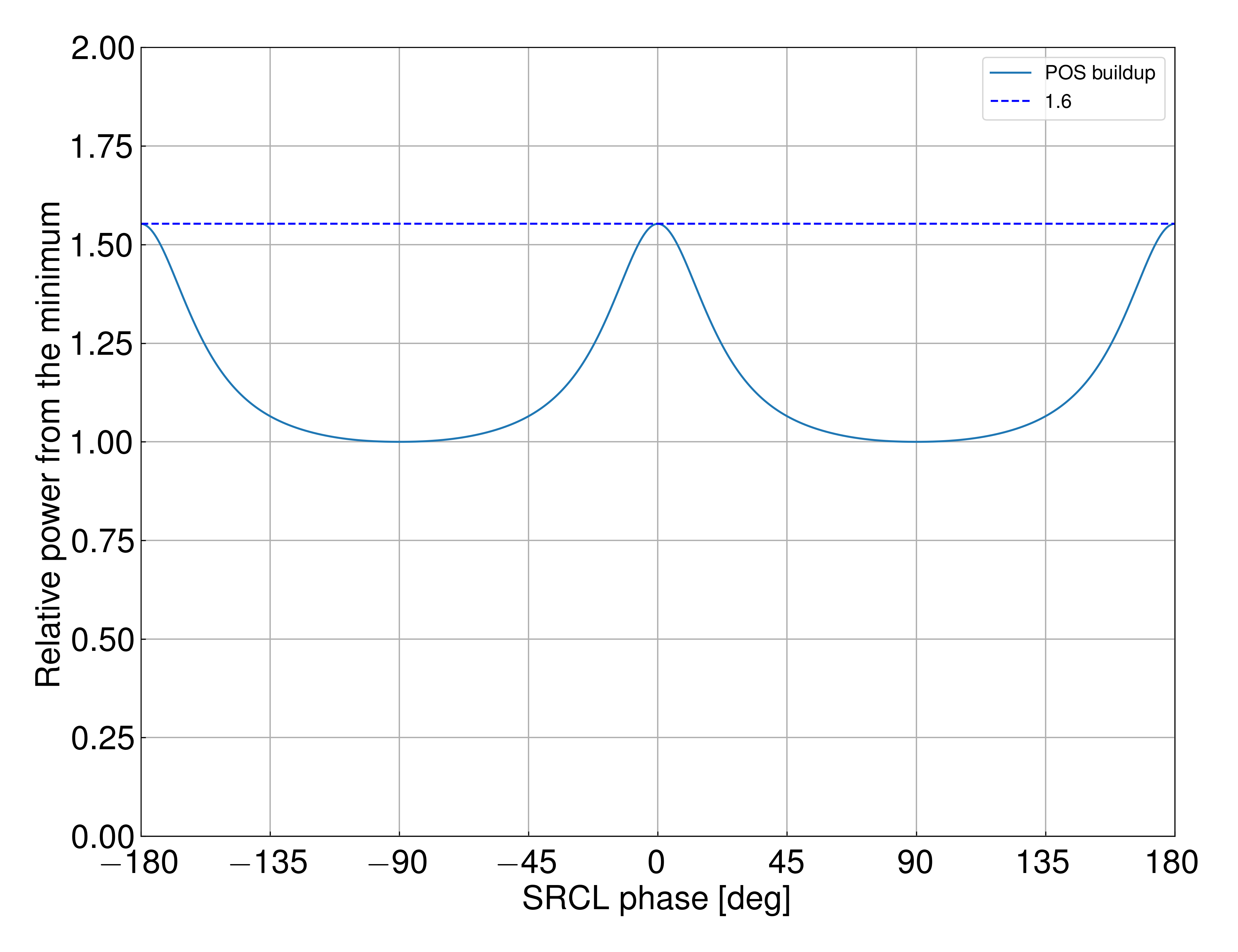
The power from 1) ITMY refl  → BS trans (the main beam), 2) ITMX refl → BS refl ('ghost' beam), and 3) these sums are shown in Fig. 1. The beam 2) works as an offset in the power measurement, and increases the power when PRY is on anti-resonance. Fig. 2 shows the buildup calculated from power 3) in Fig. 1; the value when SRC is on resonance is ~1.6, which is what we observed on the POS table. Thinking of the symmetry of the PRC and SRC, the same phenomenon probably happens both on the POS and POP tables, though the value on the POP table is smaller than this value, 1.3; on the POP table, other sources might exist, such as interference between two beams.

It is worth noting that the buildup degradation from the misaligned ITM occurs only in SRC and not in PRC. The reflection from the misaligned ITM in PRC is one of the 'cavity transmissions', which means its power change when scanning PRCL is the same as the main beam inside the cavity. Therefore, even though the main and the ghost beam are detected on PDs simultaneously, these two powers are proportional, and the buildup stays (almost) the same.

Images attached to this comment
Hiroki Fujimoto - 1:13 Wednesday 20 May 2026 (36922) Print this report

[Kawakami, Hasegawa, Abe, Tanaka, Fujimoto]

Summary

In the SRY carrier buildup measurement, improvement of the carrier buildup factor at some transmission ports was observed by applying a larger misalignment to IX than before.
The results are summarized below:

Carrier build up factor

ITMX MISALIGNED
(klog #36891)

ITMX MISALIGNED_BF
(this measurement)

REFL 5.0 3.4
POP 1.3 3.6
POS 1.6 NA
AS 5.0 6.5

We believe that the improvements at POP and AS were caused by reducing the amount of IX-reflected light entering the POP and AS ports by increasing the IX misalignment.
On the other hand, the carrier buildup at REFL became worse for an unknown reason.

Details

Regarding the issue that the beam from IFO split into two beams on the POS table (under the condition: IY aligned, IX misaligned, SRM misaligned), it was found that the IX misalignment had been insufficient, and the light reflected by IX was reaching the POS table (klog #36913,klog #36916).
One possible explanation for why the SRY carrier buildup factors at the four transmission ports (REFL, POP, POS, AS) had not reached the design value of 7.3 is that the beam reflected by the misaligned IX entered the PDs of each transmission port and acted as an optical offset.

Therefore, we investigated whether the carrier buildup could be improved by using ITMX MISALIGNED_BF, i.e., applying a larger misalignment to IX to prevent contamination from the reflected beam.
This measurement was carried out opportunistically during the SRM QPD centering work (klog #36921), when we had a chance to align the SRY and observe flashes.

Fig. 1 shows the time-series data of SRY flashes observed at each PD.
The resulting carrier buildup factors are:

Carrier build up factor

ITMX MISALIGNED
(klog #36891)

ITMX MISALIGNED_BF
(this measurement)

REFL 5.0 3.4
POP 1.3 3.6
POS 1.6 NA
AS 5.0 6.5

Comparing Fig. 1 with the previous flash data (Fig. 1 in klog #36891), the off-resonance power level at AS and POP became lower.
This indicates that increasing the IX misalignment successfully reduced contamination from IX-reflected light, and the carrier buildup factor indeed improved.

On the other hand, at REFL, the off-resonance power level unexpectedly increased compared to the previous measurement, resulting in a lower carrier buildup factor.
It is possible that the IX-reflected beam in the MISALIGNED_BF configuration entered the PD through some unexpected path, but the cause is currently unknown.

In addition, even for the improved POP and AS ports, the measured buildup factors are still below the design value: 7.3, so further investigation is necessary, although we think the priority not so high.

Images attached to this comment
kenta.tanaka - 19:13 Wednesday 20 May 2026 (36932) Print this report

We found that PRM misalignment state when REFL power bulidup was measured on May 13th, 2026 (klog36922) was differ from the state when the power was measured on May 19th, 2026 (klog36891).

Fig. 1 shows the timeseries the power on AS, REFL, and POP PDs, and the guardian state numbers of ITMX and PRM. Left panel shows them on May 19th and right panel shows them on May 13th. According to this figure, the following table is summarized the relation between the states and the REFL build up ratio.

  May 13th May 19th
ITMX state MISALIGNED (1400) MISALIGNED_BF (1600)
PRM state MISALIGNED_BF (1600) MISALIGNED (1400)
REFL buildup ratio 5.0 3.4

So one of possibilities why the REFL power buildup becomes low is that PRM misalignment angle in the MISALIGNED state is also not enough. 

kenta.tanaka - 8:52 Thursday 21 May 2026 (36936) Print this report

Sorry, I forgot to attach the figure 1.

Images attached to this comment
Search Help
×

Warning

×