[Saito, Fujimoto, Takano]
Summary
The beam separation is estimated when one of the ITMs is misaligned, and it was found that the current misalignment of the ITMs is insufficient to separate the beam on the POS table.
Detail
We observed a strange beam shape on the POS table during PRCL/SRCL measurement work. It was pointed out that the misalignment angle of the ITM, which was not used for SRC, was insufficient, and that the ghost beam from the misaligned ITM also reached the POS table.
We investigated how much the ghost beam would be separated with the current misalignment. The parameters we used are as follows:
- ITM misalignment: value difference in the TM oplev before and after we requested 'MISALIGNED' state
- ITMX: 100 µrad
- ITMY: 58 µrad
- Distance from SR2 transmission to the edge of the POS table: 2 m (estimated roughly from this schematic)
- The position of a lens with a focal length of 500mm: 515 mm
- Other distance and optics parameters: here
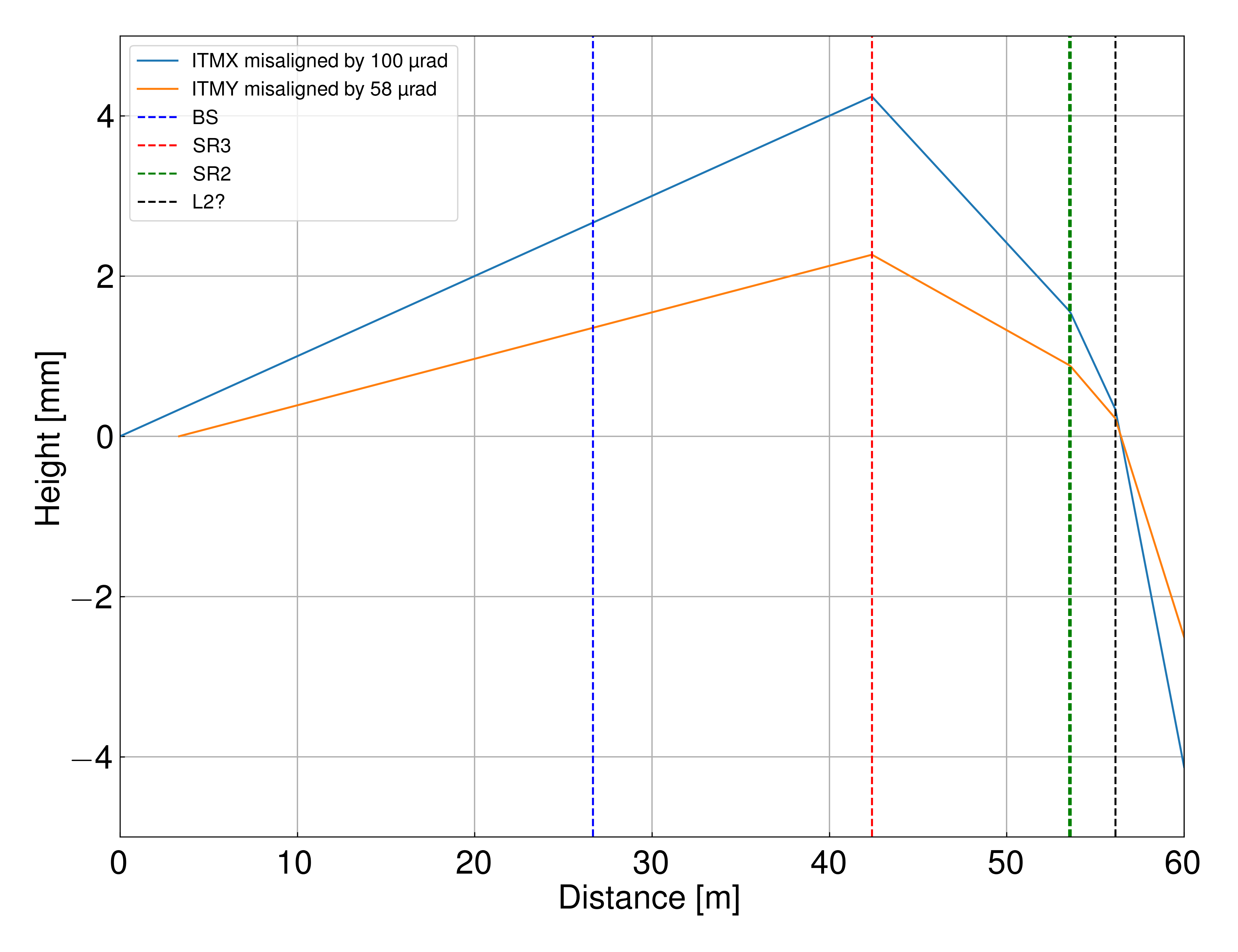
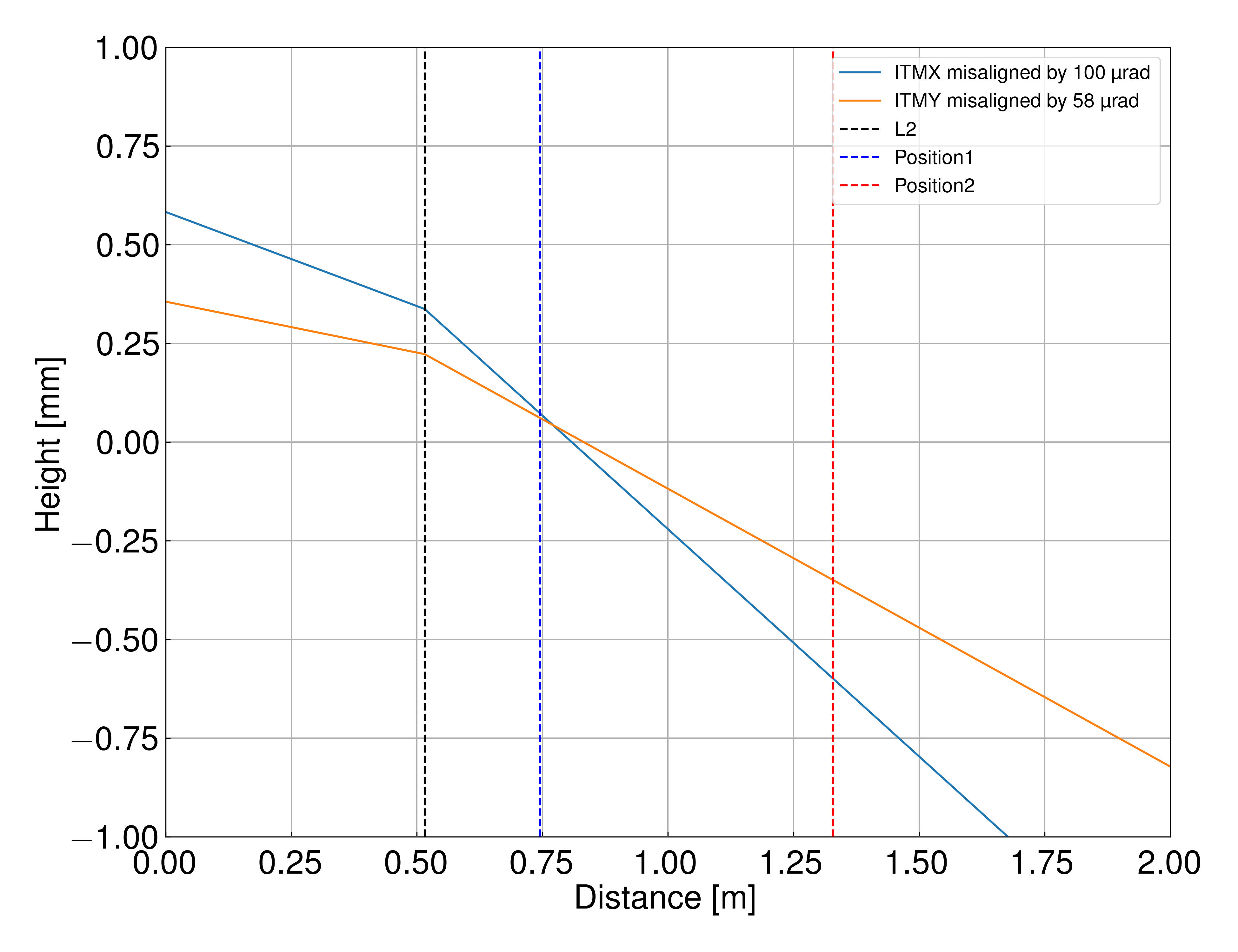
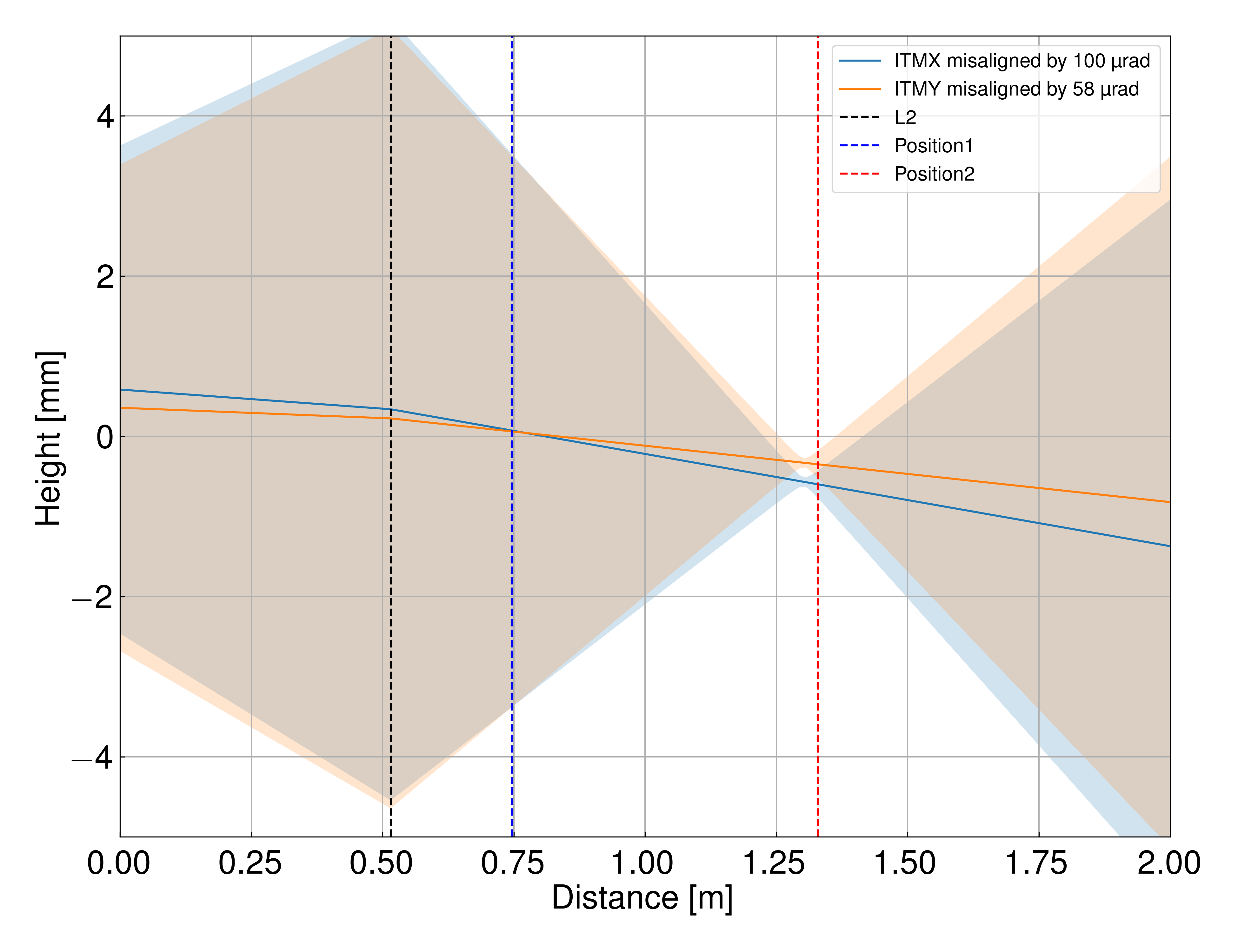
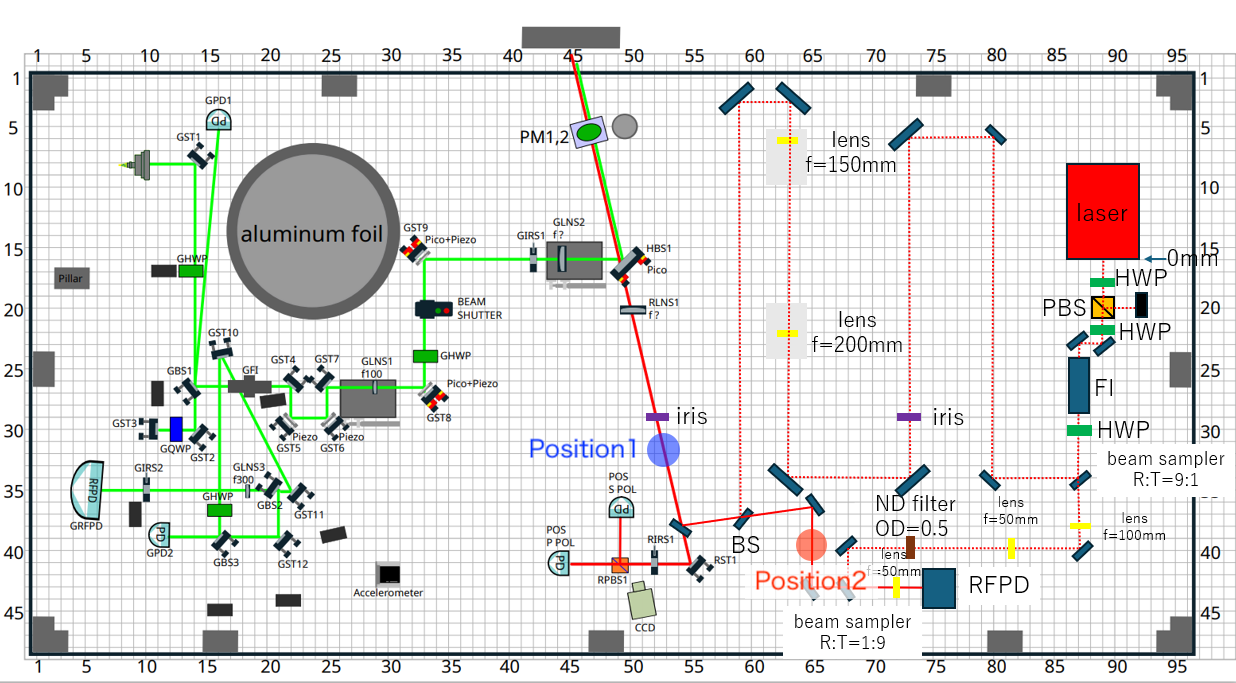
For simplicity, we assumed that only ITM is misaligned, while the other mirrors are perfectly aligned. The expected trace is shown in Fig. 1 and 2 (w/o the beam radius) and Fig. 3 and 4 (w/ the beam radius). Fig. 5 shows the position where we saw the beam shape with the beam profiler. The beam trace shows that the beam separation is almost zero at the 1st lens on the POS table, and the two beams look separated around the waist after the lens. The estimate here is highly uncertain, but the result is qualitatively reasonable.
To avoid the ghost beam reaching the POS table, we need to misalign the ITMs by more than 300 urad, which is difficult with the current misalignment method (tilting on MN); misalignment by upper stages (BF) is better for our purpose.