Reports 1-1 of 1 Clear search Modify search
MIF (General)
yuta.michimura - 20:53 Tuesday 27 January 2026 (36231) Print this report
Interferometer loss investigations

[Komori, Michimura]

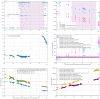
During 2025, arm cavity finesse dropped from ~1400 to ~1300 for Xarm and ~1300 to ~1200 for Yarm.
This can be explained by arm cavity round-trip loss increase from ~50ppm to ~600ppm.
This naively means that the arm cavity loss when locked was as high as ~40%, assuming that ITM reflectivities are constant.
This is not compatible with observed power recycling gain drop, which suggests that ITM reflectivities have also dropped during 2025.
Still, it is hard to explain both power recycling gain drop and arm cavity finesse drop simultaneously.

Assumptions:
 - Mirror reflectivities are well measured as follows, and are constant over 2025.
T['PRM']=10.35/100  # https://gwdoc.icrr.u-tokyo.ac.jp/cgi-bin/private/DocDB/ShowDocument?docid=5744 (uncetainties unknown)
T['ITMX']=ufloat(0.444/100,1.76e-5) # PhysRevApplied.14.014021
T['ETMX']=ufloat(6.8e-6,3.87e-7) # PhysRevApplied.14.014021
T['ITMY']=ufloat(0.479/100,2.17e-5) # PhysRevApplied.14.014021
T['ETMY']=ufloat(6.92e-6,5.16e-6) # PhysRevApplied.14.014021

What we did:
 - Fetched the minute trenda data of the following channel using ndscope from Mar 1, 2025 to Dec 12, 2025 0:00 JST, and exported into hdf5 file.
K1:GRD-LSC_LOCK_STATE_N
K1:LAS-POW_IMC_DC_INMON
K1:LSC-POP_PDA2_RF90_I_ERR_DQ
K1:LSC-TR_IRX_NORM_OUT_DQ
K1:LSC-TR_IRY_NORM_OUT_DQ

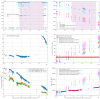
 - Plotted the data if LSC_LOCK_STATE_N>=9998 (WORKING_WITH_OBSERVATION_WITHOUT_LINES). See left panels of the attachment.

 - Also plotted measured finesses by loading the following files. See right top panel.
 /users/Commissioning/data/Finesse/Xarm/summary.txt
 /users/Commissioning/data/Finesse/Yarm/summary.txt

 - Did a similar analysis done by Takidera-kun (see klog #34857). In this analysis, we first derived the arm cavity round-trip loss (RTL) from the measured finesse using the following equations. Actually, using the raw measured finesse values, estimated RTL will be less than 0. This could be due to fitting errors of the finesse measurement code (to be fixed by Oshino-san). To make the round-trip loss values compatible with  klog #30823 at nominal finesse days, measured finesse were intentionally corrected for 40 for X (which is roughly consistent with Oshino-san's observations) and 30 for Y, and added extra +/- 10 uncertainties (See right top and middle panels).

Finesse = pi*sqrt(rITM*rloss)/(1-rITM*rloss)
ArmRTL = 1-rloss**2

 - From normalized arm cavity transmission, losses in the PRC, including losses from the arms (RTL enhanced by arm gain) can be estimated using the following equations. See blue and red dots in the right bottom panel.

TR_IRX_NORM = PRG / T_PRM = 1/(1-rPRM*rfp)**2
Tprc = 1-rfp**2

 - We can also estimate the losses from the arms using the following equation. See cyan and magenta dots in the right bottom panel. To my surprise, this was not compatible with the estimated Tprc.

Tarm = 1 - (-rITM+tITM**2*rloss/(1-rITM*rloss))**2

Next:
 - Consider that ITM reflectivities are not constant. Somehow need to be estimated from sideband power recycling gain trend (but this is degenerated with losses in PRC). Also, drop in the ITM reflectivities alone cannot explain almost 1/3 drop in the PRG.
 - Attribute all other causes of arm cavity finesse drop to arm cavity round-trip loss increase, and see if this senario can explain carrier power recycling gain measurements.
Images attached to this report
Comments to this report:
yuta.michimura - 9:48 Wednesday 28 January 2026 (36233) Print this report

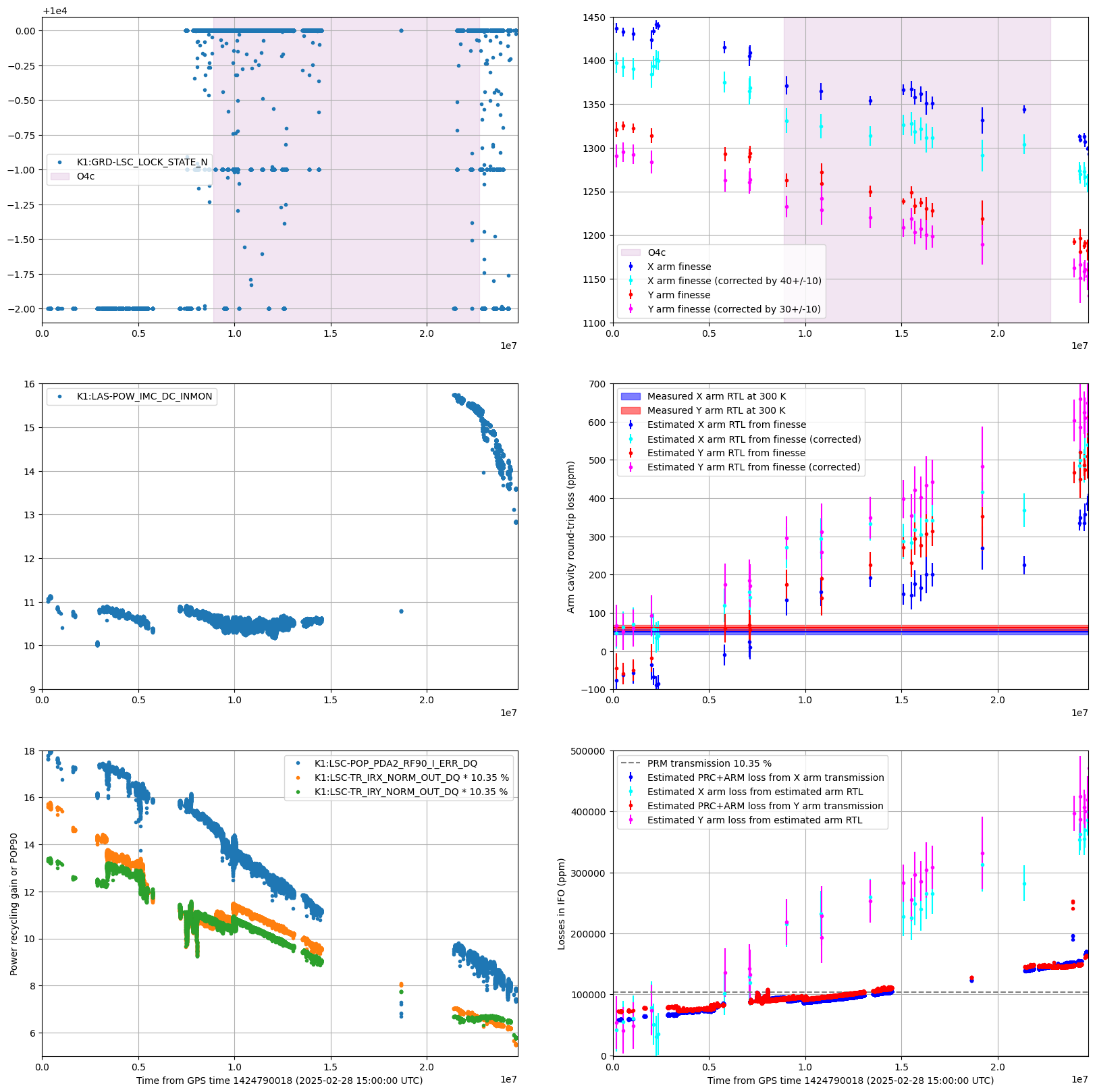
Arm cavity round-trip loss and changes in ITM reflectivity were estimated using measured power recycling gains and arm cavity finesse.
Increase in the optical loss inside the PRC from 2% to 10%, and increase in the ITM transmission by ~500ppm can explain both power recycling gain and finesse measurements.
These suggest that power recycling gain reductions are mainly from PRC loss increase, and arm cavity finesse reductions are mainly from ITM transmission increase.
Arm cavity round-trip loss (including ETM transmission) stays almost unchanged within ~20ppm.

Assumptions:
  - Nominal mirror transmissions are the ones summarized in klog #36231, but losses inside the PRC (including ITM AR losses), ITM HR transmission and arm round-trip loss changes over time.
  - Losses in PRC (TPRC) are the same for carrier and sidebands. NOTE that this could be wrong due to, e.g., Lawrence effect.

What we did:
  - Used the same data set as klog #36231.

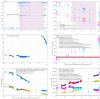
  - This time, sideband power recycling gain was estimated using K1:LSC-POP_PDA2_RF90_I_ERR_DQ, divided by K1:LAS-POW_IMC_DC_INMON to normalize for the input power changes (see left bottom plot). Overall factor was calibrated by calculating the nominal sideband PRG at the beginning of the data using the following equations. TPRCorig is the nominal losses in PRC, and was eyeball fitted to be 2% to have the arm cavity round-trip loss result consistent with klog #30823 (see right middle plot).
tp=sqrt(T['PRM'])
rp=sqrt(1-T['PRM'])
ranti=sqrt(1-TPRCorig)
PRGsideband=(tp/(1-rp*ranti))**2

  - Using the power recycling gain for sideband and carrier,  A=Tarm+TPRC (see red and blue dots in right bottom plot) and B=Tanti+TPRC (see yellow dots in right bottom plot) were estimated, where Tanti is the loss from the arm for sidebands, TPRC is the losses in PRC, and Tarm is the loss from the arm for carrier. Since estimated Tanti+TPRC is huge compared with TITM, it is safe to assume that B is mostly from TPRC.

  - Therefore, A-B gives Tarm (see cyan and magenta dots in right bottom plot). Note that in this calculation, we are assuming that TPRC is the same between carrier and sideband. Changes in A B (EDITED ON Jan 28) is actually mostly from TPRC, and Tarm is roughly constant over time. This means that the arm cavity round-trip loss is roughly constant over time.
 
  - Using the following simultaneous equations, TRTL and Tarm can be measured, where TRTL is the arm cavity round-trip loss. Results are plotted as cyan and magenta crosses and stars in right middle plot.

A-B = Tarm = TRTL*4/TITM
Finesse = 2*pi/(TITM+TRTL)

Discussion:
  - Assumption that TPRC is 2% initially is just a rough guess (+/- 0.5% or so to make TRTL consistent with klog #30823), and it does not change the overall trend very much. If POP90 is properly calibrated, this will not be necessary.
  - Huge increase in the PRC loss TPRC to 10% is a mystery. TPRC includes ITM AR losses and the Michelson fringe conditions.
  - If TPRC is smaller for carrier than that for sidebands due to, e.g., Lawrence effect, TRTL increases and changes for TITM reduces. This is also a plausible senario.

Next:
  - Redo this calculation once the fitting for the finesse measurements are fixed by Oshino-san.
  - Investigate the cause of huge increase in the PRC loss (AR frosting? Resonant condition changes for p-pol? Birefringence changes? Michelson contrast changes?)
  - See if ITM reflectivity changes are consistent with lce layers (see, also, klog #34903)
  - Calibrate POP90 using modulation depths and power at the PD so that we don't need to guess nominal losses in PRC.

Images attached to this comment
yuta.michimura - 10:56 Wednesday 28 January 2026 (36238) Print this report

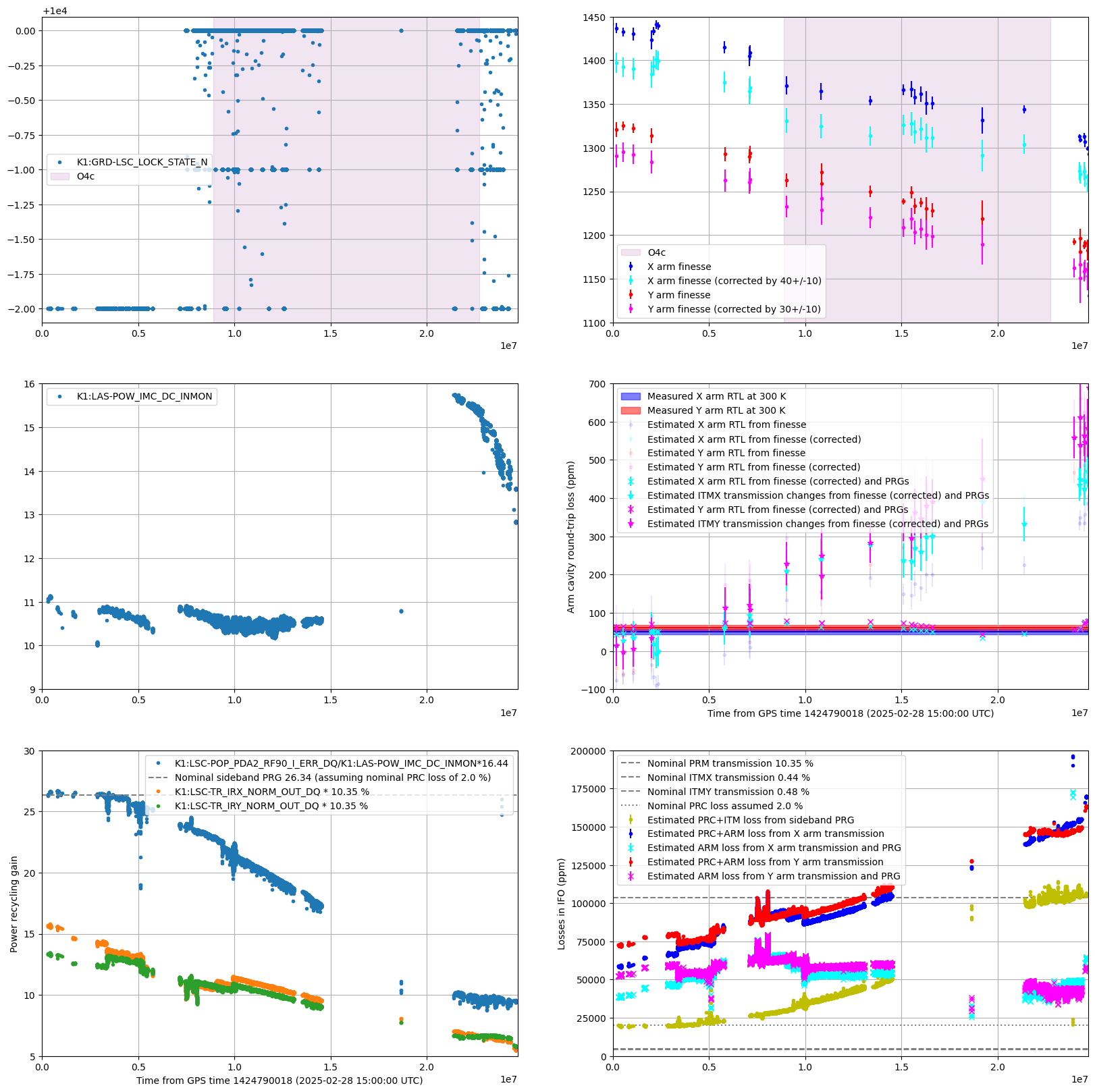
In the previous study, I assumed that the losses in PRC (TPRC) are the same for carrier and sidebands.
If this is different due to, e.g., Michelson Schnupp asymmetry and Lawrence effect, estimated PRC losses for sidebands will be different.
To demonstrate this, I have plotted the case where initial PRC loss for sidebands being 10% (roughly the same as single bounce loss to p-pol due to ITM birefringence; JGW-G1910369) and PRC loss for carrier being 0.2 of that for sidebands (this gives initial loss of 2% for carrier, to get the consistent arm cavity round-trip loss with klog #30823).
In this scenario, Tarm was estimated using A-0.2*B.

This also well explains the measured arm cavity finesse drop and power recycling gain drop.
Increase in the optical loss inside the PRC will be 10% to 23% (can be anything), and increase in the ITM transmission stays to be ~500ppm.
Estimate of the increase in the ITM transmission is robust since we cannot attribute the main cause of the finesse drop to round-trip loss increase (see klog #36231).

This senario may be the most plausible scenario.

Next:
 - Calibrate POP90 with expected sideband power recycling gain for PRX (or PRY). For PRX or PRY, expected sideband PRGs are dominated by losses from BS, and are the following.

Gprx=(tp/(1-rp*tBSs*tBSs))**2
Gpry=(tp/(1-rp*rBSs*rBSs))**2
PRX sideband PRG 0.400 +/- 0.004
PRY sideband PRG 0.344 +/- 0.003

Here, I used the following measured BS transmission and reflectivity (klog #29284).

tBSs**2=51.9 +/- 0.2 (stat.) +/- 0.2 (sys.) # for s-pol
rBSs**2=47.7 +/- 0.2 (stat.) +/- 0.2 (sys.) # for s-pol

Images attached to this comment
Search Help
×

Warning

×