[Tanaka, Hirose, Fujimoto, Saito]
Following the same procedure as in the previous measurement (klog:37185), the lengths of PRY, SRY, and SRX were measured. The differences between the measured and design values were 0.6 ± 1.2 cm for PRY, 1.5 ± 1.3 cm for SRY, and 2.8 ± 1.6 cm for SRX. Therefore, the PRY measurement is consistent with the design value within the measurement uncertainty of 1.2 cm, whereas the differences for SRY and SRX exceed their respective uncertainties, suggesting that their actual lengths may differ from the design values.
-
As in the previous measurement (klog:37185), the sub-laser was injected into PRY, SRY, and SRX, the PLL was engaged, and the beat signal was observed with the RFPD installed at OMC REFL. The minimum and maximum frequencies at which the beat-signal amplitude reached its maximum were measured. The results are summarized below.
PRY
Minimum Maximum
161.501 MHz 161.583 MHz
138.351 MHz 138.485 MHz (assuming ±67 kHz around 138.418 MHz)
−140.999 MHz −140.865 MHz (assuming ±67 kHz around −140.932 MHz)
−161.783 MHz −161.649 MHz (assuming ±67 kHz around −161.716 MHz)
SRY
Minimum Maximum
161.371 MHz 161.492 MHz
140.6095 MHz 140.7305 MHz (assuming ±60.5 kHz around 140.67 MHz)
−141.0055 MHz −140.8845 MHz (assuming ±60.5 kHz around −140.945 MHz)
−161.7595 MHz −161.6385 MHz (assuming ±60.5 kHz around −161.699 MHz)
SRX
Minimum Maximum
−160.384 MHz −160.244 MHz (assuming ±70 kHz around −160.314 MHz)
−140.65 MHz −140.51 MHz (assuming ±70 kHz around −140.58 MHz)
162.316 MHz 162.456 MHz (assuming ±70 kHz around 162.386 MHz)
140.33 MHz 140.47 MHz (assuming ±70 kHz around 140.400 MHz)During the measurements, the sub-laser temperature was changed significantly when switching the beat frequency from +160 MHz to −160 MHz. Under these conditions, the beat frequency observed at OMC REFL fluctuated much more frequently, suggesting that the fluctuations become significant until the sub-laser temperature stabilizes. In addition, after switching from +140 MHz to −140 MHz during the SRY measurement, the frequency fluctuations did not subside. However, when the MCE feedback was enabled during the subsequent SRX measurement, the fluctuations were noticeably reduced. This suggests that fluctuations of the main laser also contribute to the beat-frequency instability.
-
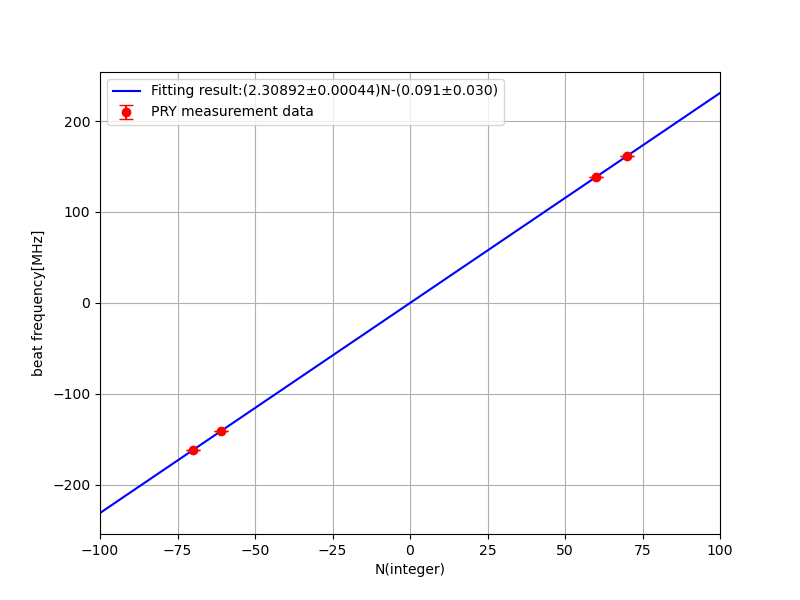
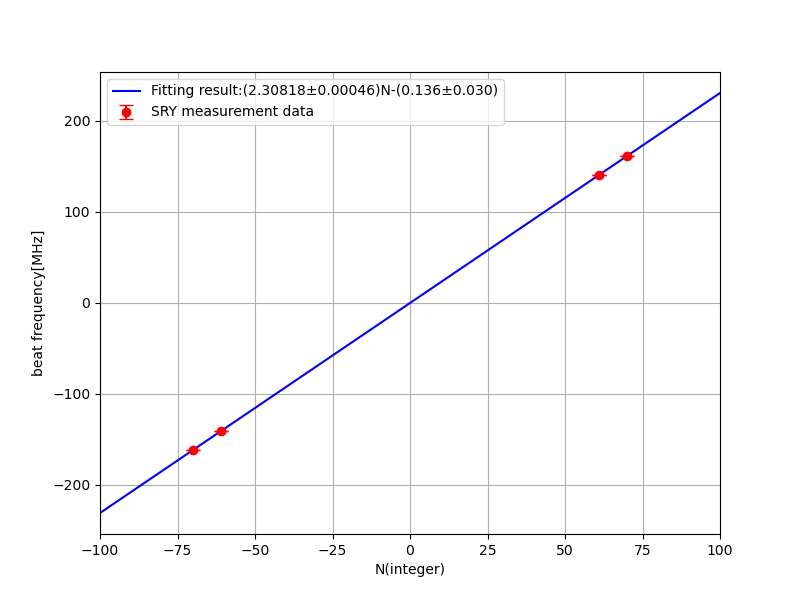
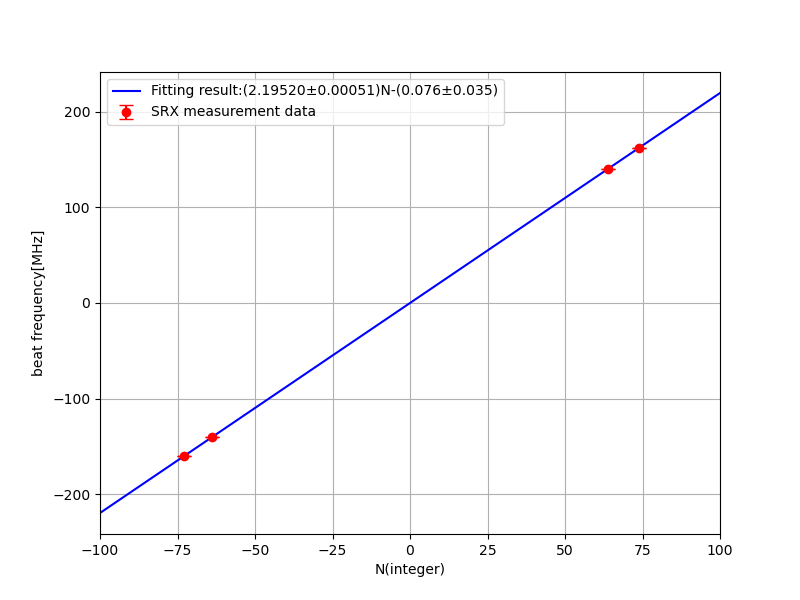
For each cavity, the midpoint between the measured minimum and maximum frequencies was calculated and divided by the corresponding FSR calculated from the design lengths of 64.9265 m (PRY), 64.9264 m (SRY), and 68.2562 m (SRX). The resulting values were rounded to the nearest integers, and the measured frequencies were fitted with the linear function AN+B, where A and B are fitting parameters and N is the corresponding integer. The fitting results are as follows.
PRY (Fig. 1)
A = 2.30892 ± 0.00044 MHz
B = −0.091 ± 0.030 MHz
SRY (Fig. 2)
A = 2.30818 ± 0.00046 MHz
B = −0.136 ± 0.030 MHz
SRX (Fig. 3)
A = 2.19520 ± 0.00051 MHz
B = −0.076 ± 0.035 MHzSince A corresponds to the FSR, the cavity lengths obtained from the fitted FSR values are
PRY
Fitted length: 64.921 ± 0.012 m
Design length: 64.9265 m
Difference (Fitted − Design): −0.6 ± 1.2 cm
SRY
Fitted length: 64.941 ± 0.013 m
Design length: 64.9264 m
Difference (Fitted − Design): 1.5 ± 1.3 cm
SRX
Fitted length: 68.284 ± 0.016 m
Design length: 68.2562 m
Difference (Fitted − Design): 2.8 ± 1.6 cmTherefore, the measured PRY length is consistent with the design value within the measurement uncertainty of 1.2 cm. In contrast, the differences between the measured and design values for SRY and SRX exceed their respective uncertainties, suggesting that their actual cavity lengths may differ from the design values.