Abstract:
The actuator efficiency of PZT was measured as 167.1V/FSR, and it corresponds to 0.889MHz/V at K1:PSL-PMC_PZT_HV_MON_OUTPUT if we assume the FSR:148.35MHz.
Detail:
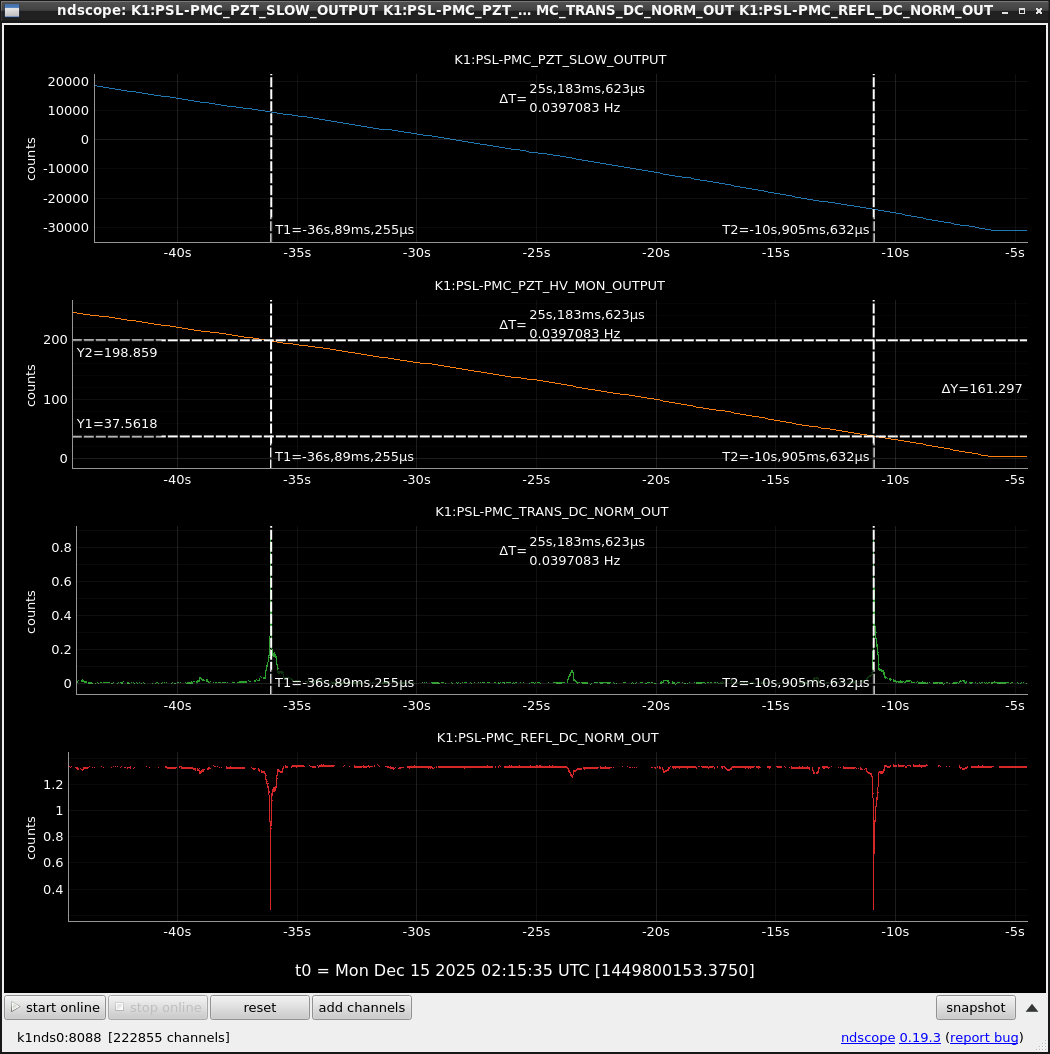
I used a similar way of klog:16311. While applying some large offset (-9V to 9V) on K1:PSL-PMC_PZT_SLOW with 60sec ramp time, carrier peaks are measured at the PMC transmitted light (Fig.1). The separation between the 2 carrier peaks corresponds to the FSR. I used the measured value of 148.35MHz for FSR in klog:5892 (klog says the value 147.35, but it does not correspond to the cavity length 2.0208m, so it was a typo, I guess.) to convert it to an actuator efficiency on the PMC feedback signal at K1:PSL-PMC_PZT_HV_MON_OUT, which is convenient to measure the frequency noise.
Actually, I used diaggui instead of ndscope, since I could use the more accurate cursors. I measured 10 times for each forward (higher voltage on HV driver) and backward (lower voltage on HV driver) direction. The results showed some discrepancy btween the directions;
- Forward (10 times average): 161.5V/FSR -> 0.9191MHz/V
- Backward (10 times average): 172.8V/FSR -> 0.8586MHz/V
I am not sure the reason for this difference, but the response of PZT is obviously different for each direction shown in Fig.2. See the shape of the green line for each direction. Backward shapes always show steeper. We should accept this anti-symmetric response since we are using such a PZT, in fact.
So the accuator efficiency should be averaged between forward and backward; it will be 167.1V/FSR, and it corresponds to 0.889MHz/V.
The last measurement by Yamamoto-kun in klog:16311 shows ~169V/FSR. So, we can say that the PMC does not show any significant change.