Reports 1-1 of 1 Clear search Modify search
MIF (General)
Hiroki Fujimoto - 2:11 Tuesday 02 December 2025 (35732) Print this report
Calibration of TMS-X polarization monitor

[Kawaguchi, Sugimoto, Michimura, Fujimoto]

We have finished some measurements for the calibration of the polarization monitors at TMS-X.
In particular, we carried out the following tasks:

  • Measurement of the output offsets of the IR PD (X_IR_PDA1), the s-pol PD (X_IRSPOL_PDA1), and the p-pol PD (X_IRPPOL_PDA1)

  • Measurement of the HWP-angle dependence of the s-pol PD (X_IRSPOL_PDA1) and p-pol PD (X_IRPPOL_PDA1)

We will analyze the obtained data and share the results on the klog tomorrow.
Also, we are planning to perform the same measurements at the Y-end tomorrow morning.

Comments to this report:
Hiroki Fujimoto - 3:00 Wednesday 03 December 2025 (35743) Print this report

[Kawaguchi, Sugimoto, Michimura, Fujimoto]

Abstract

On 12/1, we performed a calibration of the polarization monitor system at TMS-X (klog #30113).
The purpose of this calibration was to obtain the calibration factor for converting the p-pol PD spectrum (V/rtHz measured by DL950, cnt/rtHz measured by CDS) into the polarization rotation spectrum (rad/rtHz).
In addition, the polarization state (ellipticity) of the cavity transmitted light was measured at the same time.

Preparation: Dark offsets of PDs

We measured the output offsets of each PD in the polarization monitor system using both the DL950 and CDS.
For CDS, we used the channels K1:TMS-X_IR_PDA1_OUT_DQ, K1:TMS-X_IRSPOL_PDA1_OUT_DQ, and K1:TMS-X_IRPPOL_PDA1_OUT_DQ.
Note that CDS internally adds offsets before the dewhitening filter (after the ADC).

                       DL950              CDS
X_IR            -5(1)e-3 V        -0.3(2) cnt
X_IRSPOL    3(1)e-3 V      -10.24(3) cnt
Y_IRPPOL   15(1)e-3 V       0.04(7) cnt

Calibration: p-pol PD to polarization rotation (V/rtHz → rad/rtHz)

We rotated the HWP in the polarization monitor system and measured the output voltages of the p-pol PD and s-pol PD with the DL950.
During the measurement, the average output of the X_IR PD was 3.79(3) V.
Figure 1 shows the measurement results, where the vertical axis is the measured voltage after subtracting the PD offsets, and the horizontal axis is the HWP scale value.
We fitted the data using the following model:

Model: Vp=A(1-cos(4(θHWP-B)))+CV_\mathrm{p} = A(1-\cos (4(\theta_\mathrm{HWP}-B)))+C

Fitting parameters: A [V], B [deg], C [V]

Result:
A = 4.10(5) V
B = 8.2(2) deg
C = 0.64(2) V

From this, the calibration factor for converting the p-pol PD spectrum (V/rtHz) to polarization rotation (rad/rtHz), where the HWP scale is θHWP\theta_\mathrm{HWP} and the X_IR PD output is VIRV_\mathrm{IR}, is obtained as

Calibration factor:
dϕdVp=12Asin(4(θHWP-B))×3.79(3)V+5(1)×10-3VVIR+5(1)×10-3V\frac{d\phi}{dV_{p}} = \frac{1}{2A\sin(4(\theta_\mathrm{HWP}-B))}\times\frac{3.79(3)\,\mathrm{V} + 5(1)\times10^{-3} \mathrm{V}}{V_\mathrm{IR}+ 5(1)\times10^{-3} \mathrm{V}}
=0.166(6)rad/V(atθHWP=20.0(5)deg,VIR=3.79(3)V)=0.166(6) \,\mathrm{rad/V}\quad (\mathrm{at}\, \theta_\mathrm{HWP} = 20.0(5)\,\mathrm{deg}, V_\mathrm{IR}=3.79(3)\,\mathrm{V})

Calibration: p-pol PD to polarization rotation (cnt/rtHz → rad/rtHz)

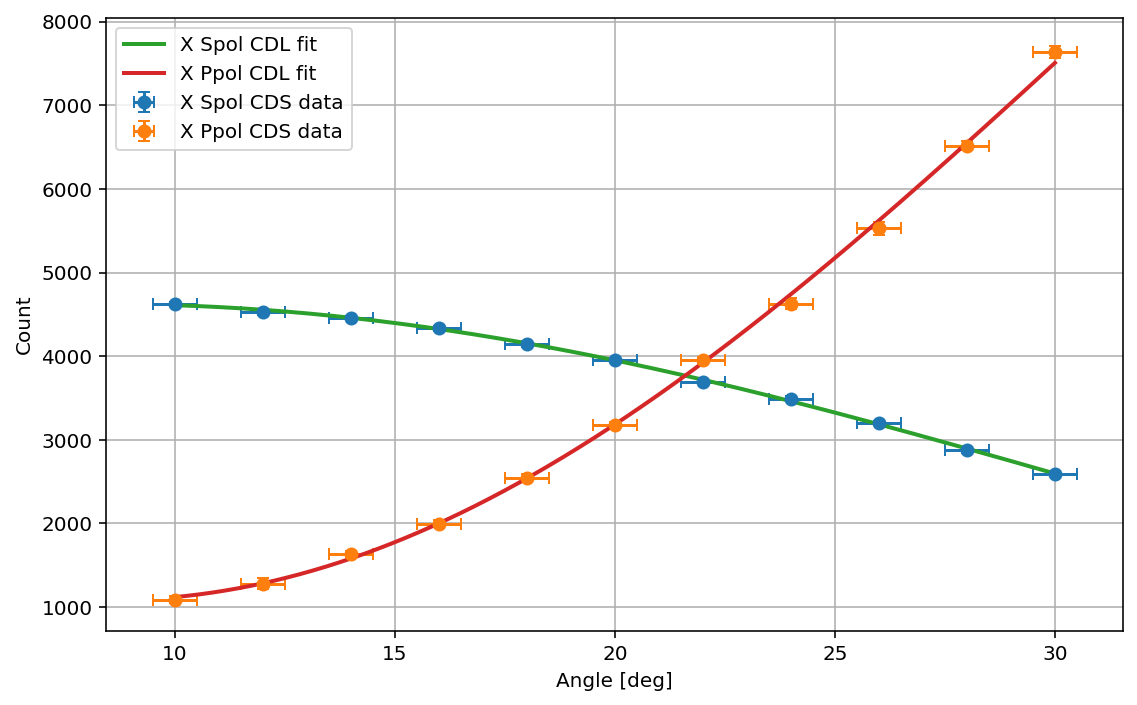
During the measurement above, we also recorded data with CDS with the unit of cnt.
The average count of the X_IR PD during the measurement was 3.17(2)e3 cnt.
Figure 2 shows the measurement results, where the vertical axis is the measured count after subtracting the offsets, and the horizontal axis is the HWP scale.
We fitted the data using the model:

Model: Cp=A(1-cos(4(θHWP-B)))+CC_\mathrm{p} = A(1-\cos (4(\theta_\mathrm{HWP}-B)))+C

Fitting parameters: A [cnt], B [deg], C [cnt]

Result:
A = 6.9(1)e3 cnt
B = 8.5(3) deg
C = 1.08(4) cnt

From this, the calibration factor for converting the p-pol PD spectrum (cnt/rtHz) to polarization rotation (rad/rtHz), where the HWP scale is θHWP\theta_\mathrm{HWP} and the X_IR PD output is CIRC_\mathrm{IR}, is obtained as

Calibration factor:
dϕdCp=12Asin(4(θHWP-B))×3.17(2)×103cnt+0.3(2)cntCIR+0.3(2)cnt\frac{d\phi}{dC_{p}} = \frac{1}{2A\sin(4(\theta_\mathrm{HWP}-B))}\times\frac{3.17(2)\times10^3 \mathrm{cnt} + 0.3(2)\,\mathrm{cnt}}{C_\mathrm{IR}+ 0.3(2)\,\mathrm{cnt}}

=1.01(4)×10-4rad/cnt(atθHWP=20.0(5)deg,CIR=3.17(2)×103cnt)=1.01(4) \times 10^{-4}\,\mathrm{rad/cnt}\quad (\mathrm{at}\, \theta_\mathrm{HWP} = 20.0(5)\,\mathrm{deg}, C_\mathrm{IR}=3.17(2)\times10^3 \mathrm{cnt})

Polarization ellipticity

For reference, the ellipticity (semi-minor/semi-major axis) of the polarization incident to the polarization monitor system can be estimated as

Ellipticity = sqrt(V_p_min/V_p_max)=sqrt(C/(2*A+C))=0.270(5)

Since the transmitted beam from the ETM passes through multiple steering mirrors before reaching the polarization monitor system, it is highly likely that the polarization acquires ellipticity along the optical path.
Nevertheless, the above value gives an upper limit on the ellipticity of the cavity transmitted light.

Next

We will perform a similar analysis for the calibration measurements at TMS-Y polarization monitor system conducted on 12/2.
Using these calibration results, we will convert the measured p-pol PD spectra into polarization rotation spectra.

Images attached to this comment
yuta.michimura - 10:36 Wednesday 03 December 2025 (35747) Print this report

For sanity check, I compared the measured calibration factor with my rough calibration extrapolated from the calibration done a year ago in klog #30113.
There were multiple factors, but my rough calibration was off in total by a factor of ~2.2.

In klog #33283, I used the following to estimate the calibration factor from K1:TMS-X_IR(S|P)POL_PDA1_OUT_DQ to radians to take into account of the PD gain difference and optical gain difference from klog #30113.

PDp2Rad=1/(4*(300.7-16.3)*np.sin(4*np.deg2rad(20-10.1)))*10**(20./10)  # Calibration from klog #30113, but calibration was done in 30 dB, but now in 10 dB
PDs2Rad=1/(4*(297.0-19.7)*np.sin(4*np.deg2rad(20-54.7)))*10**(30./20)  # Calibration from klog #30113, but calibration was done in 30 dB, but now in 0 dB
PDp2Rad/=130*10.8/1.1/2  # 130 for PRFPMI instead of single arm, 10.8/1.1 for input power difference, 2 for installation of additional BS in TMS (klog #32183)
PDs2Rad/=130*10.8/1.1/2

First, the factor of 4 should be 1, as correctly pointed out by Fujimoto-kun in klog #35743. Factor of 2 from calibrating into radians in polarization rotation angle, not in HWP rotation angle. Another factor of 2 is my mistake probably from confusing peak-to-peak (2A) and amplitude (A). My bad.

Second, 10**(20./10) should have been 10**(20./20) to take into account of 20 dB difference. Simply typo. My bad.

Lastly, the power recycling gain now is more like 6, instead of 13 due to arm cavity finesse drop, and IMC output power during the measurement this week was 14.6 W.

If we take into account of all the factors, estimate of the amplitude A for p-pol PD extrapolated from klog #30113 is:

(300.7-16.3)/2 / 10**(20./20) * 60 * 14.6/1.1/2 = 5.7e3 counts

This is roughly consistent with A = 6.9(1)e3 cnt reported in klog #35743 within ~20%.
The difference could be from the uncertainties in the power recycling gain, the split ratio for the beam splitter in TRX, and polarization ellipticity changes.
Actually, HWP angle to minimize the p-pol PD was 8.5(3) deg now in klog #35743, but it was 10.1 deg a year ago in klog #30113, which suggest the polarization state changes in the arm cavity transmission (due to beam spot changes?).

The calibration factors for counts and volts reported in klog #35743 are consistent with each other considering the +/- 20V, 16 bit ADC. Very good.

A * ADC = 6.9(1)e3 cnt * 40 V / 2**16 cnt = 4.21(6) V <-> 4.10(5) V
dphi/dCp * ADC = 1.01(4)e-4 rad/cnt / (40 V / 2**16 cnt) =  0.165(7) rad/V <-> 0.166(6) rad/V

Hiroki Fujimoto - 20:05 Wednesday 03 December 2025 (35758) Print this report

As an additional data analysis for the TMS-X polarization monitor calibration, we have also determined the calibration factor that converts the s-pol PD spectrum (V/rtHz measured by DL950) into the polarization rotation spectrum (rad/rtHz).
The analysis procedure follows the same steps as in (klog #35743), but since the HWP dependence of the s-pol PD signal is opposite in phase to that of the p-pol PD signal, the sign of the model function has been modified accordingly.
Also, because the output of the X_IR PD was not plotted in Figures 1 and 2 of (klog #35743), we have added those plots and attached the modified figures in this post.

Calibration: s-pol PD to Polarization rotation (V/rtHz → rad/rtHz)

ModelVs=A(1+cos(4(θHWP-B)))+CV_\mathrm{s} = A(1+\cos (4(\theta_\mathrm{HWP}-B)))+C

Fitting parameters: A[V], B[deg], C[V]

Result:
A = 1.311(9) V
B = 8.1(2) deg
C = 0.22(1) V

Calibration factor:
dϕdVs=-12Asin(4(θHWP-B))×3.79(3)V+5(1)×10-3VVIR+5(1)×10-3V\frac{d\phi}{dV_{s}} = -\frac{1}{2A\sin(4(\theta_\mathrm{HWP}-B))}\times\frac{3.79(3)\,\mathrm{V} + 5(1)\times10^{-3} \mathrm{V}}{V_\mathrm{IR}+ 5(1)\times10^{-3} \mathrm{V}}
=-0.52(2)rad/V(atθHWP=20.0(5)deg,VIR=3.79(3)V)=-0.52(2) \,\mathrm{rad/V}\quad (\mathrm{at}\, \theta_\mathrm{HWP} = 20.0(5)\,\mathrm{deg}, V_\mathrm{IR}=3.79(3)\,\mathrm{V})

Calibration: s-pol PD to Polarization rotation (cnt/rtHz → rad/rtHz)

Model: Cs=A(1+cos(4(θHWP-B)))+CC_\mathrm{s} = A(1+\cos (4(\theta_\mathrm{HWP}-B)))+C

Fitting parameters: A[cnt], B[deg], C[cnt]

Result:
A = 2.16(7)e3 cnt
B = 8.4(5) deg
C = 3(2)e2 cnt

Calibration factor:
dϕdCs=-12Asin(4(θHWP-B))×3.17(2)×103cnt+0.3(2)cntCIR+0.3(2)cnt\frac{d\phi}{dC_{s}} = -\frac{1}{2A\sin(4(\theta_\mathrm{HWP}-B))}\times\frac{3.17(2)\times10^3 \mathrm{cnt} + 0.3(2)\,\mathrm{cnt}}{C_\mathrm{IR}+ 0.3(2)\,\mathrm{cnt}}
=-3.2(2)×10-4rad/cnt(atθHWP=20.0(5)deg,CIR=3.17(2)×103cnt)=-3.2(2) \times 10^{-4}\,\mathrm{rad/cnt}\quad (\mathrm{at}\, \theta_\mathrm{HWP} = 20.0(5)\,\mathrm{deg}, C_\mathrm{IR}=3.17(2)\times10^3 \mathrm{cnt})​​​​​​​

Images attached to this comment
Search Help
×

Warning

×