We investigated the reason of the unstable ALS DARM lock.
But, we still not have a conclusion, we need more check.
What we did;
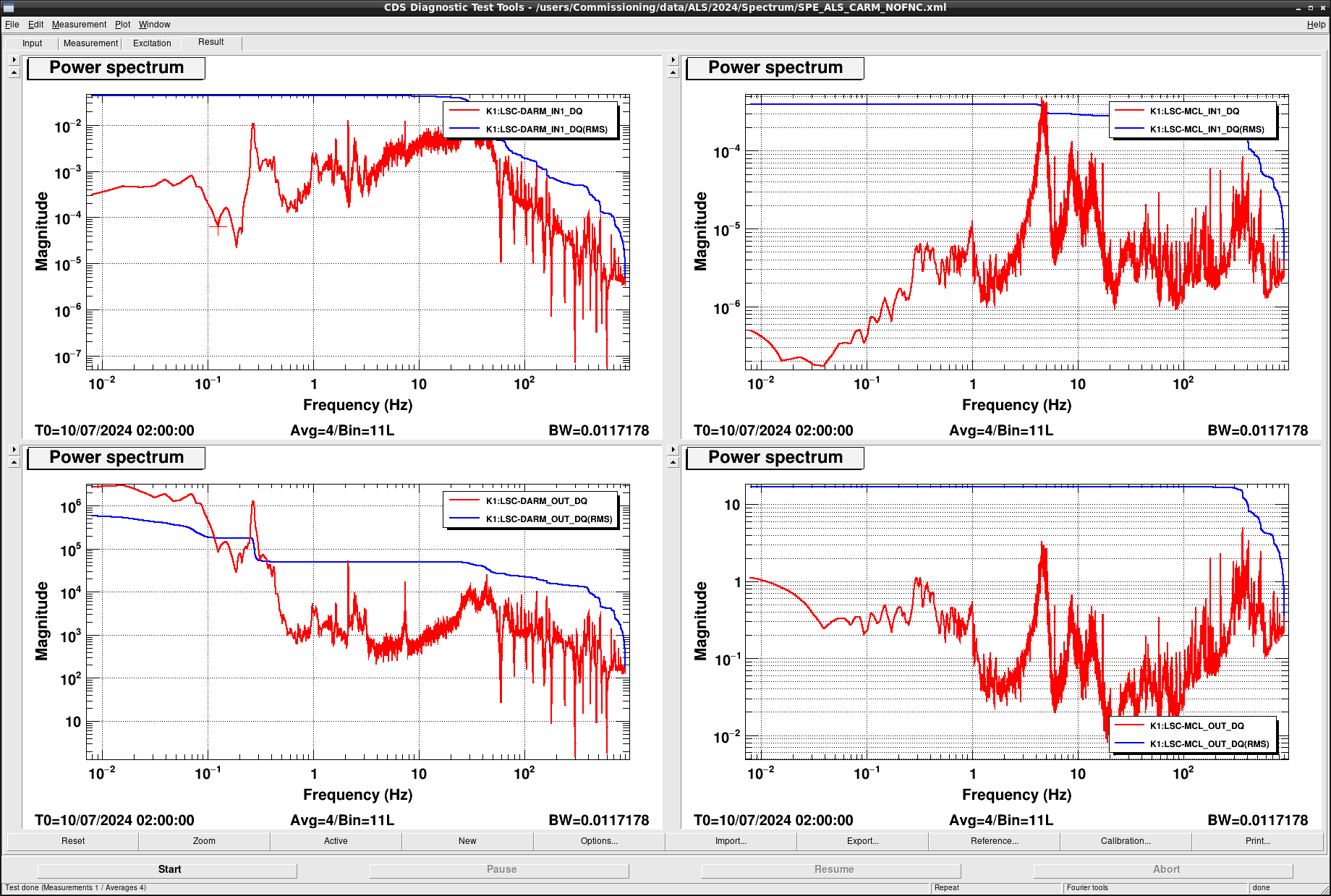
Yesterday, we can lock the ALS DARM for several minutes, we measured the spectrum, as shown in Fig.1.
From the RMS value of the DARM control signal, the high frequency(above 20 Hz) and sharp 0.27 Hz peak may be the large reason.
Investigation of the 0.27 Hz narrow peak.
We cannot find the strong coherence in other channels (Even using the Bruco)
And we cannot see this peak in the situation of the DARM input signal when IFO was locked with ALS CARM.
The resonant frequency of the SUS bread board for the POP and POS were different frequency (See klog30312 and klog30315)
That imply that this peak would not be come from the suspensions nor PD noise (or environment), but would be caused by the mass lock.
So, we will check the control signal of the ETMX suspension with mass lock more.
Past spectrum check : We need to check the past ALS DARM spectrum more.
One notification of the past spectrum check is that this peak exist in the ALS DARM lock before the earthquake(Frequency was different, due to the suspension temperature?).
Fig.2. and Fig.3. showed the ALS DARM error and feedback spectrum at the 5th Nov. and 10th Nov. 2023.
In this situation, even the narrow peak exist, ALS DARM lock can be succeeded.
Next step.
We will check the RMS value for the past ALS DARM spectrum.
Also, we want to check the Filters for the DARM controls and check the difference from the O4a situation.
Even if we concluded the difficulties of the ALS DARM, we need to reduce the environmental noise or we will start to plan to use the both ETMX and ETMY mass lock.
Phase margin of the ALS DARM is about 23 degree, so if required, we need to change the shape of the DARM control filter.
Today's work
Check the control filter for the past DARM control
Check the spectrum and RMS
If we can lock the ALS DARM more stable, measure the OLTF and trial of the IR handover.


Fig.1. (Red, Blue) last lock (Green,Brown) Yesterday lock
In the error signal, there are large discrepancy in higher frequency, but not so large different in the RMS value of the feedback signal (Several contribution 30 - 50 Hz noise)
But the largest contribution to the feedback RMS is still 0.27 Hz.
Below 0.1 Hz, the feedback RMS value seemed similar value, so suspension vibration below 0.1 Hz is not so large matter.
Also, I checked the past filter banks for the
ALS_DARM, DARM1, DARM2, ETMX_{TM,IM,MN}_LOCK
But there are no different including filter ON/OFF situation.

I checked the spectrum of ALS_DARM error signals with (red: spectrum, blue: RMS) and without (pink: spectrum, cyan: RMS) locking ALS_DARM loop (fig1).
DARM error signals becomes large when locking ALS_DARM around 30 Hz by a factor of 3 and the bumps around 30 Hz are dominant source of the RMS above 10 Hz.
Since DARM loop UGF is designed at 20 Hz, 30 Hz bumps probably come from the gain peaking due to poor phase margin at UGF.
Figure 2 shows an example of the modification of OLTF.
Left graphs show the gain and phase of OLTF in current design (UGF is 19.6 Hz, phase margin is 32.2).
Right graphs show the gain and phase of OLTF added lead filter (z:15, p:30, g:0.752).
Phase margin around UGF becomes 50 Hz if we added lead filter.
So, redesigning of ALS DARM loop might reduce the RMS of feedback signals and help the stable lock.


Takano, Yokozawa
After noticing the difference of the filter setting, we changed the filters of ETMX_TM_LOCK_L.
We removed FM3, which was a zero-pole filter with a zero at 0 Hz and a pole at 1 Hz, and modified FM5 by adding an elliptic highpass filter to restore the proper filter shape. Now FM5 is the same as that on 2023/10/02.
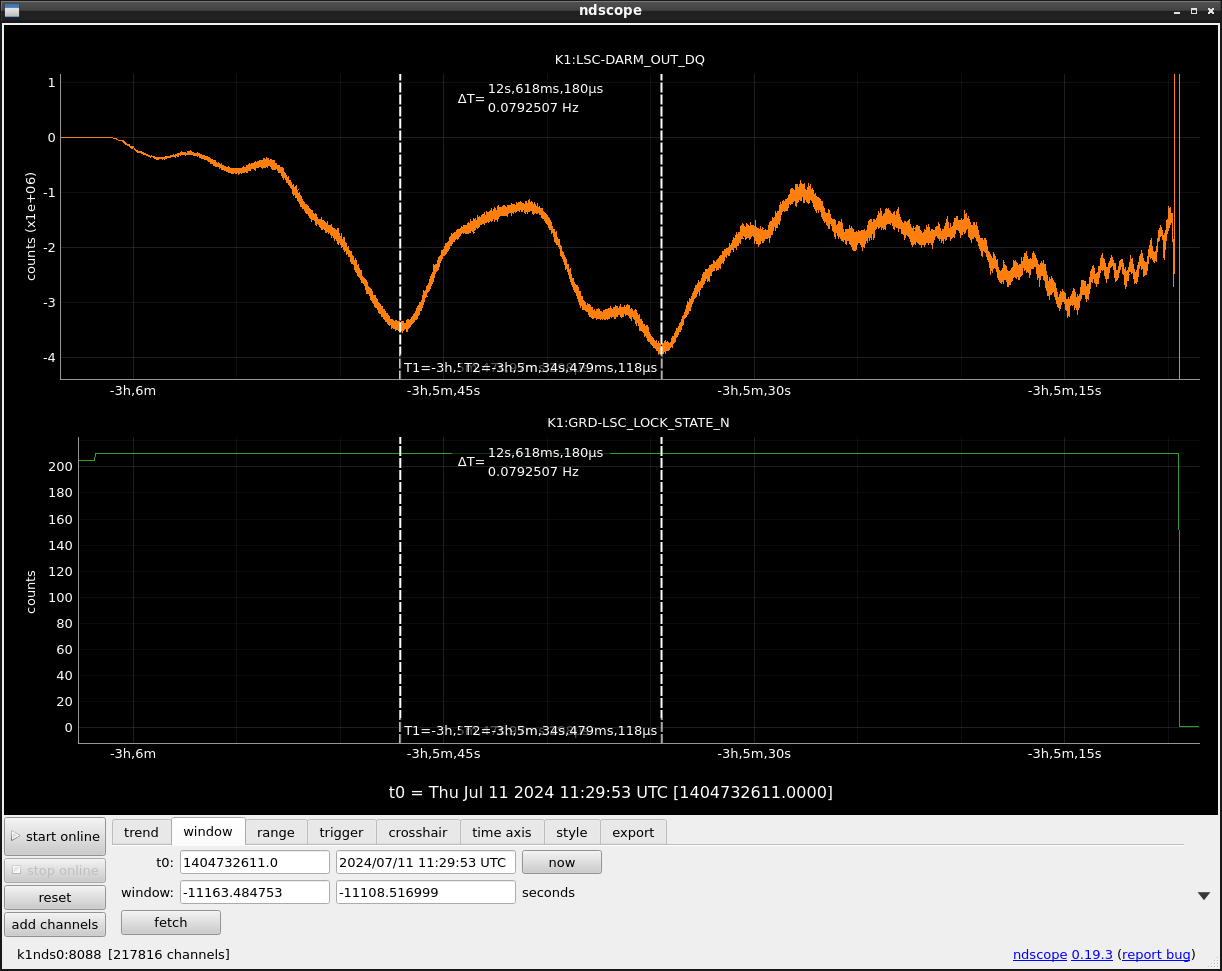
With this modification, we tried to lock ALS DARM. The lock was succeeded two times and kept in ~ 1 min. Figure1 and Figure2 show the time series of DARM feedback signal during each lock trial. It seems that the problematic 0.27 Hz peak was gone by modifying the filter. Still, we see a slow oscillation around 0.08 Hz in both cases. This oscillation may be the reason why lock was lost.