[Miyoki, Tanaka, Komori]
Abstract:
We estimated the input-equivalent noise of the SR560 recently installed in the IMC slow loop.
The SR560 noise is lower than that of the CMS board below ~2 kHz, but higher above ~2 kHz.
We can conclude that the SR560 does not cause additional noise below ~2 kHz.
Detail:
The interferometer successfully reached the DC readout state, but its sensitivity is currently much worse than before the fiber laser failure (Fig. 1).
Please note that the feedforward gain has not yet been optimized and the calibration has not been updated.
On the other hand, since the heights of the violin peaks are similar, the sensitivity at high frequencies is likely not severely incorrect.
The SR560, which was recently installed between the notch filter and the IMC CMS board, was identified as a potential noise source responsible for the degraded sensitivity.
To evaluate this possibility, we compared the input-equivalent noise of the SR560 with that of the CMS board.
According to the datasheet, the input noise of the SR560 is 40 nV/√Hz at a gain of 2, which matches the current configuration.
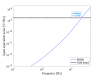
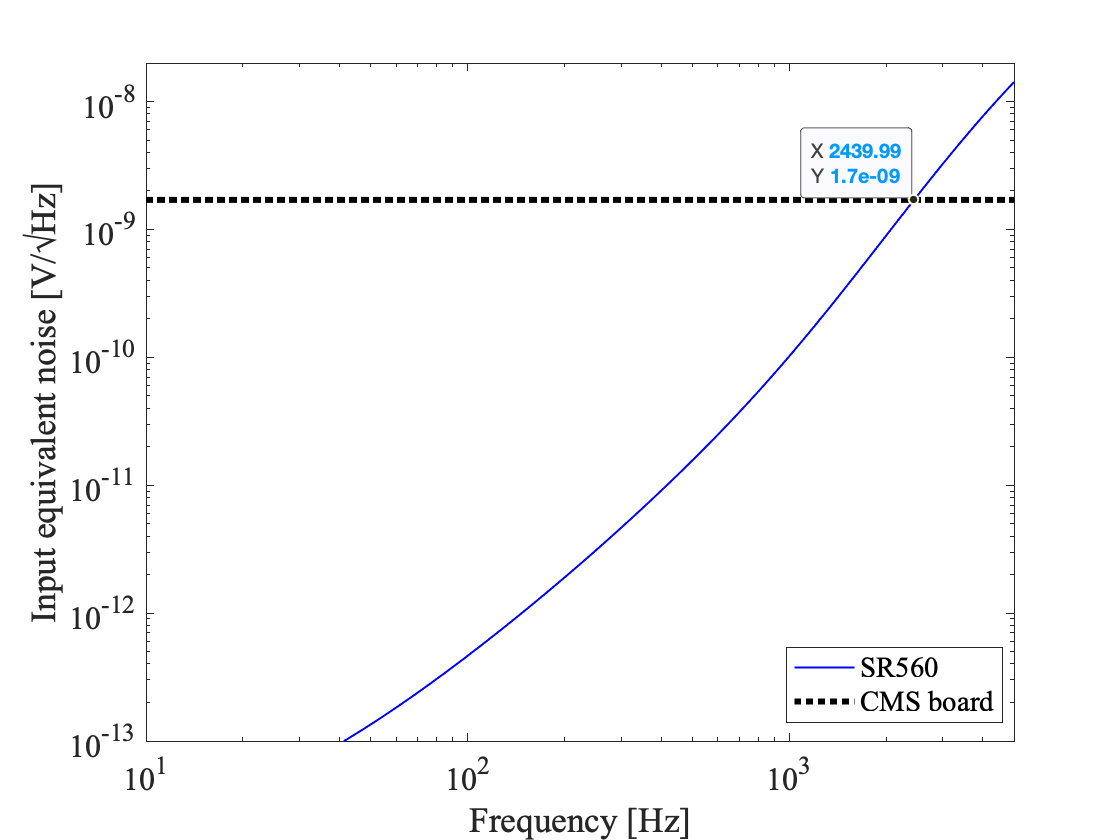
We conservatively estimated the SR560 noise contribution, converted into the input-equivalent noise for the IMC CMS as shown by the blue line in Fig. 2
This estimation is based on the transfer function of the boost filters, which are engaged during interferometer operation, and assumes CMS input gains of 0 dB.
For comparison, we also plot the conservative input-equivalent noise of the IMC CMS (black dotted line, 2 nV/√Hz), dominated by multiple AD829s at the input gain.
The SR560 noise is lower than the CMS noise below ~2 kHz, but becomes larger above ~2 kHz.
We can conclude that the SR560 does not cause additional noise below ~2 kHz.
On the other hand, it is possible that the larger noise floor from several hundreds of Hertz to 1 kHz originated from the CMS noise.
Proposal:
I would like to propose the following future commissioning tasks:
-
To check whether the noise above ~2 kHz originates from mere residual frequency noise, we should estimate the raw frequency noise by measuring the IMC length signal without the interferometer.
-
We should estimate the CARM optical gain. Since the CARM optical gain is proportional to the reflectivity of the RF sidebands, it may have been drastically reduced by the recent increase in optical loss due to frosting. If so, the CARM sensing noise contribution would be significantly larger than before.
-
We should search for the optimal beam spot and interferometer alignment to minimize frequency noise coupling into DARM.








.png)





.png)


