Reports 1-1 of 1 Clear search Modify search
MIF (General)
kenta.tanaka - 22:37 Wednesday 17 September 2025 (35090) Print this report
IFO recovery with NeoLASE : Day 2

Miyakawa, Tanaka

We started investigating several unresolved issues from yesterday.

Initially, for some reason, we were unable to engage PRMI ASC in the PRFPMI configuration, unlike yesterday.

---

### Actuator Efficiency Check

To understand the observed 8 dB increase in DARM loop gain, we checked whether the actuator efficiency had changed—possibly due to a temperature shift of ETMX.  
We measured the transfer function (TF) from `ISCINF_L` to `ALS_DARM` when `ALS_CARM` was locked (i.e., during the `ENGAGE_FNC_PNC_XY` state of the `LSC_LOCK` guardian).  
Figure 1 shows the results: the red line is today's TF, and the brown line is the previous measurement.  
No significant change was observed, indicating that the gain increase in DARM is not due to actuator efficiency changes caused by ETMX temperature variations.

---

### Relocating the 150 kHz Notch Filter in the IMC Loop

The CARM TF shows a large resonance peak around 150 kHz.  
This resonance appears to approach the 0 dB line when the CARM UGF is increased to 50 kHz by raising the gain by +10 dB.

Since this resonance originates from the IMC loop, we had previously installed a 150 kHz notch filter in the EOM path. However, it does not appear to be effective.  
We therefore attempted to move the notch filter to different locations:

- **From EOM path → PZT path**:  
  Figure 2 shows the IMC OLTFs. The bright line represents the TF with the notch in the PZT path, and the dark line represents the TF with the notch in the EOM path.  
  The peak at 150 kHz was slightly reduced (by <1 dB).

- **From PZT path → INPUT1 of CMS**:  
  Figure 3 shows the results. The bright line corresponds to the notch before the CMS INPUT port; the dark line corresponds to the notch in the EOM path.  
  Although the overall gain increased, the peak height also increased, indicating the notch had no significant effect at this location.

Based on these results, we decided to install the notch filter in the **PZT path** for now.

---

### Cross-over Frequency Adjustment (PZT ↔ EOM)

We then adjusted the cross-over frequency between the PZT and EOM loops.  
Previously, it was set to 14 kHz using `IN1GAIN = 19 dB` and `FASTGAIN = 27 dB` (see klog35055).  
This time, we reduced it to 10 kHz by setting `IN1GAIN = 16 dB` and `FASTGAIN = 30 dB`.  
However, the 150 kHz resonance peak was not significantly reduced (Fig. 4).

We also measured the CARM TF under this condition (10 kHz cross-over).  
Figure 5 shows the CARM TF; the relative gain between 50 kHz and the 150 kHz resonance is ~6 dB.  
This suggests that even with +10 dB gain, the resonance peak should remain below 0 dB.  
However, the change in resonance peak height does not match the IMC-only measurement. The reason is unclear, but the current state appears acceptable.

After these trials, we realized we had **forgotten to adjust the CARM gain** after modifying the IMC gain.  
When we replaced the laser, we increased `IMC IN1GAIN` from 14 dB to 19 dB, and should have increased the CARM gain by +5 dB to maintain the original UGF.  
Therefore, **5 dB of the 11 dB discrepancy** in CARM UGF can be explained by this oversight.  
The remaining **6 dB discrepancy** remains unexplained.

---

### Demodulation Phase Check

We attempted to verify whether the RF demodulation phases used in each LSC DOF are optimized.  
Although we couldn’t find the previous reference measurements, we checked the current situation.

#### PRCL and MICH

We excited {PRM, BS} in the L-direction at {84.125 Hz, 90.125 Hz} while PRMI was locked with 3f signals, and observed the spectra of POP45 and POP17 I/Q signals, which serve as the error signals:

- **Fig. 6**: POP45 — the 84 Hz peak is larger in **I** than **Q** → PRM excitation  
- **Fig. 7**: POP17 — the 90 Hz peak is larger in **Q** than **I** → BS excitation

While this confirms the expected coupling, both demodulation phases are not optimal.  
However, since the PRCL and MICH TFs remain unchanged, we decided **not to modify their demodulation phases** for now.

#### CARM

We excited the laser frequency at 90.125 Hz using `K1:LSC-CARM_SERVO_EXC_A_CALI_EXC` while PRFPMI was locked without ASC.  
We measured the spectra of REFL45 I/Q signals from both **REFL PDA1** and **REFL PDA3**:

- **Fig. 8**:  
  - REFL PDA1: The 90 Hz peak is larger in **I** than **Q**, but the I-signal does not double even under optimal phase conditions.  
  → The demodulation phase is not optimal, but cannot fully explain the 6 dB discrepancy.
  - REFL PDA3: 90 Hz peaks in I and Q are almost the same.  
  → Also not optimal.

---

### Conclusion

- 5 dB of the CARM UGF discrepancy is due to missing gain compensation.
- The remaining 6 dB is not explained by actuator efficiency, IMC notch filtering, or demodulation phase.
- Further investigation is needed to fully restore optimal PRFPMI locking.

Images attached to this report
Comments to this report:
shinji.miyoki - 13:38 Thursday 18 September 2025 (35091) Print this report

As long as the ~150kHz resonance originated from EOM structure, the notch filter should be inserted between the EOM and the HV amplifier.

By the way, do we know the Q of resonance and precise resonance frequency ?

The notch filter Q should be comparable with Q of the resonance. In addition, the notch frequency also should be matched with the resonance frequency. Normally, the notch filter should have a variable C or so to adjust the frequency. Otherwise, the notch filter never be effective.

Example: https://www.marutsu.co.jp/pc/i/43781778/


Judging from the TF data, we can see the resonance and notched area near the resonance. These structures can be recognized before installing the notch filter?


Assuming 150kHz resonane is originated from the PZT structure, is there any high order LPF to minimize the feedback signals to the PZT for the frequency range above the crossover frequency? Otherwise, the unnecessary feedback signals excited the PZT resonances above the crossover frequency.

takafumi.ushiba - 18:08 Monday 22 September 2025 (35116) Print this report

[Tanaka, Miyakawa, Ushiba]

Abstract:

Currently, the notch filter for IMC 150kHz peak doesn't seem to be effective.
The notch filter design should be reconsidered to reduce the peak at 150kHz.

Detail:

We discussed the notch filter for 150kHz peak reduction of IMC loop and found that the notch filter design doesn't seem to match the current circuit configuration.
According to the RF amplifier manual (F10A) and CMS circuit (JGW-D1503567), their imput impedances are 1M and 100k Ohms, respectively.

According to the simulation by AEL group (fig1), notch filter depth becomes very small if the notch filter is connected to the high impedance circuit.
So, the current configuration of te notch filter doesn't seem effective for reducing the 150kHz peak.

To solve this problem, it is necessary to redesign the notch filters so that we can obtain enough notch depth even with high input impedance circuit. 

Images attached to this comment
shinji.miyoki - 20:29 Monday 22 September 2025 (35118) Print this report

The notch assumes the 50 ohm terminator at its output as Fig.1

Firstly, please identify which path should have this 150kHz notch, the PZT or the EOM path. Check the resonance peak growing when you increase only the gain for the EOM path. If it grows up, the EOM path has this resonance. If not or rather decreases, the PZT has this resonance. 

  • If EOM, put this notch with a 50 ohm terminator at the input of F10A or F30PV as long as F30PV (for input of F10A) and the output driver amp in the servo circuit (for input of F30PV) can drive current.
  • If PZT, put this notch at the input of the HV driver with 50 ohm terminator as long as the output driver amp in the servo circuit can drive current.
  • If you don't want to put this notch around HVs and servo circuit outputs, apply it to the error signal with 50 ohm terminator.
  • Never put this notch with a 50 ohm terminator after HV amplifier. It will be burned out, or the current limiter of the amplifier will be triggered.

Of course, the dynamic range will be 1/2 if the output resistances are 50 ohm for each amplifier and the servo circuit.

Otherwise, remake the notch again.

Images attached to this comment
shinji.miyoki - 18:33 Tuesday 30 September 2025 (35175) Print this report

Abstract

We successfully installed the 150kHz notch filter in the path to the PZT in the IMC control loop, and also recovered the UGF of 120kHz for the IMC control loop without resonance at 150kHz.

Background

After replacing the neoLase laser, we could not increase the UGF for the IMC  loop as FBL case upto 120kHz because of 150kHz resonance appeared. Ushiba-kun confirmed that the 150kHz resonance existed in the PZT path in the contol loop. A passive 150kHz notch filter was prepared, assuming 50 ohm terminator resistance at the PZT input. However, the present output circuit IC(AD829) for the IMC servo to the PZT can drive only 6mA current, then 50 ohm resistance cannot be directly connected with this notch filter. On the other hand, the actual voltage amplitide to the PZT seemed to be limited within +/- 1.5V because 1/10 attenuator was set at the output in the IMC control servo circuit to the PZT path. Consequently, a current driver amplifier with roughly ~ 30mA driving ability is enough to solve this situation. 

Countermeasure

 We decided to use SR560 to drive 50 ohm resistance with 150kHz notch because it has a specification to drive 50 ohm resistance with 5V output voltage using its 50 ohm output. According to Shimode-san, OP37 + LM6321 current buffer amp are used in the SR560 for the output circuit.  It can drive 300mA according to its specification sheet. 

Reforming the PZT path and IMC lock recovery

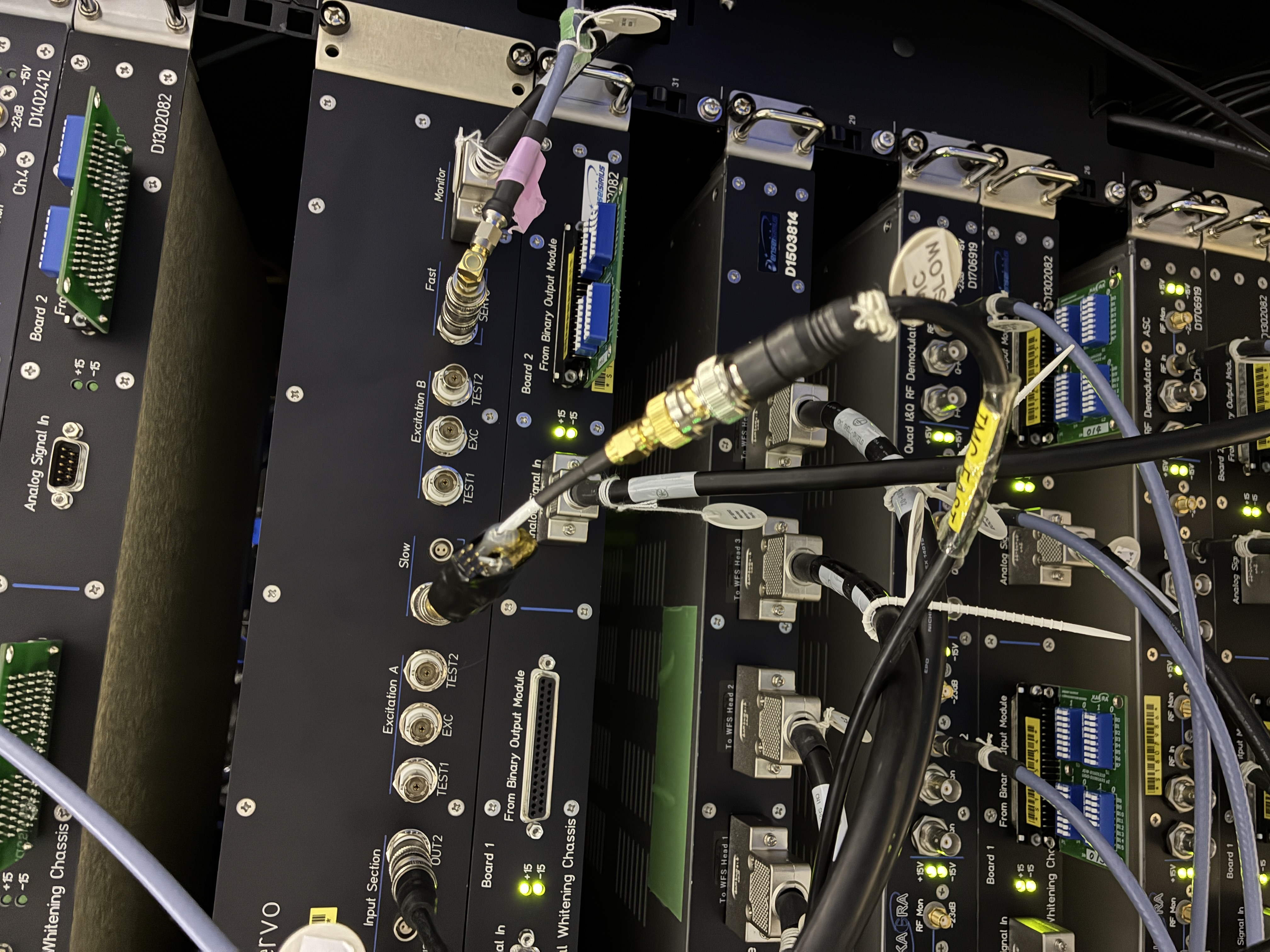
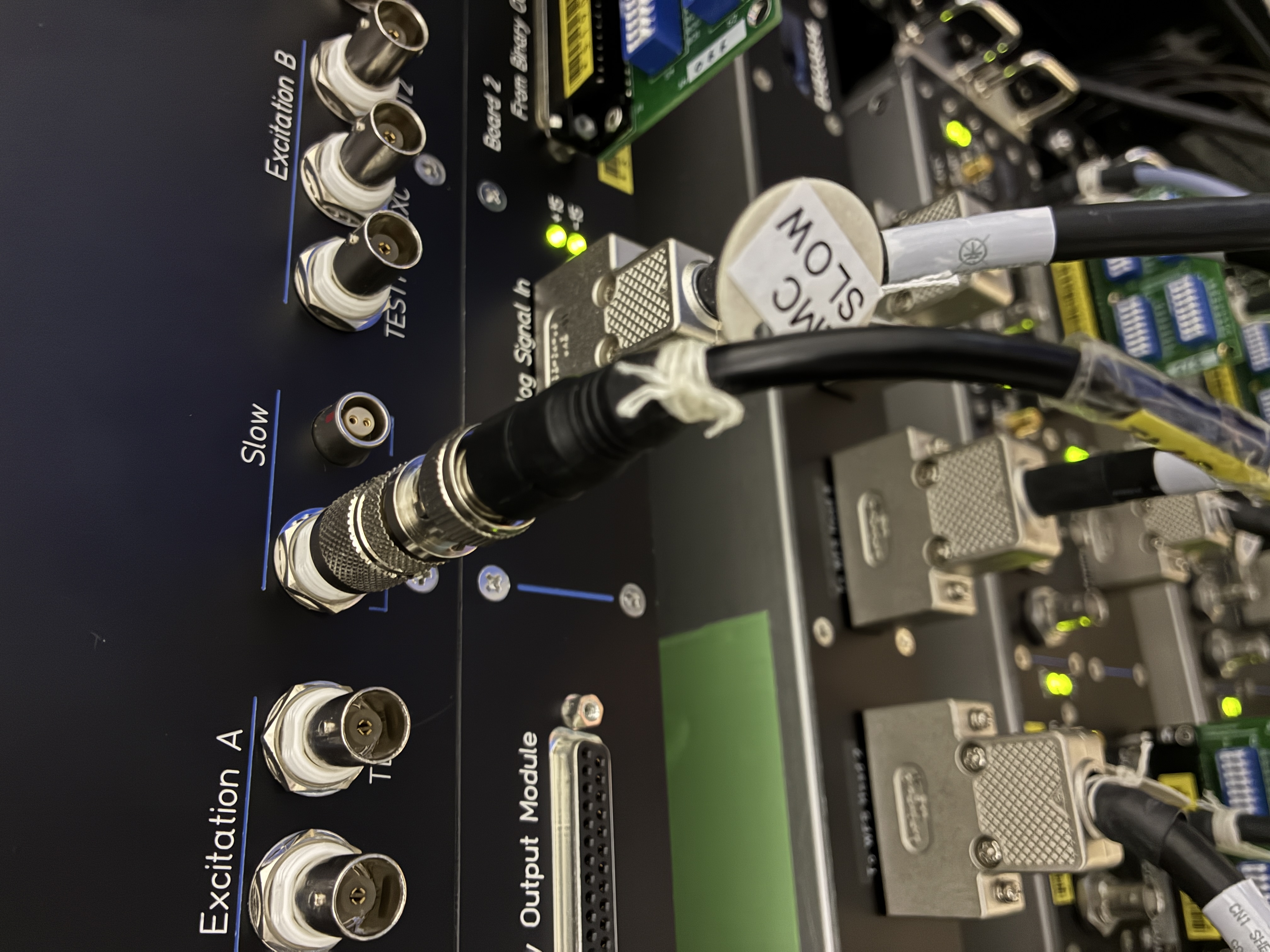
  1. confirmed that the notch filter was connected at the output of the IMC servo SLOW out (PZT) as photo.1,
  2. set IMC down (PMC was set resonance),
  3. disconnnected the BNC cable at the PZT input of the neoLase laser's master laser, then I connected only 2W type 50 ohm terminator,
  4. removed 150kHz notch filter from the IMC srvo slow output (photo.2), and connect it at the 50 ohm terminator input at the master laser side.  (photo.3)
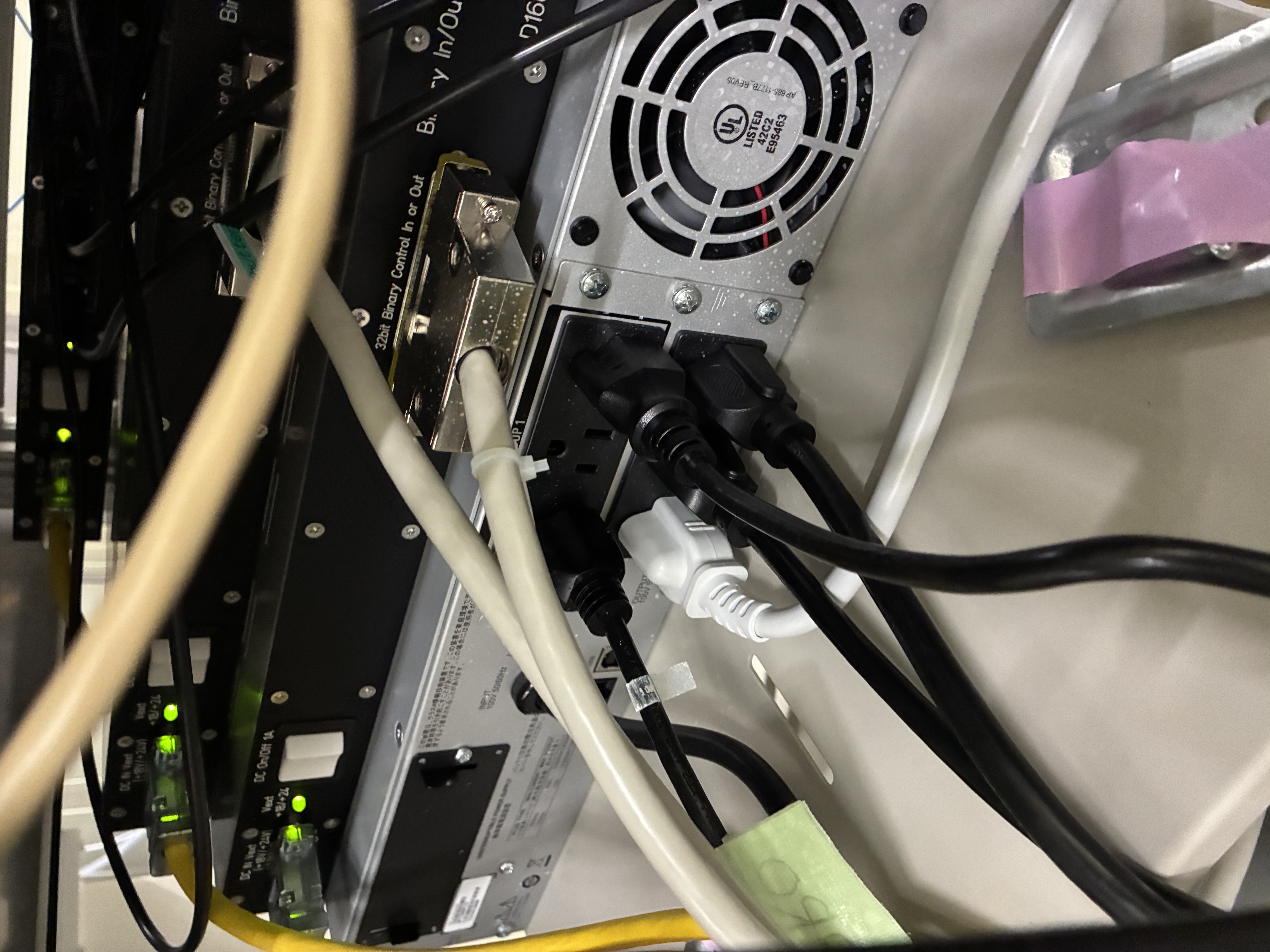
  5. set SR560 on the 19 inch rack cage that houses neoLase controller and DC voltages (photo.4). The power line of the SR560 was taken from the uninterruptible power supply that was also used for the neoLase amp, etc. (photo.7) set the input status at GND. connect the BNC cable from the IMC control servo at the "B" input in the SR560. The polarity was "non INV". set the gain of 2 to compensate the 1/2 voltage reduction due to 50 ohm output and 50 ohm load condition with the notch filter. set no filter in the SR560.
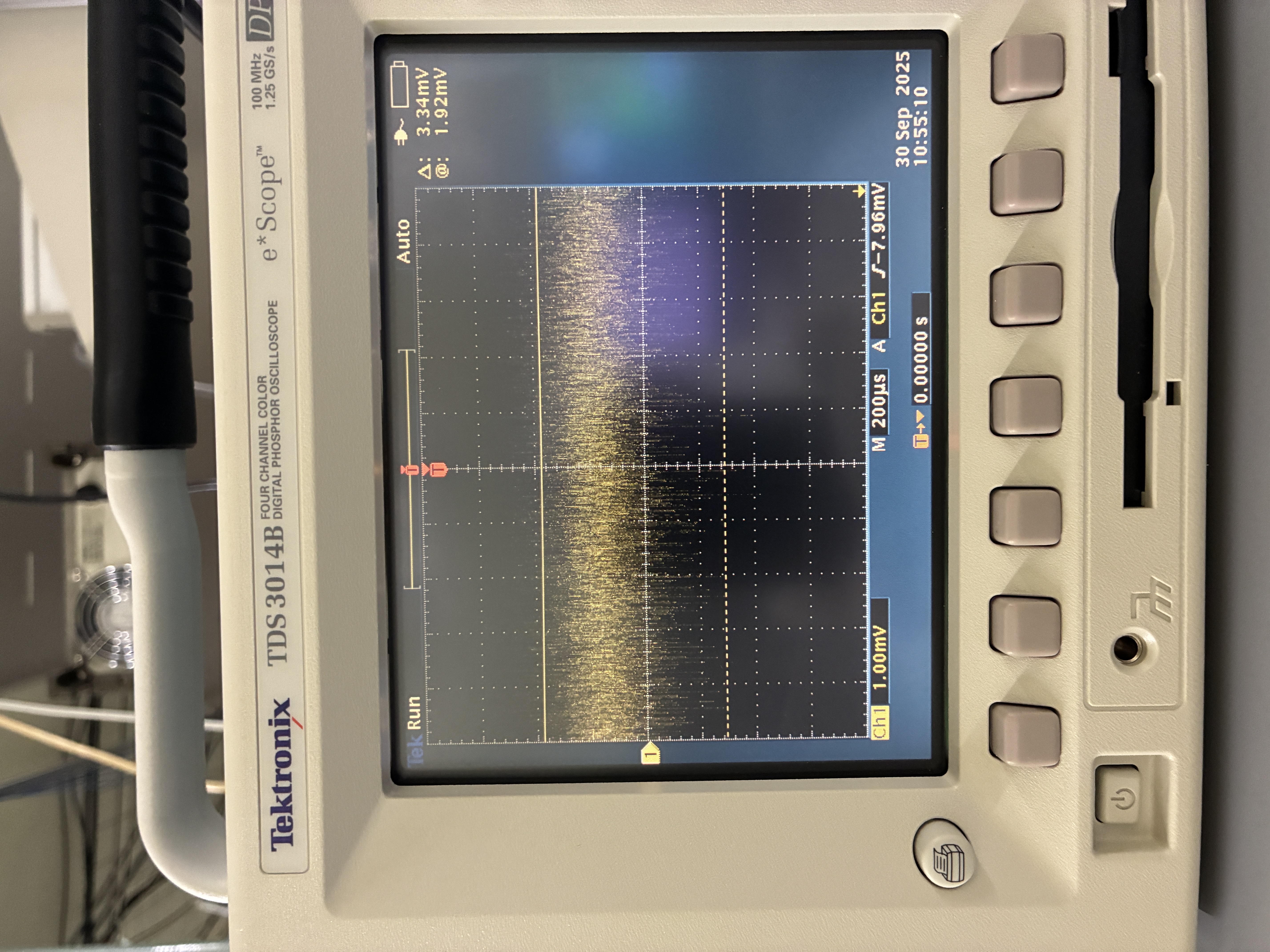
  6. check the output voltage from the 50 ohm output using oscilloscope. it showed very slight offset at the level of mV. I adjusted it around zero by rotating the offset adjustment resistnace? in the SR560.  (photo.5, 6)
  7. connect a BNC cable between the SR560 50 ohm output and the notch filter. also connecte a BNC cable between 600 ohm output of the SR560 and the oscilloscope to monitor the feedback voltage to the PZT. 
  8. change the input statsus from GND to DC coupling.
  9. I set "Providing Stable Light" in the IOO guardian. IMC could be locked.

Loop gain, etc, checks

  1. I checked the RMS amplitude to the PZT. Just after the IMC lock, RMS was ~ 1.5Vp-p. After ~ 20 minutes or so, it became smaller to the level of 0.5Vp-p or so, maybe because I exited from the PSL room and no air turbulace was generated.
  2. To measure the transfer function of the IMC control loop, I rearranged cables to measure it by using Moku. Ushiba-kun confiemed that the 150kHz bump disappered in the TF.
  3. We tried to increase the UGF for the IMC control. Although 140kHz was realized, the phase margin became ~ 27 degrees or so. We decide to keep the same UGF of 120kHz as before with the phase margin of > ~ 40 degrees. (Becasue of troubles, TF data was lost. We will measure later again.)

Additional Note

I change the target temp of the precision cooler for the PSL from 21.1C to 19.1C only during activities in the PSL room to mitigate the temp changes inside the PSL room.

Images attached to this comment
takafumi.ushiba - 18:33 Tuesday 30 September 2025 (35177) Print this report

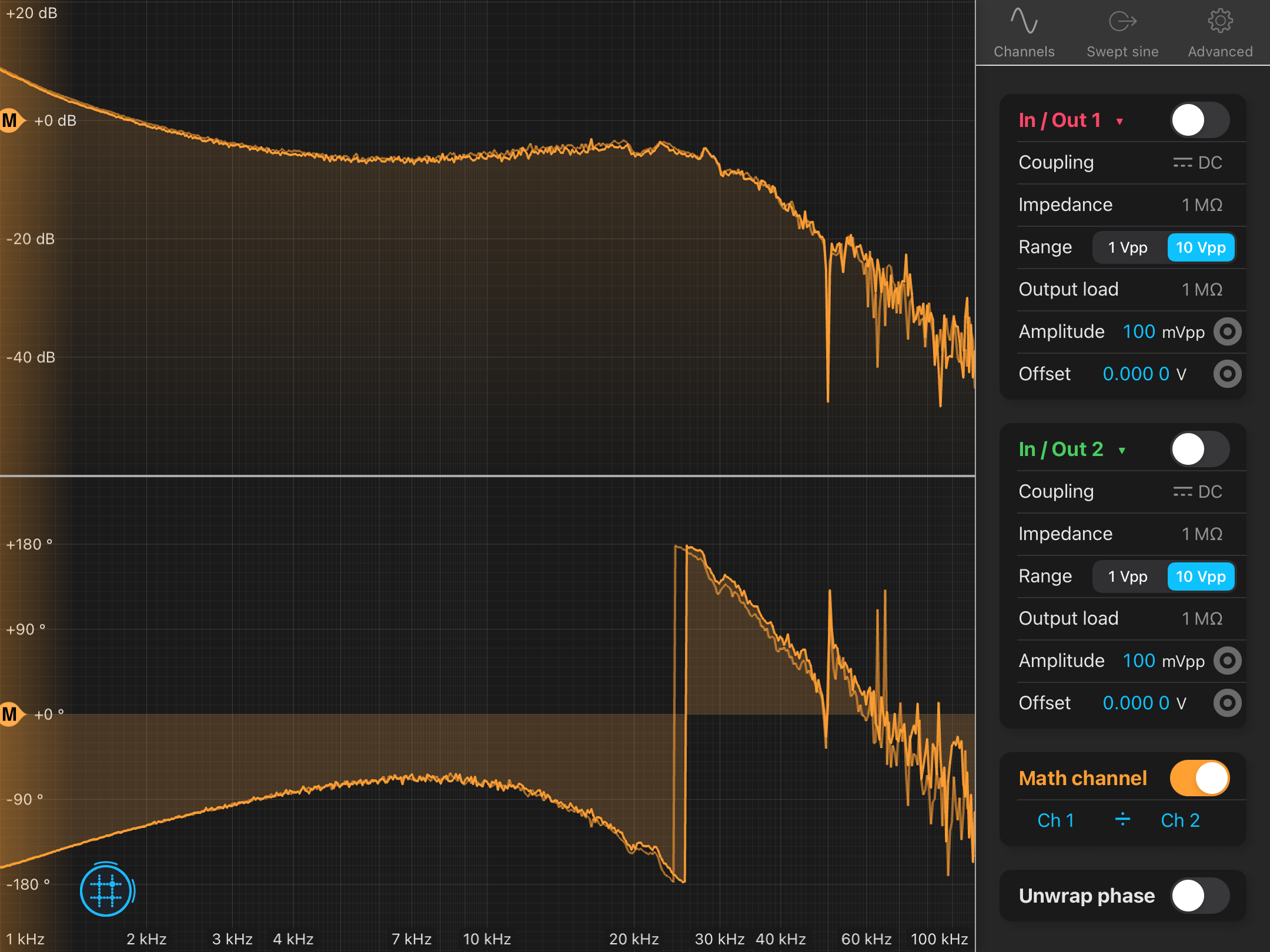
Figure shows the PLTF of IMC loop with SR560 + 150k notch + 50ohm resistance.
Thin line shows the OLTF with the nominal IMC gain determined by the IMC guardian.
Thick line shows the OLTF with increasing gain by 3dB from thin line.

A peak at 150kHz was disappeared thanks to the notch filter and we can increase the UGF at 130kHz without any problems.

Images attached to this comment
takafumi.ushiba - 18:41 Tuesday 30 September 2025 (35178) Print this report

I modified the IMC guardian so that the IMC UGF becomes 130kHz by increasing the IMC CMS IN1 gain by 3dB (fig1).
In addition, I also increased IN2 gain by 3dB (total gain is +3dB as shown in fig2) to keep the relative gain between IMC loop and CARM loop. 

Figure 3 shows the OLTF of ALS_CARM with the above condition.
Thin and thick line shows original gain and increased gain for both IMC CMS IN1/2, respectively.
So, the ALS_CARM phase is slightly improved due to the increase of IMC UGF.

Images attached to this comment
shinji.miyoki - 22:19 Tuesday 30 September 2025 (35181) Print this report

[miyoki, ushiba]

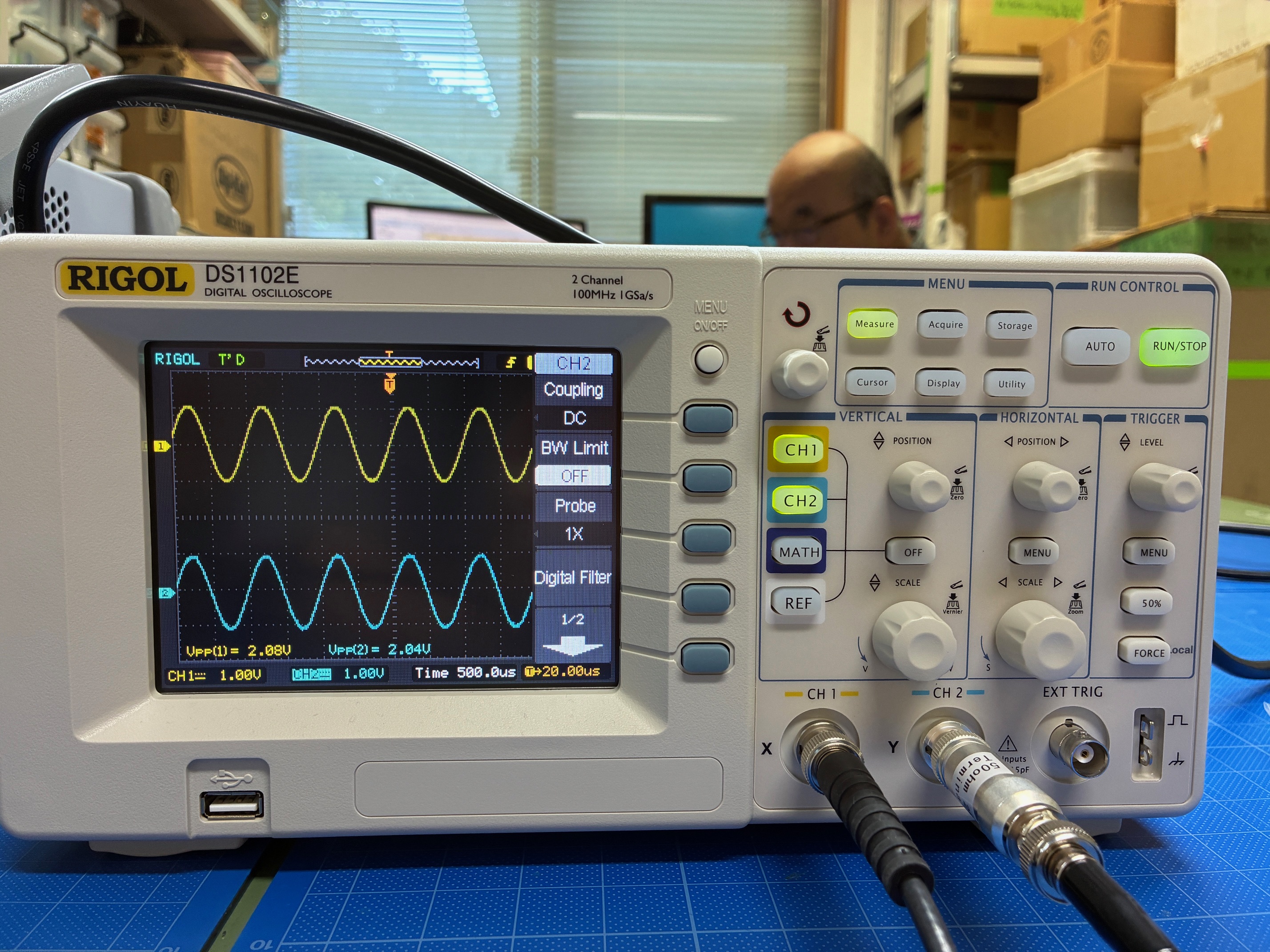
Before installing SR560+Notch+ 50ohm teminator, we checked the pahse dely of the SR560 for 10kHz and 100kHz with legacy methods (photo1,2).

Assuming Gain=2, DC coupling, no filters, 50 ohm output and 50 ohm terminator, roughly, 3.6 degrees delay for 10kHz and 36 degrees delay for 100kHz. (In other words, 1 useconds delay for 100 usec(10kHz) and 10usec(100kHz)). So we judged the pahse delay effect can be accepted.

By the way, SR560 now costs over 5000 USD! we should prepare more cost effective solution :(

Images attached to this comment
Search Help
×

Warning

×