Reports 1-1 of 1 Clear search Modify search
LAS (General)
osamu.miyakawa - 18:27 Thursday 04 September 2025 (35007) Print this report
Investigation about laser frequency noise: Day 3

(Tanaka, Miyakawa)

Tanaka-kun reported that a -20dB attenuator was inserted between the power divider just after the 15MHz RF oscillator and the EOM yesterday, and there was a 20dB RF amplifier before the EOM. This is a very strange situation for noise. Today we tried to remove both of them.

Meanwhile, we noticed the RF LO monitor showed a sudden drop when I touched the cable around the power divider. I confirmed the cable connection, and I surprisingly noticed that 2 of 3 connectors of the power divider were loose. One BNC cable was just inserted and not rotated, and not clamped at all, and one SMA cable was also just inserted, and the screw was not rotated at all.

We fixed them by tightening the connectors. Then the error signal of PMC was improved. We see fewer glitches. However,  glitches sometimes show up. We leave the PMC locked and see the stability tonight.

Additionally, we removed the -20dB attenuator and 20dB RF amplifier, but it seemed to be less effective for stability.

We measured the OLTF of PMC servo and adjusted the gain to have 4.0kHz UGF (See Fig.1, and -10dB gain is inserted in the actual circuit between two measurement points).

Images attached to this report
Comments to this report:
shinji.miyoki - 20:04 Thursday 04 September 2025 (35008) Print this report

I checked several noise excess. There are two type excess noise. One is  noisy signal with 2~3 times amplitude. Fig.1 shows the excess noise bundle, and its close up is the Fig.2.

Fig.3 shows the recent ~3 hours data. You can find ~ 3 times larger amplitude noises. 

The other is gliches with much smaller amplitude than before(Fig.4 and 5).

Anyway, the noisy situation has ~ 2~3 times larger noise than the quiet situation.

Images attached to this comment
shinji.miyoki - 8:46 Friday 05 September 2025 (35010) Print this report

Fiber-type EOM dynamic range in the case of FBL was higher than the present dynamic range of the free-space type EOM. So, more excess feedback signals to the fiber-type EOM path in the IMC control room had much wider room to survive the IMC lock, while it ieasily resulted in the unlock of IMC in the case of free-space type EOM.

We need special care for the EOM feedback path in the case of free-space type EOM, such as,

  • Steep high pass filter insert to reject the signal satulation in the EOM path because of the low-frequency components that don't contribute to the feedback.
  • Higher cross-over freequency between the PZT and EOM to minimize the rms of the feedback signals to the EOM path. However, too much feedback to the PZT will occure the resonance oscillation of the PZT structure inside the Mephisto seed laser.

In the past, we also noticed that the frequency noise in the displacement curves fluctuated: higher in sometime than near-best  level. 

shinji.miyoki - 8:57 Friday 05 September 2025 (35009) Print this report

Fig1, shows the last 12 hours data. It still clearly shows the excess noise several times. Fig.2 shows the biggest timing. Fig.3 shows the higher time reslutiFig.5 also shows the pair glitch with longer time interbal (~10Hz).  The pair glitch noises again. So these pair glitch noise souce still exists.

Fig. 4 shows the other noise that had lower amplitude. It shows the single glitch as reported. 

So the loose connections at the mixer are not the direct noise sources which annoies us for 3 weeks.

Images attached to this comment
shinji.miyoki - 9:28 Friday 05 September 2025 (35013) Print this report

To check the influence of the PLLXY control to the PMC control and IR, we checked the correlation between PSL-PMC_MIXER and ALSY-X/Y_ERR_OUT.

No correlation was found. So, the gliches came from inside the loop of PMC.

Images attached to this comment
shinji.miyoki - 16:05 Friday 05 September 2025 (35017) Print this report

After replacement of RF OSC from N5181B to AFG1022, noisy situation in PSL-PMC_MIXER could be seen, also.

After PSL-PMC_MIXER became quiet, Fig.1,2 shows the relation between PSL-PMC_PZT_HV and PSL-PMC_MIXER. They showed some relation

  • Higher voltage to PMC PZT, noisy situarion appeared.

By the way, after RF OSC replacement, ALS-X_ARM_ERR_OUT became large, while ALS-Y_ARM_ERR_OUT became small. Fig.3 shows the  ALS-X_ARM_ERR_OUT shape.

Images attached to this comment
shinji.miyoki - 20:27 Friday 05 September 2025 (35019) Print this report

After replacement of RF OSC from N5181B to AFG1022, I checked the noise situation in PSL-PMC_MIXER_OUT.

Fig.1 shows the last 4 hours data. Although you might recognize there are still glitches, the appearance of each glitch is different with before.

Fig.2 shows the biggest glitch. The amplitude is very large. It is single and actually caused the change of PSL-PMC_HV_MON. This could be a killer pulse to unlock IMC.

Fig.3 shows other small two glitches. The amplitude is almost double of the nominal value. Fig.4 shows one of them in the short time duration. It is a pair glitch. Fig.5 and 6 shows other glitches. These are also a pair glitch. However, the amplitude is also double of the nominal value. Not so huge as yesterday.

Fig.7 shows another glitch. It is single and clearly affected in PSL-PMC_PZT_HV. Fig.8 shows the effect of this glitch. The chnage of PSL-PMC_PZTHV reached 10V so large! However, its effect came back as in Fig.9

Fortunately, we did not see any crazy glitch parades with about 10 times large amplitude as before. Only pair and single glitches with ~ 2 times amplitude, except for one big single pulse. We will keep monitoring.

P.S. Among discussions with Miyakawa-kun and Tanaka-kun, we noticed that an UPS was used for neoLase and FBL, and other instruments were also connected with this UPS. We would like to check the power load situation and what kinds of instrument are connected with this UPS. Power consumption of AFG1022 is 30W, on the other hand N5181B is ~150W. We suspect the power line for the oscillators.

Images attached to this comment
shinji.miyoki - 23:29 Friday 05 September 2025 (35023) Print this report

We tried IMC lock from ~ 20:10. IMC lock still has unlocks for ~ 30 minutes maybe because of excess noise in PSL-PMC_MIXER_MON_OUT.

Pair glitch noise that had 10 times larger amplitude appeared for 30 minutes. (Fig.1)

Fig.2 shows the ~3 times larger noise unlocked the IMC.

Images attached to this comment
shinji.miyoki - 8:42 Saturday 06 September 2025 (35024) Print this report

Some of glitches that unlocked IMC in the last night are shown Fig.1-4. They seems to be a pair glitches that had large amplitude, except for one glitch.

We need to find the source of these large amplitude glitches.

Images attached to this comment
shinji.miyoki - 11:37 Saturday 06 September 2025 (35025) Print this report

Noise eater was on/off. It seems to reduce the amplitude, even if the glitches appeared.

Images attached to this comment
shinji.miyoki - 12:58 Saturday 06 September 2025 (35026) Print this report
  • All instruments for neoLase laser were confirmed to be connected to UPS, and  no other instrument was conected to it. The power load was 33% in the UPS.
  • I changed the 100kohm resistance position on the back of the HV for the PMC PZT because it was surrounded many signal cables. However, glitches did not vanish.
  • I move one ondotori from the 19 inch rack where the FBL amp was set to on the desk near the wall. However, glitches did not vanish.
  • I unpluged the AC adapter for one ondotori near the optical table during glitches appeared. However, glitches did not vanish. So I repluged again.
shinji.miyoki - 19:13 Saturday 06 September 2025 (35030) Print this report
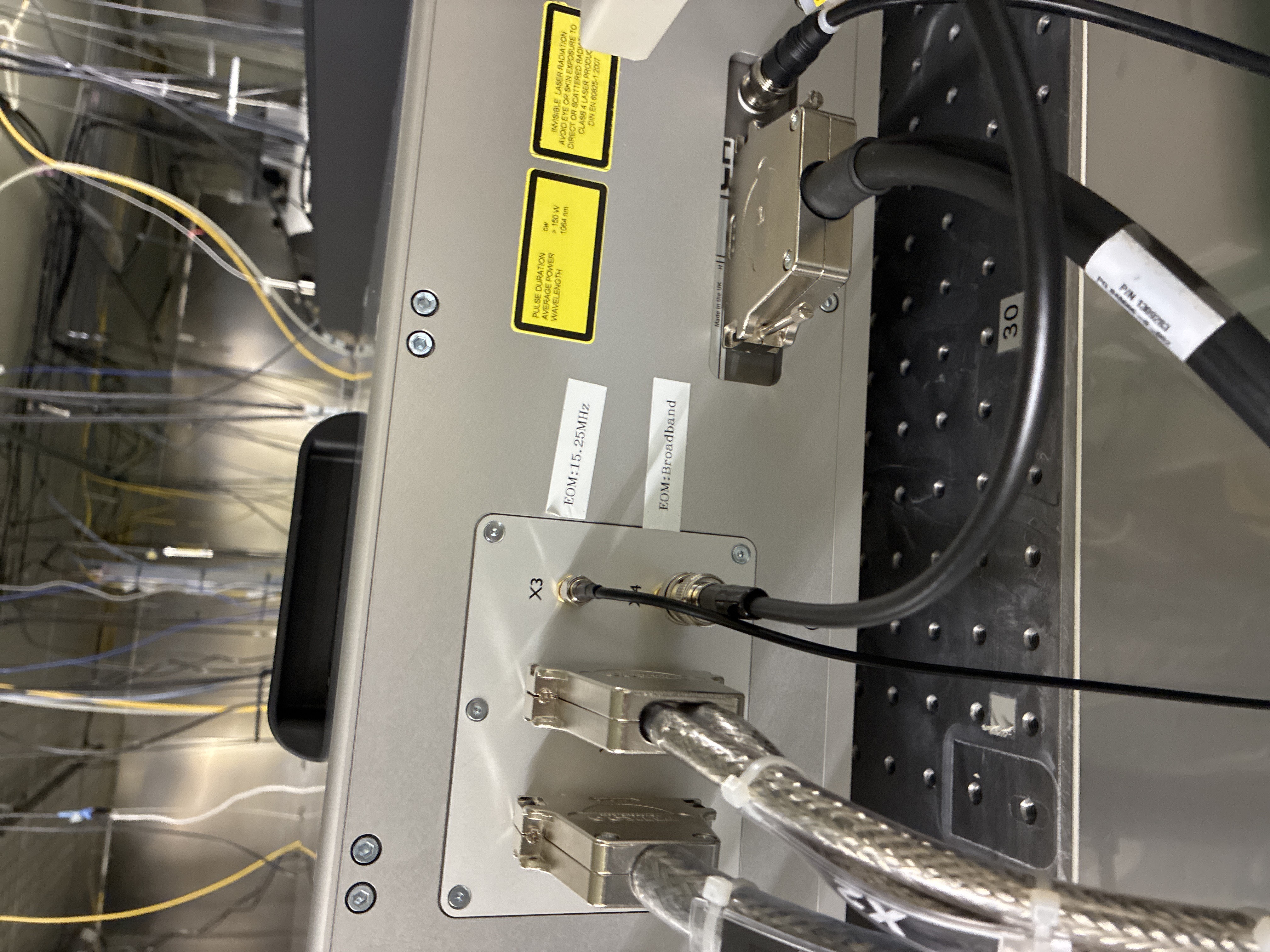
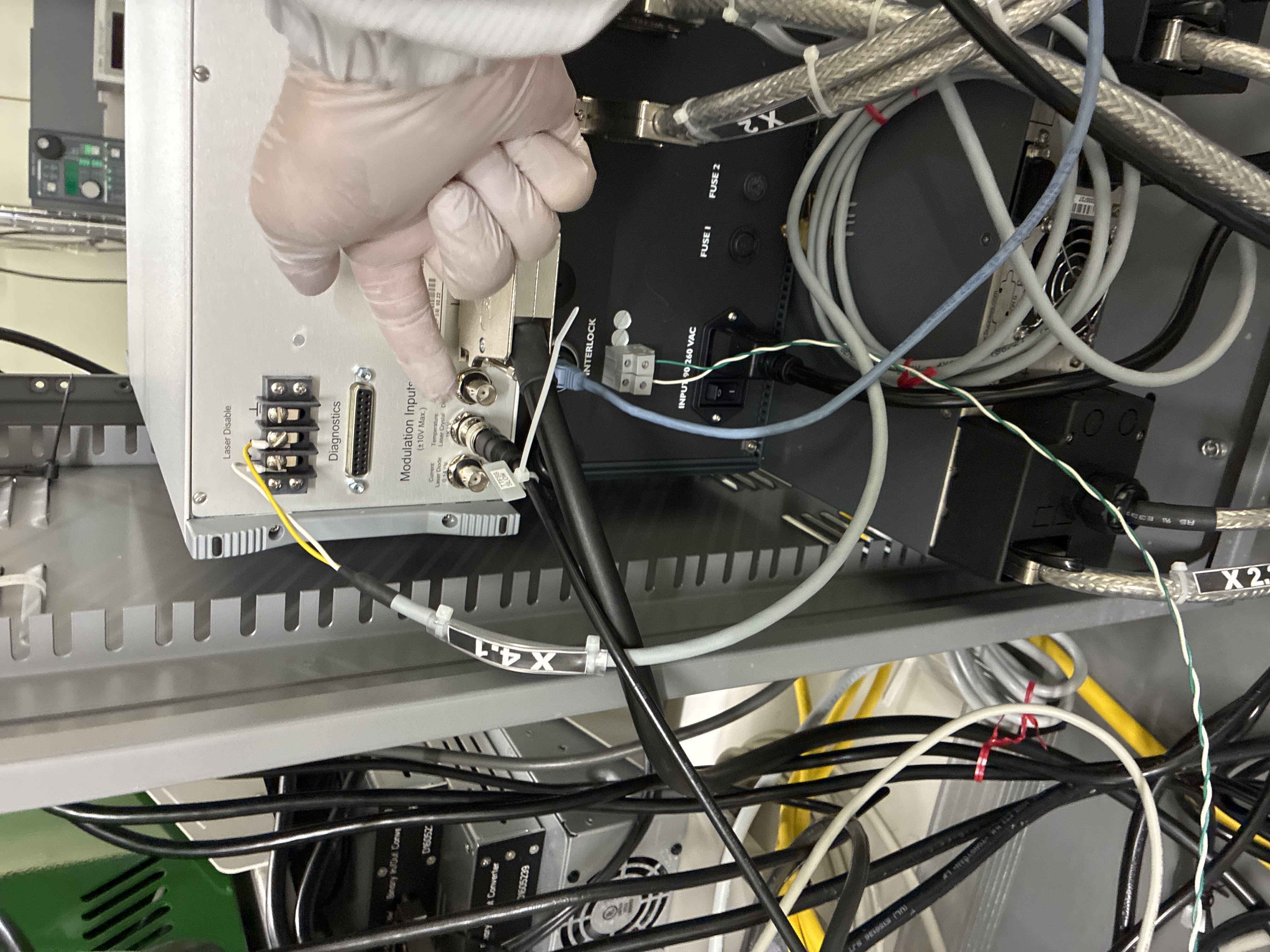
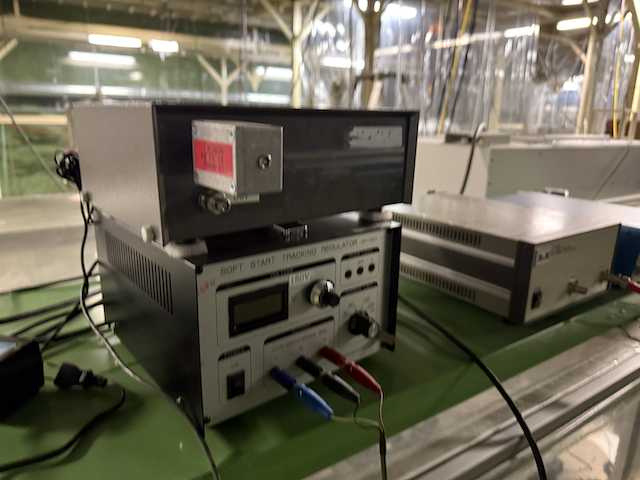
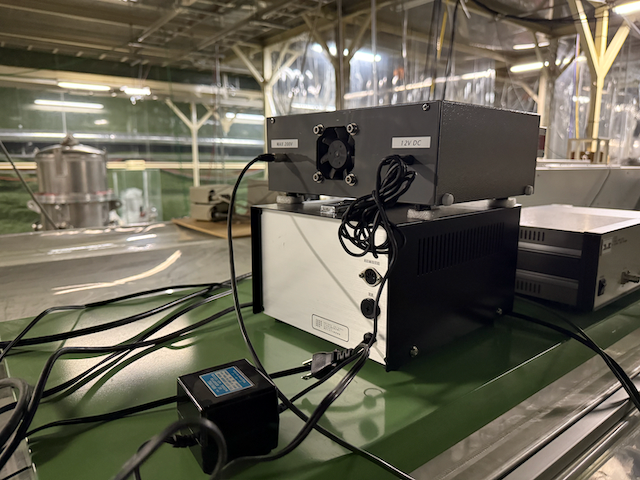
  • I disconnected the BNC to the PZT input of the neaoLase master laser and the BNC to the thermal input of the master laser controller. However, glithces did not vanished. (Photo. 1, 2)
  • PSL-PMC_MIXER_MON became crazy about from 13:30 to 15;00. after that it became quiets and showed glitches some times.
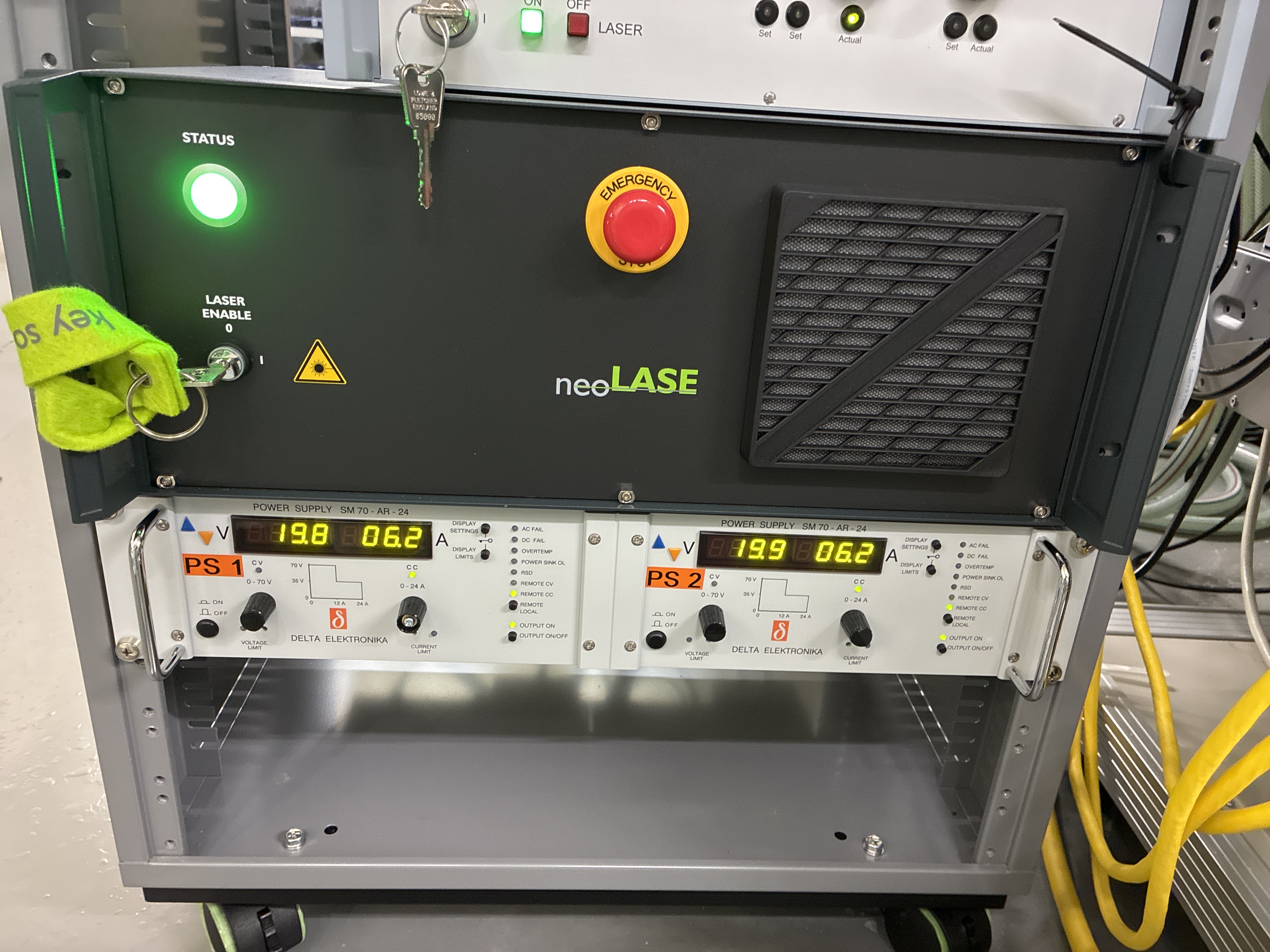
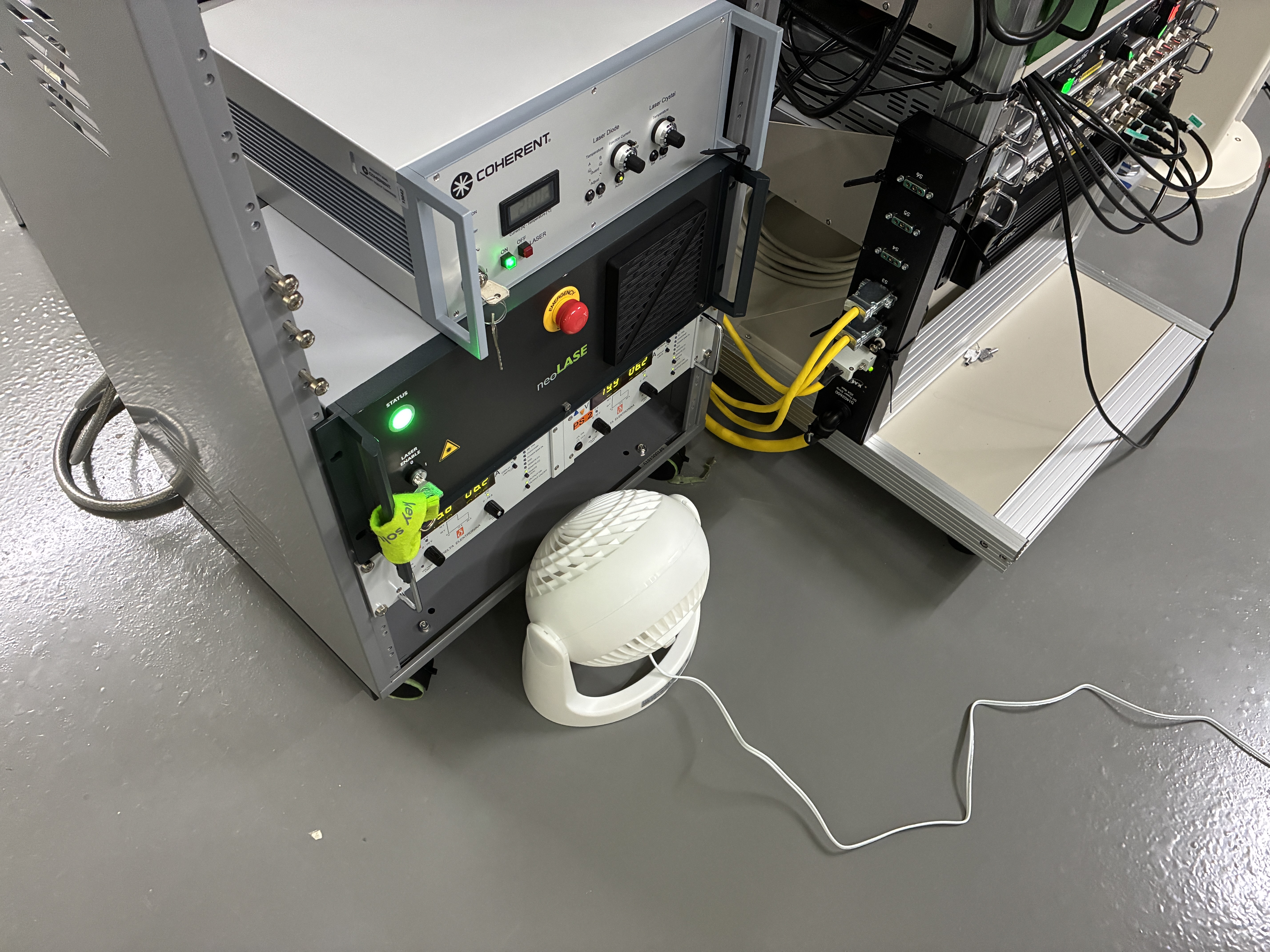
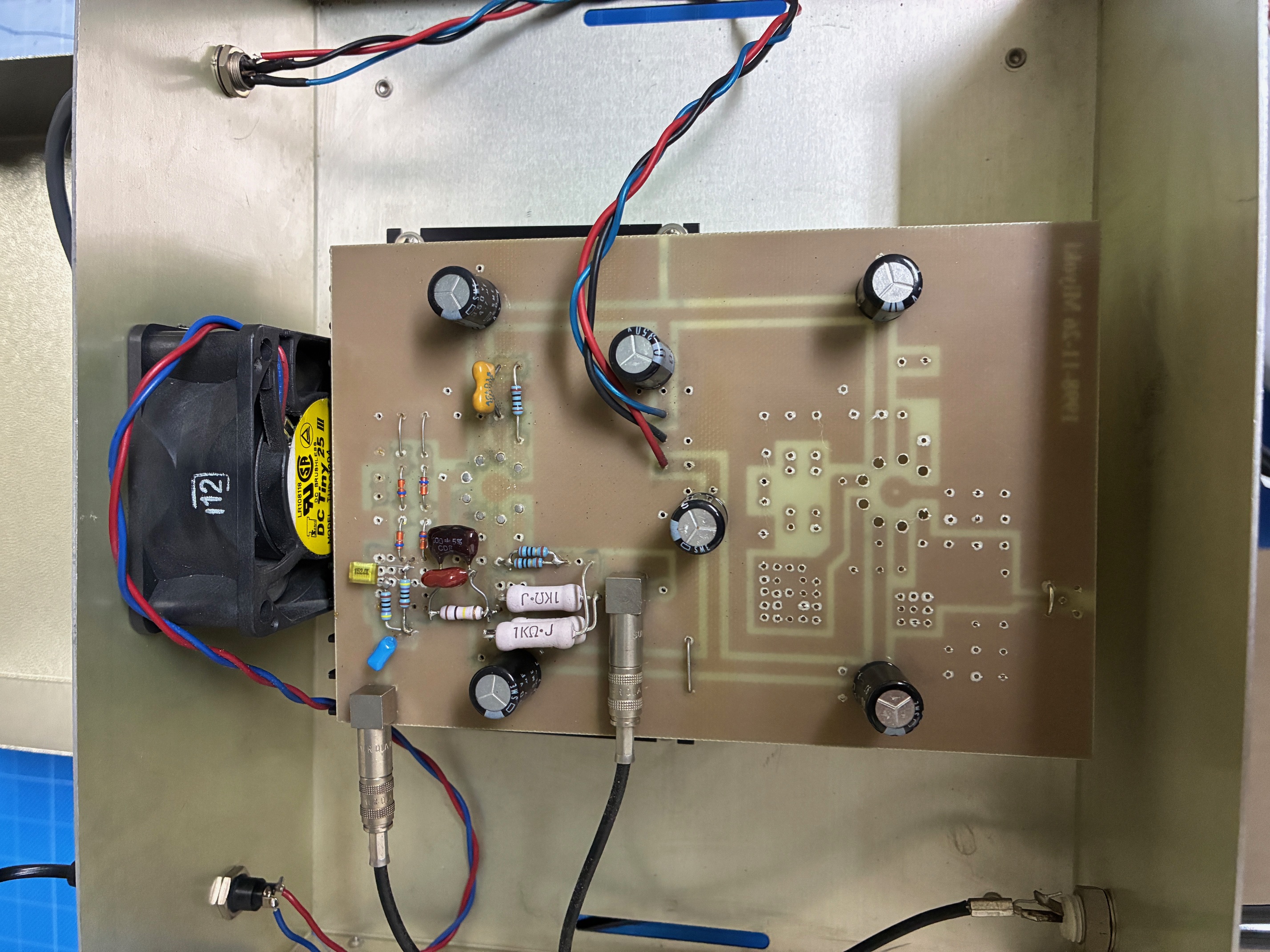
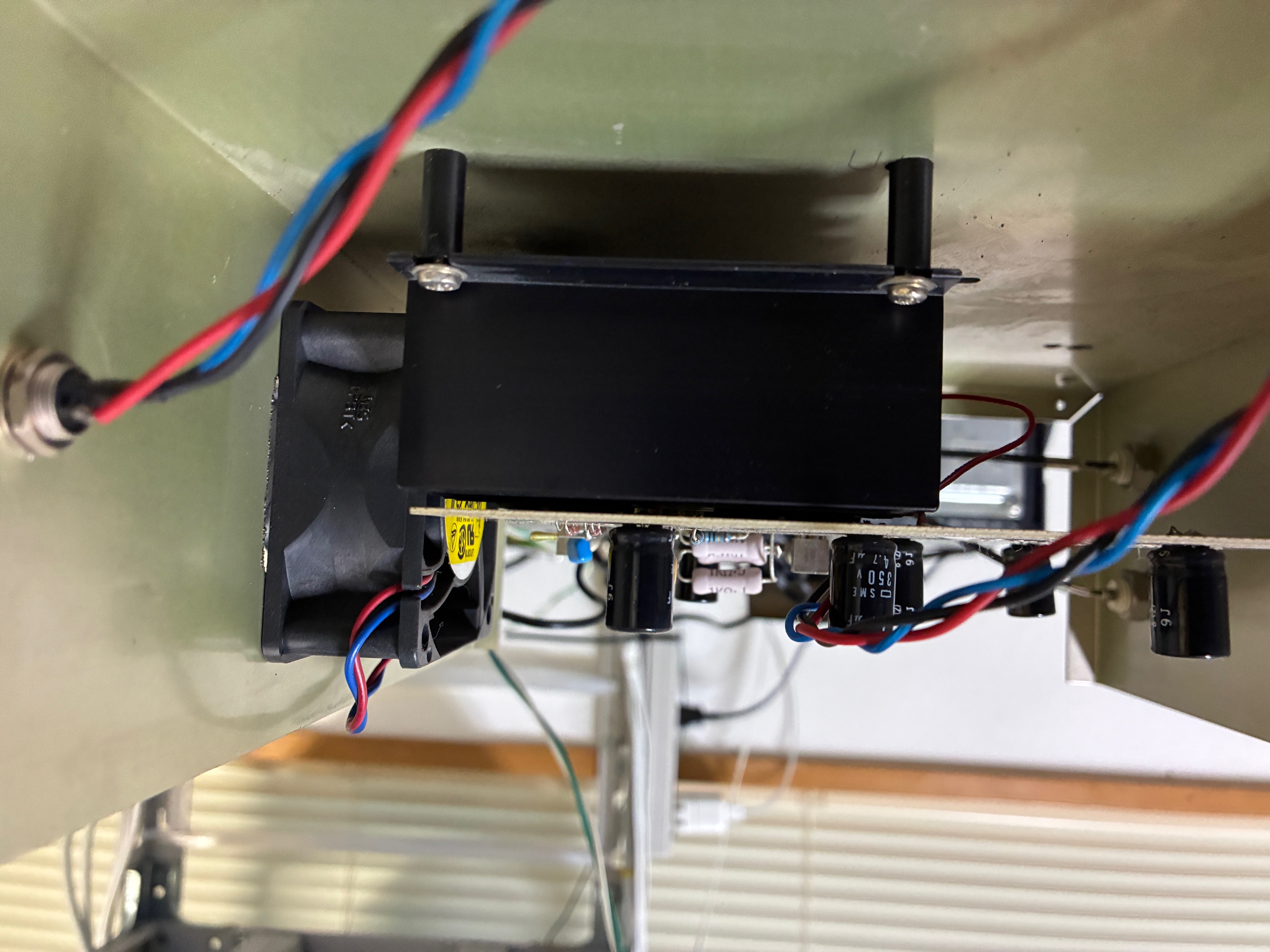
  • I noticed that the bottom of the DC power suppliesr for neoLase laser LDs(?) (SP1,2) were hot, and they are over 40C degrees by using radiation type thermometer. Then I temparally put a brand new circulator and set its wind level at weak level. (Photo 3, 4)
  • Anyway, the glitchs rate and amount seemed to change at the level from 20 minutes to several hours. So the glitch phenomenon seemed to be related with the thermal condition of something.
  • The master laser's noise eater was effective to reduce the amplitude of PSL-PMC_MIXER_MON in the case of quiet situarion, the reduction ratio was about ~0.8 or so. In the glichy case, its reduction ratio was ~ 0.5. However, in the case of crazy situation, the noise eater had almost no effect and rather ocured the DC level changes. I set the noise eater after my today's work. (Photo.5 for the quiet case, photo.6/7 for the  glichy case, photo/8 is for the crazy case.)
  • I restarted the N8151B synthesizer, and check the signals by using an oscillo scope. The Error 508 Synthesizer Unlocked: FracN loop was displayed as reported in  klog#23010. This is the same error with other broken one. However, the sinusoidal signals monitored by the oscilloscope seemes to be fine by eyeballs. I kept N8151B on, but no connection to naywhere.

By the way the high voltage drivers (FLC F10A ) is not enough to drive the wideband EOM in the IMC loop because it can drive only 70-100V. Even in CLIO and the past experiments, PA-85 amp or old new focus model 3211 that can drive 150 - 200V were used. Maybe I have model 3211 in CLIO or Kashiwa campus.

Images attached to this comment
shinji.miyoki - 8:00 Sunday 07 September 2025 (35032) Print this report

After cooling the power supplier for the LDs, the glitch noise situation seemed to change. Almost no pair glitch and crazy noise situation were drastucally reduced for one night.

Fig.1 shows the last 12 hours situation. Owing to the noise eater, the amplitude of the quiet situation became 0.009Vpp as in Fig.2. Before applying it, it was 0.014. From -11 hours, the biggest amplitude was +/- 0.045, except for one big glitch. This value is just 3 times of the amplitude before applying the noise eater. If the EOM path can have more dynamic range, the EOM path feedback signal will avoid satulation.

Fig.2 is the quiet situation. Because of the noise eater, the amplitude was less than before.

Fig.3 is one of noisy situation. The amplitude became ~ 2 times. Fig.4 shows another noisy situation. Fig.5 shows the single glitch type.

Anyway, we will check the tempearture of the power suppliers again and will add more cooling. Actually, air flow in the PSL should be avoided. So, the present setting of the power supplier for LDs  should be urgently improved. I am seriously afraid they have already had mulfunctions.

Images attached to this comment
shinji.miyoki - 8:20 Sunday 07 September 2025 (35033) Print this report

I tried IMC lock. However, the Fig.1 like glitch unlocked the IMC.

Images attached to this comment
tomotada.akutsu - 9:51 Sunday 07 September 2025 (35034) Print this report

Thanks for your investigations in the weekend.

  • As you may know, the noise eater may have good and/or bad effects (sometimes just getting crazy...), so please be careful when you use it.
  • Probably, certain amount of spatial gaps should be given the above and bottom of the hot driver. Hopefully some recommended numbers can be found in its manual document.
  • As you mentioned, the effeciency of the old(?) broadband EOM should be quantitatively compared with that of the modern fiber EOM used in the previous laser source first; then please insert such a PA-85-ish amplifire if needed (but that to be a new thermal source in the PSL room, though...) Please also be careful that the high-voltage cable may affect the other small signal cables. Also, the electric signals in the frequency range from like a few tens kHz to a few MHz would be sometimes more difficult to manage than that of the apparently RF region.
shinji.miyoki - 20:42 Sunday 07 September 2025 (35038) Print this report

> All instruments for neoLase laser were confirmed to be connected to UPS, and  no other instrument was conected to it. The power load was 33% in the UPS.

Sorry, this was wrong. HV drivers for EOM were also connected to this UPS. However, this situation is same to the previous trial in December 2024.

shinji.miyoki - 20:43 Sunday 07 September 2025 (35035) Print this report

In this morning, crazy noise and pair noises appeared again. So no improvements were done. However, I increased the fan rotation speed for the power supplier for LDs from low to middle. Because of this, the PMC refl beam seems to be slightly swinging?

Just a memo on what I found,

  • X4 cable that is used for the interlock between the master laser controller and the noLase laser controller was loose. I fixed it.
  • I changed the RF OSC from AFG1022 to N5181B again because the spectrum property of N5181B seems to be better accoding to Tanaka-kun's post even though it has some error messages.
  • The bottom temperature of the power supplier for LDs was 34C today (41C yesterday) owing to fan cooling
  • I measred the surface temperature of the neoLase closing body.
    • Near back fins of the master laser:25C
    • middle of the back pannel: 24C
    • near the water tube of chiller: 23C
    • Top panel : 24C
    • Judging from these data, the temp inside the body may be not so high.

From around 12:00, the IMC could lock for one or two hours. Although unlocks of IMC were caused by big glitches in the PMC loop, except for one earthquake, no crazy and a glitch parade did not appear until 16:30. Fig.1 is the pair glitch in the PMC loop that unlocked IMC. Fig.2 shows the IMC lock from about 12:00 to 18:00. All IMC unlocks seemed to be caused by glitches in the PMC loop. -> Around 18:00, the glitch parade has started and it got crazy and around 19:30, it became quiet again. Yes, this cycles are now repeated.

  • Is there any control loops for temperature in this neoLase? If so, it seemed to be unstable. 
  • The chiller might cause the temperature oscillation in amps?
    • If there is low heat load in amps and the chiller setting temp is high, the chiller can easily reach the target temp and stop cooling. This cooling on and off cycle will repeat frequently. So, temp in amps will fluctuate?
    • If there is high heat load in amps,  the chiller keeps cooling for a long time to reach the target temp, or just keep cooling because the target temp cannot be obtained. So, temp in amps will be at the stable equilibrium temp?

At present, the neoLase power was reduced from 50W to 20W level to avoid too much power waste. Then the PMC transmittance became worse. One concern about the lower transittance of PMC is the effect of higher modes resonance near TEM00. Such higher mode resonances might affect the PMC error signals for TEM00? In this case, the glitches expected not to so fast. However, we are annoying the very fast glitches, especially in its rising time. Such fast glitches might be generated from electrical sources.

Images attached to this comment
shinji.miyoki - 7:15 Monday 08 September 2025 (35039) Print this report

Fig.1 shows the last one day situation. you can recognize noisy situation and better situation are repeating for several hours. (-20, -13, and 0 hours correspond to noisy timing)

Fig.2 shows the no IMC unlock event even if there was a short glitch.

Images attached to this comment
takashi.uchiyama - 16:06 Monday 08 September 2025 (35040) Print this report
2025/09/08

Uchiyama

I brought the high-voltage amplifier and power supply that were used for the wide-band EOM of CLIO.
Images attached to this comment
shinji.miyoki - 20:24 Monday 08 September 2025 (35043) Print this report

PA-85 part circuit is listed in this pdf file. If we want to use this amp as just an amplifier that has no filters, we need modification. Anyway I checked this circuit can work today.

However, it is better to have some filters to avoid oscillation of PA-85 itself. Sorry for the amature diagram.

I will ask Shomde-san's advice tomorrow. Please let me know the filter shape for the EOM path in the IMC loop.

Non-image files attached to this comment
tomotada.akutsu - 20:24 Monday 08 September 2025 (35044) Print this report

Well, without looking at the actual circuit board photo, it might be hard to say about the performance... several tens kHz - a few MHz might be very annoying frequcny range in terms of making proper common ground. 

shinji.miyoki - 20:51 Monday 08 September 2025 (35046) Print this report

All parts are on a one-layer PCB board that I made mannually. A socket is also used for PA-85 and its recommended heat sink is also used for the thermal damage protection. In addition a fan was set to flow air to this heat sink.

shinji.miyoki - 6:59 Tuesday 09 September 2025 (35049) Print this report

Circuit photo of PA-85. The PCB plate can put two PA-85s to enable the +/- signal sending to obtain the double efficiency.

Images attached to this comment
shinji.miyoki - 11:29 Tuesday 09 September 2025 (35047) Print this report

According to Nakano-kun, LIGO is using PA-98. Apparently, they seem to have almost same property, except for the package design

hirotaka.yuzurihara - 15:49 Tuesday 09 September 2025 (35053) Print this report

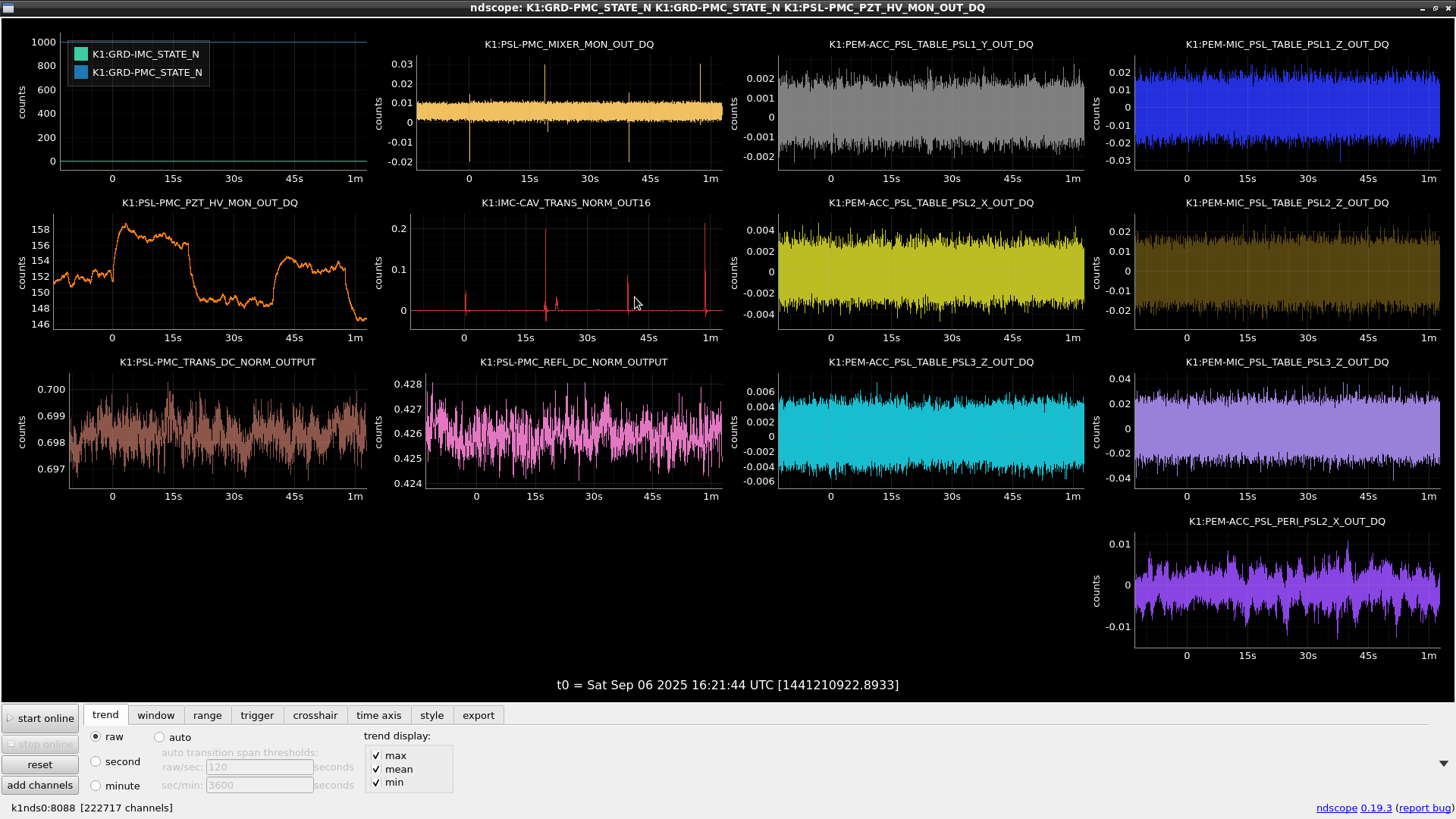
I investigated the coincident channels with K1:PSL-PMC_MIXER_MON_OUT_DQ's glitch and other channels. The channel list is attached.
The time span which I checked is 9/6 10:00:00 UTC~16:30:00 UTC. During this period, the IMC was down and PMC was locked. This timing is just after Miyoki-san's work (klog).

Memo

  • In short, I did't find any new things...
  • At 10:00~11:00 UTC, that glitch happened often. I wondered if there was a pattern to the occurrence cycle, but it seems there is no specific pattern.
  • At 11:00~12:00 UTC, the glitch was rare.
  • I picked up the glitchy time by eye-scan and checked the Q-spectrogram and whitened time-frequency map around that time. But, there was no coincidence with the other channels (reated to PMC/PEM accelerometer/ PEM micropone in the PSL room).
  • I attach one example of glitchy time.
Images attached to this comment
Non-image files attached to this comment
Search Help
×

Warning

×