Reports 1-1 of 1 Clear search Modify search
LAS (General)
osamu.miyakawa - 19:06 Monday 25 August 2025 (34919) Print this report
Intensity noise investigtion for new neoLASE laser

Continued work from klog:34877

(Uchiyama, Miyakawa)

abstract:

We measured the intensity noise for the neoLASE laser with full 20W (9A) power. We confirmed that Intensity noise grows depending on the distance from the laser source. We checked the laser path and removed some miscenterings or stray light, then the intensity noise at low frequency was improved 3-4 times. ISS can be locked a little longer (~5min).


Detail:

This morning, we could not enter the mine fo falling blocks from the ceiling, so I confirmed the intensity noise for existing PDs with full 20W (9A) power remotely. Behavior was the same as last week, where upstream has less intensity noise and downstream around PMC, even before/after PMC, intensity noise is ~100times higher than upstream one.

In the afternoon, we entered the PSL room and performed additional measurements at several locations with transmitted light of the existing high reflected steering mirror using another DC PD, especially before/after the AOM. The result showed that there was no significant difference before/after AOM, and the intensity noise grows depending on the distance from the laser source (see Fig.1). It means that there is no specified optics that degrades the intensity noise drastically.

We thought that some misalignment or stray light might cause the intensity noise, so we checked the miscentering on the optics with a viewer or added a beam dump to block stray light. We re-aligned PMC roughly and locked it, then measured the intensity noise again for existing PDs. Noise became 3-4times better at low frequency than before (See Fig.2). We know still one of the steering mirrors, which is just before the PMC, is off-center largely. We will fix it tomorrow. Time was limited, and the alignment to the PMC is so not good right now. We will also fix it tomorrow with some fine alignment procedures.

ISS seems to be working ~5 minutes order with integrator ON, but still sometimes fails.

Images attached to this report
Comments to this report:
osamu.miyakawa - 19:12 Tuesday 26 August 2025 (34923) Print this report

(Tanaka, Miyakawa)

Yesterday's improvement was still a mystery this morning. We had just thought to improve the optical path anyhow, and we should better the intensity noise.

We tried many things, and we realized the next two things were important.

1. We put a small hole (~5mm) on the black metal board into the beam path to remove the junk light around the beam spot. Two same boards have been installed along the FB laser path. However, the intensity noise at low frequency got worse.

2. Intensity noise at the transmitted light of the 2nd steering mirror is small but has a bump at low frequency. This bump is higher than what we measured at Toyama Univ. This indicates there are two possibilities, one is that the intensity noise gets worse depending on the distance from the laser source, another one is that the inserted optics make something worse. We measured a very simple path that was the intensity noise of the transmitted light of the first steering mirror at the same distance as the transmitted light of 2nd steering mirror. The results say that the low frequency intensity noise does not depend on the distance. It means that something inserted in the beam path makes the intensity noise worse. 

After we realized No.2 above, we removed the hole again of No. 1, and the intensity noise was recovered to the same level this morning.

These things suggest to us that beam clipping by a limited aperture may cause intensity noise. Of course, the design beam diameter is much smaller than the aperture of existing optics, but the current neoLASE beam is dirty compared with the output of the fiber laser. Clipping of the neoLASE may be more critical than the FB laser.

This can explain yesterday's mystery. I did some centering for several lenses and mirrors that have the largest beam size hitting them.

Tomorrow, we will reduce the number of steering mirrors and replace some 1 inch mirrors with 2 inch mirrors if we can. We hope it will improve the intensity noise more.

osamu.miyakawa - 18:05 Wednesday 27 August 2025 (34935) Print this report

(Tanaka, Miyakawa)

Our guess seemed to be correct. We replaced two 1-inch steering mirrors to 2-inch mirrors, and we removed two steering mirrors from the current path that were used to merge the new beam path of neoLASE to the original path of FB laser to the PMC. It required the change of the beam path, so after some hard work for the realignment to PMC with the new path, especially with careful centering to the AOM hole, PMC was locked with low power. At this stage, we did not want to change the alignment anymore upstream of the AOM; we performed the fine alignment using pico motors. During the fine alignment, we did see much more stable transmitted power of PMC already.

We measured the intensity noise again, and we obtained 2-3 times better results at low frequency than the day before yesterday's result (See Fig.1, red, blue, and green lines). Current intensity noise of the neoLASE laser is almost the same as the FB laser or slightly better.

However, some sudden fluctuations sometimes exist, and they disturb the ISS lock. We need more investigation.

Images attached to this comment
shinji.miyoki - 22:20 Wednesday 27 August 2025 (34936) Print this report

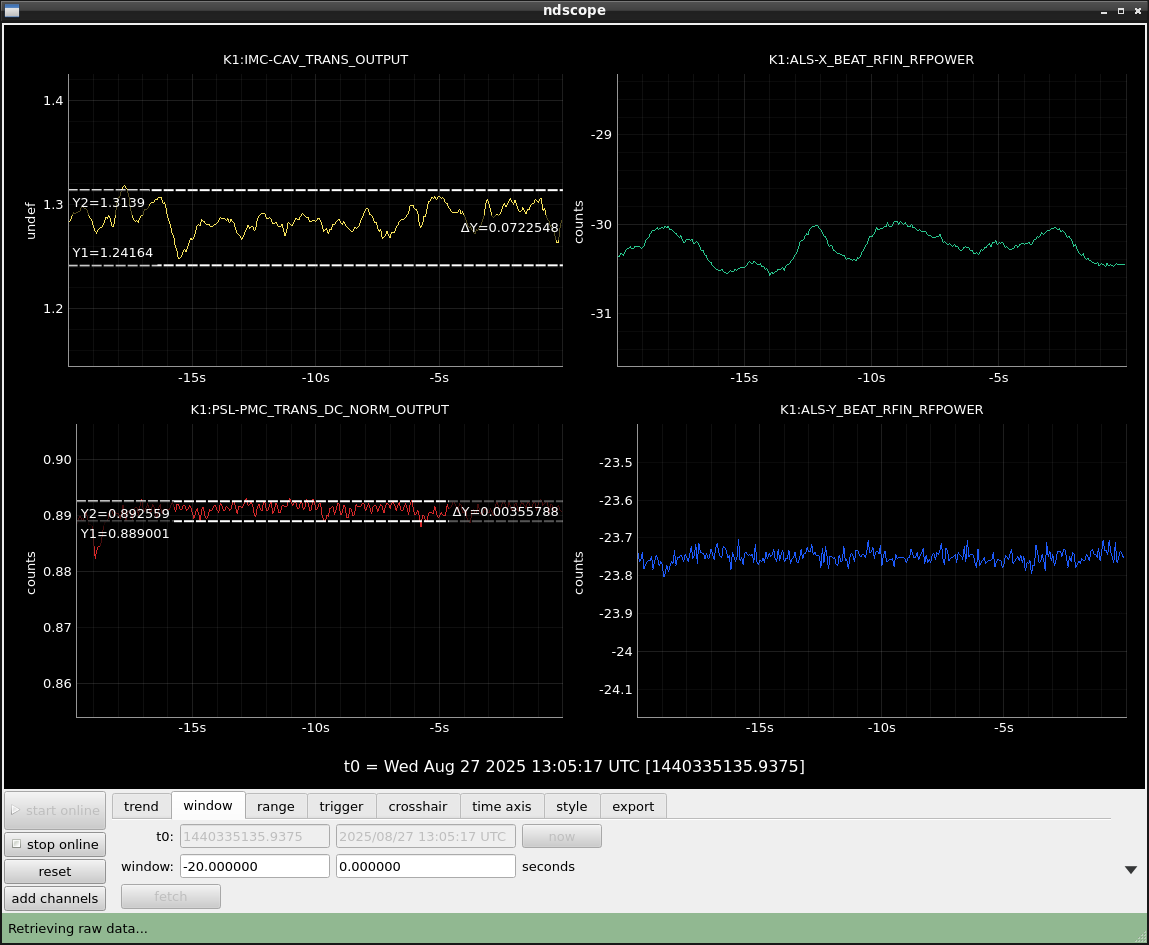
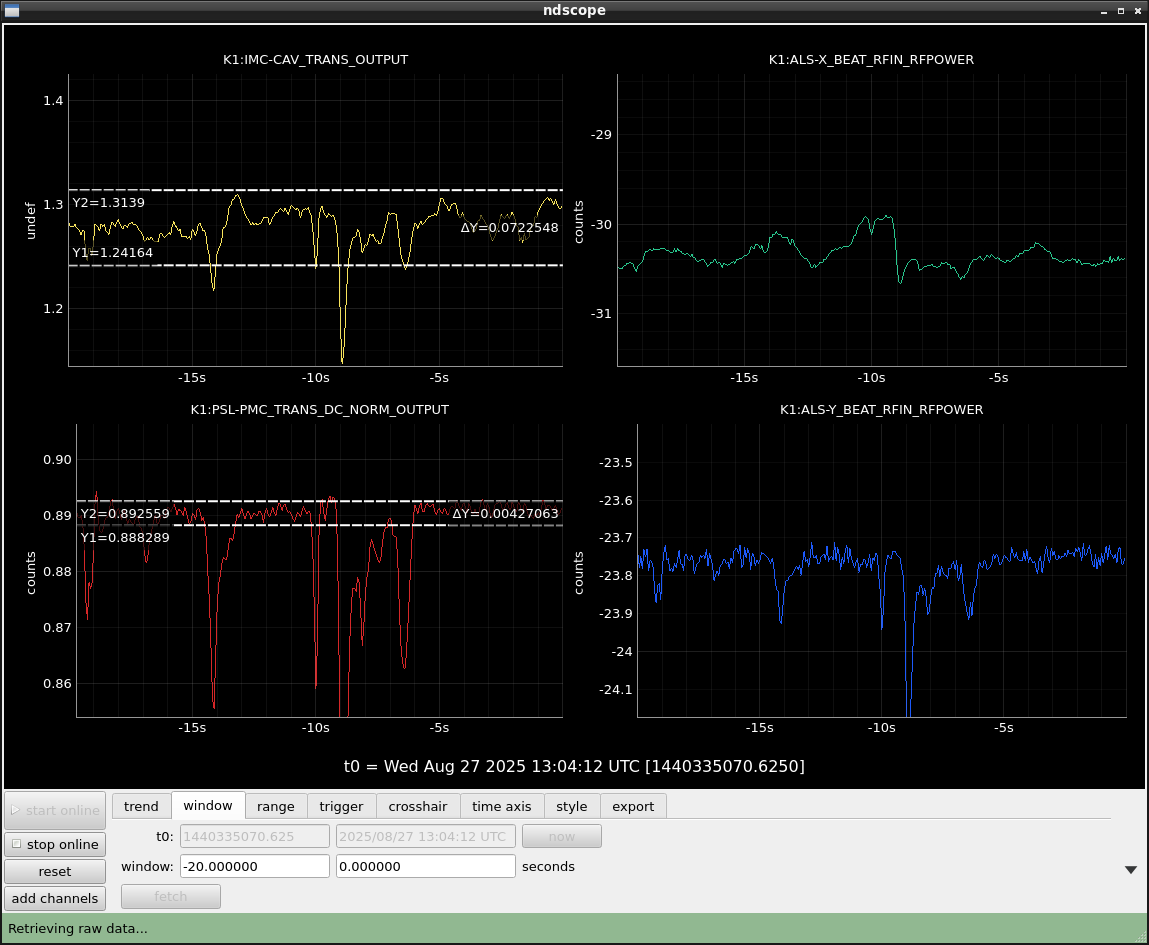
I checked the PMC/IMC trans and ALS-Y_BEAT_RFIN_REPOWER under the condition where the PPY was locked and PPLX was down (around 23:00 JST, these PLL servo situations were set).

Fig.1 shows the stable timing, while Fig.2 shows the unstable timing, especially for the PMC lock.

Fig.1 shows that the stability was drastically improved, compared with that in a few days.

Fig.2 shows the relation between PMC trans drop and  ALS-Y_BEAT_RFIN_REPOWER. However, I don't know which servo instability was the origin. Of course, the power drop of the PMC trans will affect the servo gain for the PLLY servo?

This instability seemed to appear frequently, roughly 30 seconds.

Images attached to this comment
shinji.miyoki - 7:18 Thursday 28 August 2025 (34938) Print this report

The PLLY became unstable around 2:00 JST at least. So IMC lock became unstable.

After the recovery of PLLY, the IMC trans drastically increased, while no changes in the PMC trans, again. So. the IMC lock seemes to have some offset?

Images attached to this comment
osamu.miyakawa - 17:46 Thursday 28 August 2025 (34949) Print this report

(Tanaka, Miyakawa)

Finally, we solved the mystery of spot jumps!

They were coming from the heated air generated by Thorlab's power detector. We have ~50W power at the output of the neoLASE box, and ~24W is injected into PMC, and ~25W is discarded into the power meter. Unfortunately or safely, the power meter is air cooled type. If we walk around the optics near the power meter, or even very small convection with no person, it can cause a drastic beam distortion.

We reduced the original power to ~20W, and we rotated the HWP to make all P polarization to avoid sending laser power to the power meter. After waiting until the power meter is cooled down, we looked at the transmitted light, and it became much much less spikes.

Fig.1 shows the situation this morning. Transmitted light (blue) and reflected light (orange) of PMC had many spikes of 5~10% total power several times in 10minutes.

Fig.2 shows that after fixing the heat problem, Transmitted light (blue) and reflected light (orange) have no spikes in 20 minutes. Note that the power calibration is not yet done for refl light, so please ignore the left axis number.

Then we tried the ISS lock, and it worked without any lock loss for at least 40 minutes (we will leave it for tonight).

We still have some remaining work in the PSL room tomorrow. We can try the IFO lock then.

Images attached to this comment
osamu.miyakawa - 15:26 Friday 29 August 2025 (34959) Print this report

(Tanaka, Miyakawa)

We finished some remaining work in the PSL room.

  • We calibrated the DC PD for the output power monitor of the neoLASE laser.
  • Currently, we have set 7A for LD current, and the output is ~28W. It is not the full power, so the mode is not perfectly matched to the PMC, and the transmissivity of PMC is ~78%. The transmitted power of PMC is ~22W.
  • We performed the fine alignment procedure for PMC.
  • We put beam dumps for transmitted/reflected light from several new/current optics.
  • We cleaned up the tools, optics we used in these two weeks.
  • We checked the PMC lock, IMC lock, and PLL lock at the last stage before leaving the PSL room.

There are still some remaining work;

  • Changing the air-cooled power meter to the water-cooled one.
  • We tried to put an iris into the main path to block the ring-shaped scattering light, but the intensity noise got drastically worse, so we removed the iris. There remains some scattering light. We should change some 1-inch optics to 2-inch optics.

We can try the IFO lock next, but one concern is that IMC sometimes becomes unstable to acquire lock. Once IMC is locked, it lasts long.

Search Help
×

Warning

×