[Ushiba, Kenta, YamaT]
Abstract
We estimated actuator efficiency of NPRO PZT by using PMC sideband.
Estimated value is 3.018 +/- 0.037MHz/V which is consistent with 3MHz/V (klog#13012).
It may be better to check that the resonance of sideband which we think so is surely sideband not TEM10 or other higher order modes.
Details
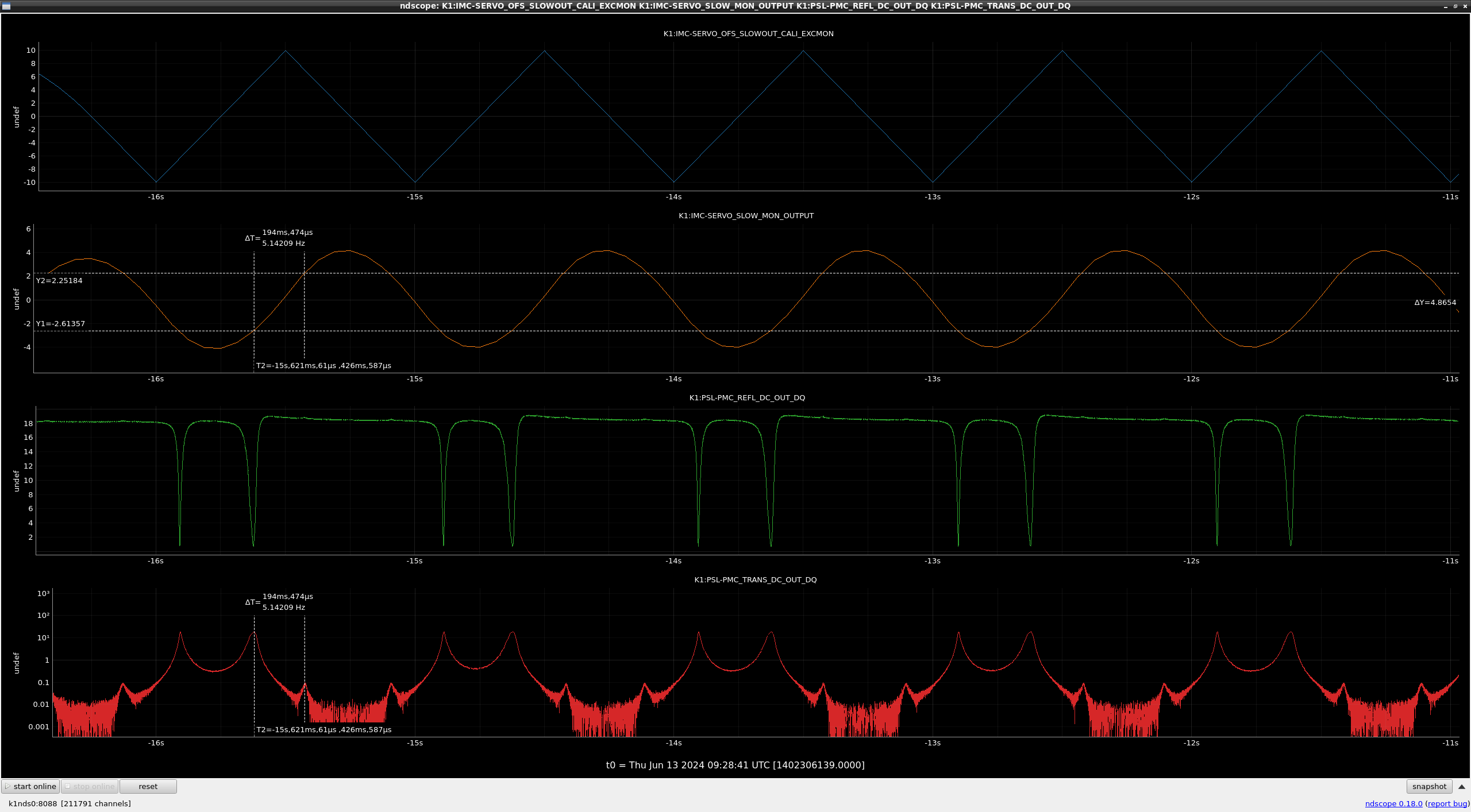
Actuator efficiency of NPRO PZT was estimated from the relationship between PMC resonance and applied voltage to PZT by injecting a triangular wave from the slow offset of IMC CMS in the unlock state of PMC.
The actual injection port was K1:IMC-SERVO_OFS_SLOWOUT_CALI_EXC, from which a 1Hz triangular wave with an amplitude of 10V@DAC was injected (see also the top panel of Fig.1). The 2nd top panel of Fig.1 shows the actual applied voltage to PZT, with the amplitude and waveform is different from the excitation channel on digital system due to the resistive voltage divider (R173, R177) and RC low-pass (R173, C269, C270) at the offset port. This measurement does not assume that excitation is done at constant velocity, so the dulling of the waveform is not a problem.
Bottom two panels of Fig.1 show the REFL and TRANS PD readout. Note that the vertical axis of the TRANS PD plot is logarithmic due to the visibility of sideband resonances. We estimated the actuator efficiency of PZT by using the applied voltage to PZT at the time of the carrier and sideband resonance on the PD readout.
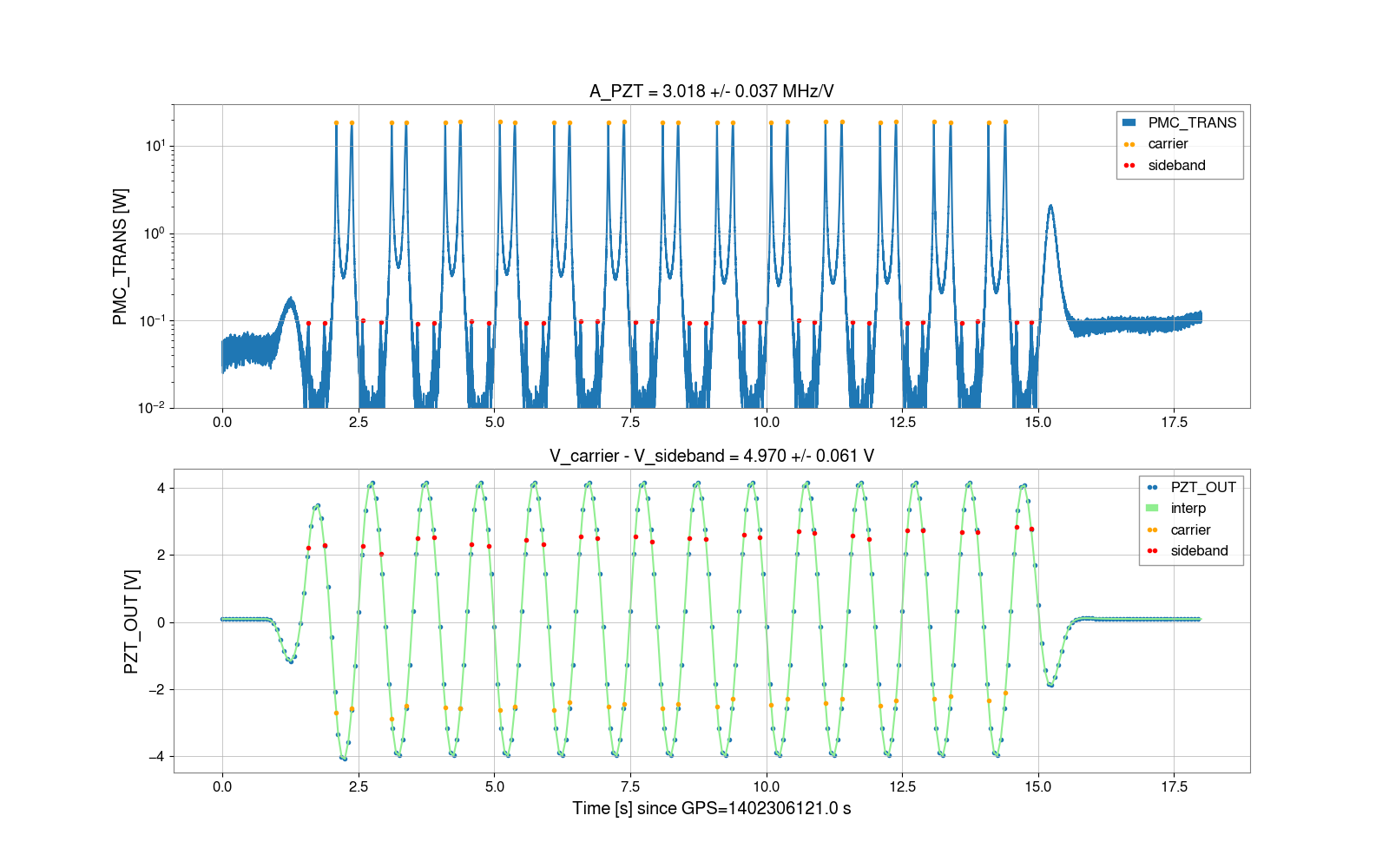
Detected carrier and sideband resonance are shown in the top panel of Fig.2. Though PD signal is DAQ-ed as 16kHz sampling, there is no fast channel at the downstream of the output offset port of CMS. So applied voltage to PZT at the timing of resonances was estimated by the interpolated signal of K1:IMC-SERVO_SLOW_MON_OUTPUT which was only DAQ-ed channels with 16Hz sampling at the downstream of the offset port. The averaged voltage difference at the time of adjacent carrier and sideband resonances was 4.970 +/- 0.061V. Using the PMC sideband frequency of 15 MHz, the PZT efficiency is derived to be 3.018+/-0.037MHz/V. This value is consistent with 3MHz/V in klog#13012. (Strictly speaking, the value in klog#13012 is 4.2*10^(17/20)=2.973... and it doesn't match by 1-sigma. On the other hand, considering the fact that only statistical errors were taken into account in our estimation and errors of the past measurement are unknown, it is probably okey to assume that two estimations are consistent each other.)
Kenta advised that we might want to make sure that sideband resonances we think are not higher-order mode resonances. We don't actually do such checks, so we should keep that in mind. It would be possible to see the the higher modes by shifting the PMC alignment and making the same measurement with the higher modes more likely to appear. But that would mean touching the picomotor at the input path of PMC. If we will do, we should discuss somewhere.