Miyoki, T. Yamamoto, Kimura(remote), Uchiyama(remote)
Slack sent emergency mail telling the vacuum pressure level in EX was over 10^-5 Pa. We found that the EX ref3 cryocooler was stopped around 18:40 on January 14th.
Miyoki-san and Yamamoto-sama came to Kamioka to see the ref3 cryocooler at around 23:45 on January 14th.
They found the oil level of the ref3 was too low and could not restart.
They closed the water valves for ref3 and started ref2 and ref4 to keep the temperature in the cryostat.
They started two TMPs (#39 and #33) between EXC and EXA to keep the vacuum level. One ion pump (#33) between EXC and EXA was stopped.
Kimura-sama said that no increase in the partial pressure of H20 was observed.
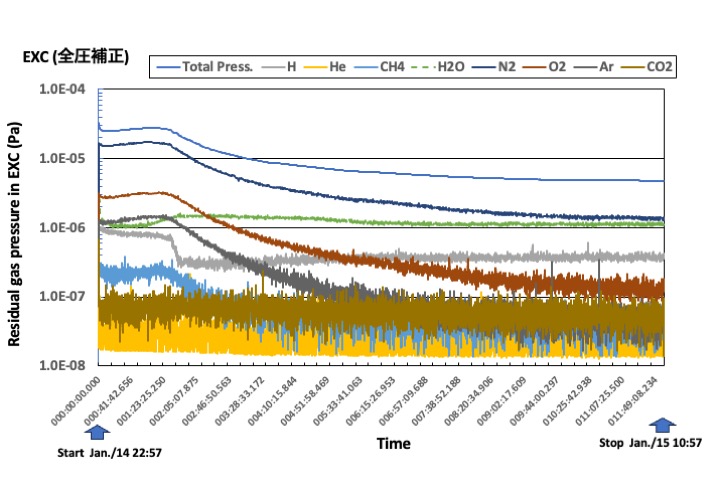
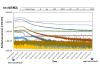
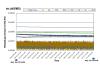
Attached are graphs of residual gas measurements between the time Ref 3 was stopped and the time Ref 2 and Ref 4 were started.
The measurements show that the main gas released during the period between starting Ref2 and Ref4 was N2.
It was observed that there was little change in the partial pressure of H2O.
[Kimura, M.Takahashi and Sawada]
We replaced the failed Ref 3 (P-55) compressor with a spare and restarted cooling of the inner radiation shield.
We conducted a simple inspection by irradiating a black light on the discharge side connection of the removed compressor and the connection piping.
As a result, luminescence indicating oil traces were observed at the gas contact area. Therefore, the connection piping and filter from Ref 2 (P-54) compressor were converted to Ref 3 (P-55).
The connecting piping and filter need to be newly replaced.
Currently, there are a total of five cryo-coolers in operation at EXC: two duct shielded cryo-coolers, Ref1 (P-53) for radiation shield, Ref3 (P-55)for radiation shield, and Ref4 (P-56) for payload.
[Kimura and M. Takahashi]
We turned off two turbo morecular pumps (#39 and #33) and turn on one ion pump (#33) at around 13:40.
Please confirm k-log (k-log 28275).
MN/TMOplev values changes are shown in the Fig.1. Although sudden drops were observed after the vacuum level increase due to the cryocoolers' accident, the long-term trend seemed to be recovered.
After the accidents, the vacuum level around EXC/EXA/TMSX showed a reduction compared to before, and the oplev reduction ratio might seemed to get smaller than before. Or it is just the effect of the heating up IM.