The transmission power of Xarm and Yarm in PRFPMI was unbalanced over.(klog24598)
I simulated to confirm the difference in transmission power between Yarm and Xarm in PRFPMI using GUI.
Preparation
Measured transmission and loss values for ITMs(Transmission: HR transmission, loss: HR scattering+HR absorption, p.32 Summary, T1809173) and ETMs(p.20, T1807981) were substituted.
ITMs-> Transmission: "HR transmission", loss: "HR scattering"+"HR absorption", p.32 Summary, T1809173
ETMs-> Transmission: "transmittance [ppm]", loss: "scattering ppm"+"absorption [ppm]", p.20 Summary, p.20, T1807981
| Refl(1-(Trans+Loss)) | Trans+Loss | |
| ITMX | 0.9955927 | 0.0044073 |
| ITMY | 0.9951921 | 0.0048079 |
| ETMX | 0.9999815 | 18.5e-6 |
| ETMY | 0.9999813 | 18.7e-6 |
The above values were modified to R (reflectance) and T (transmittance) of the mirrors in the finesse code.
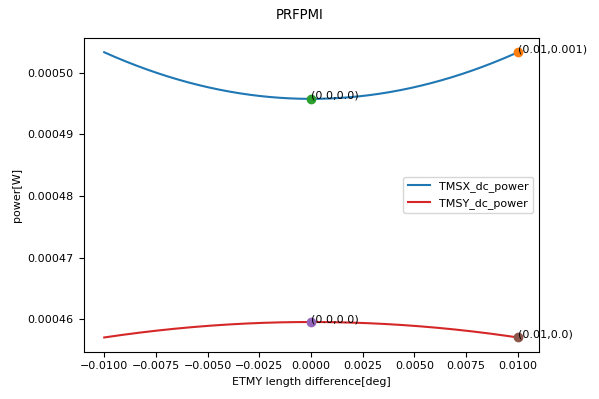
The simulation that change the length of the Yarm by sweeping the ETMY location.
(Result: Fig1, Code: ETMY_length_sweep_PRFPMI.txt)
- The shift in the resonance point of the Yarm increases the reflected power; the PRM increases the incident power to the Xarm, so the Xarm has gone up.
- Also, since the reflectance of the mirrors of Xarm and Yarm is different, the difference in finesse between them is 8 percent.
The difference in transmission power at the resonance point in the simulation results is theoretical.
Notes
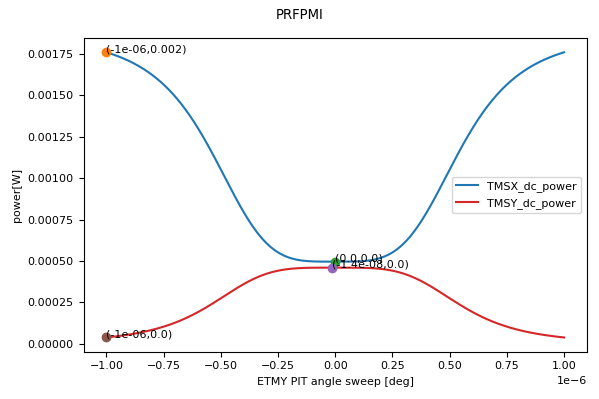
I tried to simulate that sweep ETMY angle in PRFPMI. (Result: Fig2, Code: ETMY_angle_sweep_PRFPMI.txt)
If I run the simulation as following the gui template, the horizontal axis is deg, maybe rad?