[Saito, Yokozawa, Smith, Komori, Fujimoto]
Abstract
We succeeded in reducing the OMC REFL intensity noise for PRX and PRY to a level comparable to that obtained in the SRY, by tuning the PRCL OLTF and suppressing the control noise.
As the next step, we plan to perform the PRX/PRY length measurements using the OLTF tuned in this work.
Details
In the SRY length measurement, we were able to reduce the main laser intensity noise observed with the OMC REFL PD by locking the OMC to the carrier and suppressing the control noise from the SRCL control. This significantly improved the SNR of the length measurement.
Therefore, as preparation for the next PRX/PRY length measurements, we tuned the PRCL OLTF so that the OMC REFL intensity noise for PRX and PRY becomes comparable to the level achieved in the SRY/SRX cases.
Tuning of the PRCL OLTF
First, we requested PRX_1F_LOCKED in the VERTEX guardian to lock PRX. At this point, excluding the simple gain filters, the filters used for the control were as follows, and no roll-off filter was applied:
- UGF20: z3p300, gain = 94.6
- DC8: 8 Hz integrator
We then created and applied the following filter in the PRCL1 filter bank:
- tmp260701:
- gain = 1.2
- z1p8 (to change the cutoff frequency of the 8 Hz integrator to 1 Hz)
- ELP80
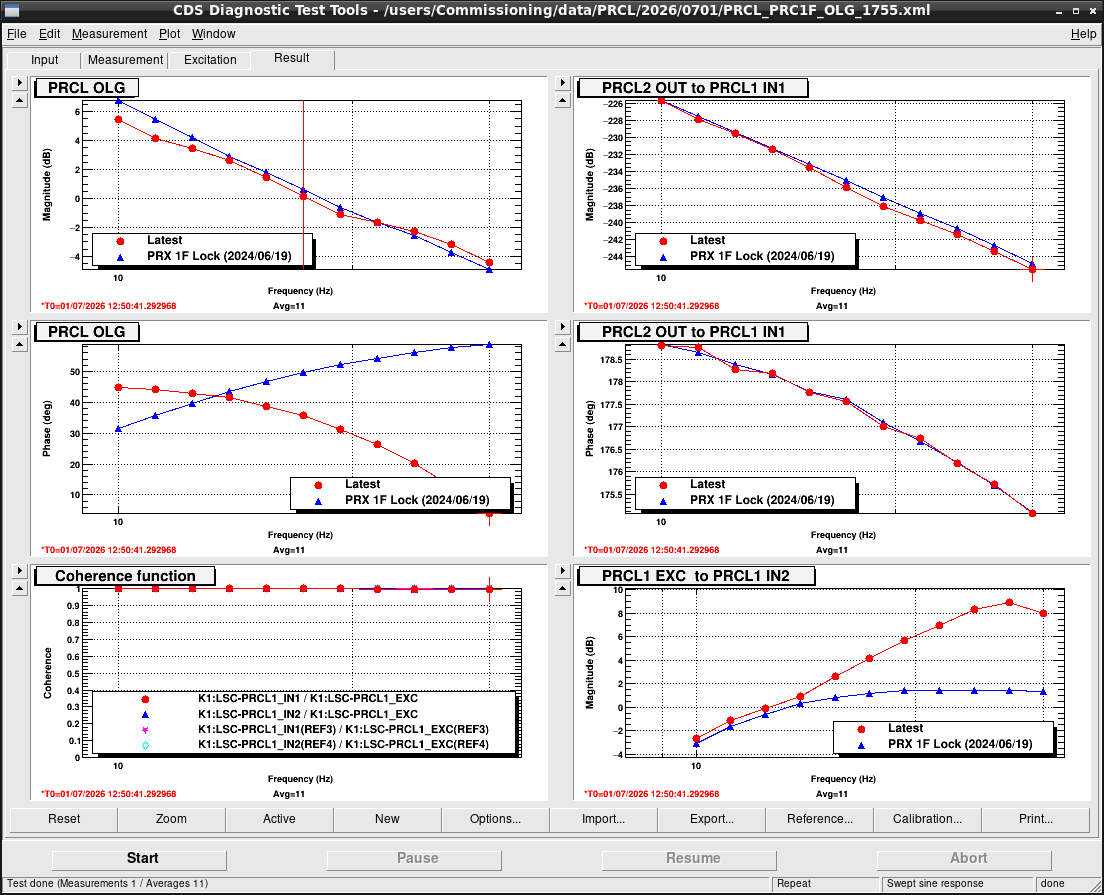
By adding tmp260701, the OLTF became UGF ~17 Hz, PM ~36 deg, roll-off at 80 Hz, and an integrator cutoff at 1 Hz, which is almost same as the one used for SRY.
The measured PRCL OLTF is shown in Fig. 1.
Measured OMC REFL intensity noise with PRX/PRY
Using the OLTF described above, we measured the main laser intensity noise with the OMC REFL PD.
During the measurement, the ISS was turned on, and the OMC control was operated with gain = 3 and dither amplitude =1000, which realizes UGF of 30 Hz.
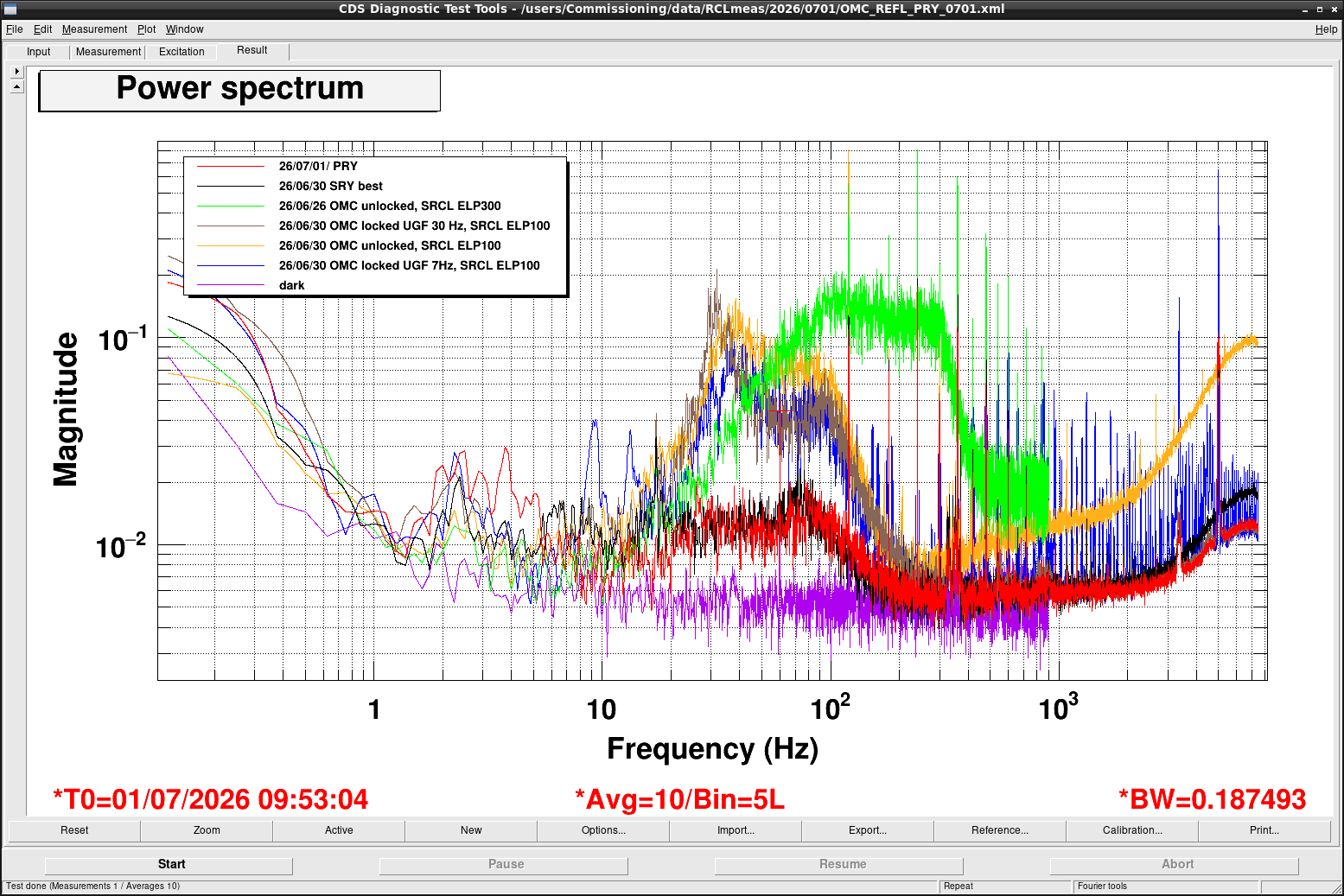
The red trace in Fig. 2 shows the intensity noise measured with the OMC REFL PD for PRX. It reaches a level comparable to the SRY intensity noise measured yesterday, shown by the black trace, above 10 Hz.
Fig. 3 shows the result for PRY. A similar noise level was also obtained in this case.
One point to note is the peak around 2–3 Hz. Since this peak was not observed in the SRY/SRX cases, it may be related to the motion of the Type-Bp suspensions. However, since its contribution to the RMS seems to be small, we decided to leave it as it is for now.
Plan for tomorrow
Tomorrow, we plan to perform the PRX/PRY length measurements using the OLTF tuned in this work.
However, since we have not resonated the auxiliary laser in PRX or PRY before, we will first check whether we can make the auxiliary laser resonate in the same way as in the SRY case, and whether we can lock the PLL.