[Ushiba, Smith, Saito]
We measured the upstream laser power, which had not been measured previously, and found that the transmission of the FI was approximately 86%, indicating that there was no unexplained laser power loss. The beam profile of the sub-laser itself was also measured and found to be clean. However, when the beam profile was measured after reflection from the beam sampler (R:T = 9:1), the beam shape became distorted. This suggests that the FI was causing the problem. Since the sub-laser beam diameter may be too large relative to the maximum allowable beam diameter of the FI, we plan to place a lens before the FI in the next measurement to reduce the beam diameter and investigate whether the beam profile improves after transmission through the FI.
-
First, we measured the upstream laser power, which had not been measured previously. The measurements were performed using a power meter with an OD = 2.0 ND filter. The results were as follows:
Immediately after the sub-laser output: 24 mW
Reflected by the PBS: 3 mW
Transmitted through the PBS: 21 mW
Before the FI: 21 mW
After the FI: 18 mW
After reflection from the beam sampler (R:T = 9:1): 16.6 mW
Before the BS: 16.5 mWTherefore, the transmission of the FI was approximately 86%, and there appears to be no significant laser power loss elsewhere in the optical path. In other words, clipping does not seem to be occurring.
-
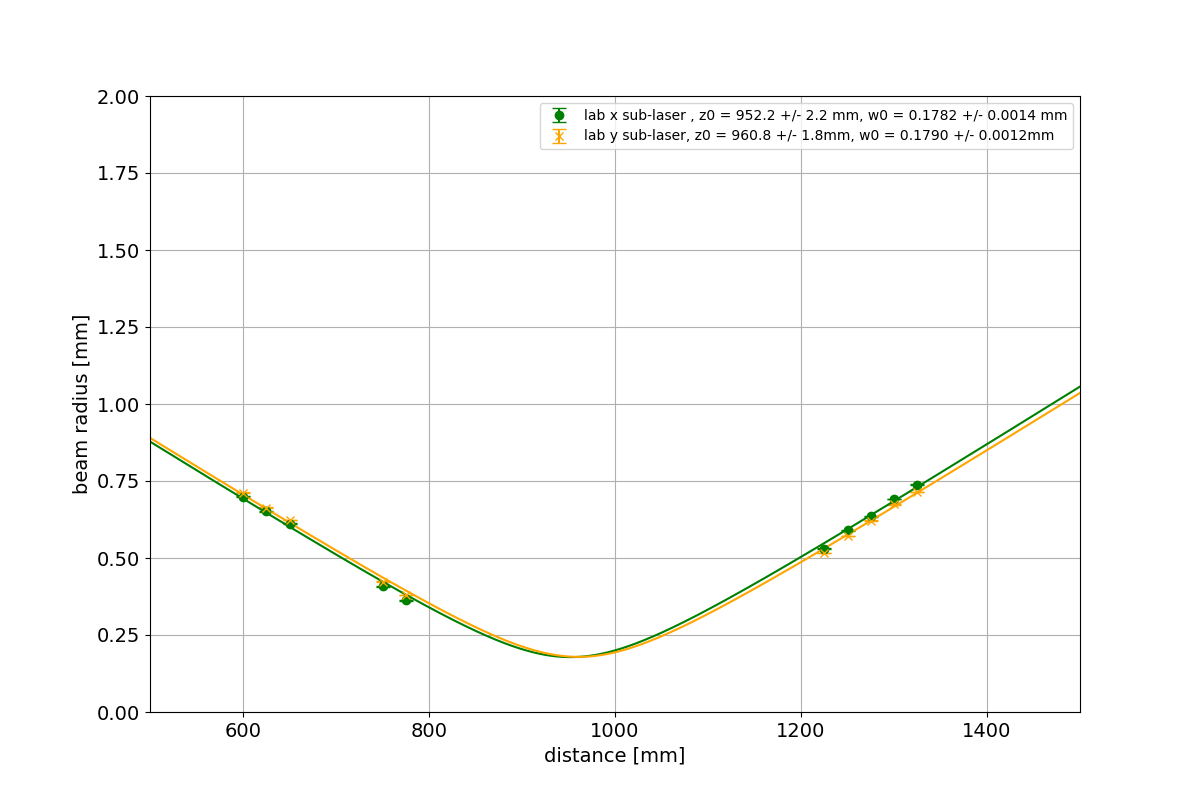
Next, we measured the beam profile near the beam waist using a beam profiler and observed a beam profile similar to that reported previously (klog:37065). To identify the source of the distortion, we first removed the HWP closest to the sub-laser and replaced it with a mirror, then measured the beam profile of the sub-laser itself (Fig. 1). The beam shape of the sub-laser appeared clean. Next, the mirror was replaced with the original HWP, and the beam profiler was placed after the reflection from the beam sampler (R:T = 9:1) to measure the beam profile (Fig. 2). In this case, the beam shape became distorted. We then removed the FI and measured the beam profile again, finding that the beam shape returned to a clean profile (Fig. 3). This indicates that the FI is likely responsible for the distortion. To investigate further, we measured the beam diameter at the FI input and output locations. The results were:
At the FI input:
x: 1.869 mm
y: 1.687 mmAt the FI output:
x: 2.075 mm
y: 2.121 mmThe maximum beam diameter specified for the FI (IO-3-1064-HP) is 2.7 mm, suggesting that the beam diameter may be too large for proper operation. In the next measurement, we plan to install a lens before the FI to reduce the beam diameter and determine whether the beam profile becomes cleaner after passing through the FI.