Reports 1-1 of 1 Clear search Modify search
VIS (PR3)
dan.chen - 16:38 Wednesday 25 February 2026 (36437) Print this report
Investigation of Large PR3 Motion Observed

[Kenta Tanaka, Dan Chen]

Before starting ASC work, the IFO failed to achieve stable lock.
Since PR3 appeared to be flactuated, we requested LSC_LOCK down and examined the behavior of PR3.

We confirmed that large and continuous oscillations occasionally occurred. The motion was observed in both P and Y directions. In some cases, the oscillations lasted for several minutes and then naturally subsided, but after some time they reappeared, repeating this behavior intermittently.

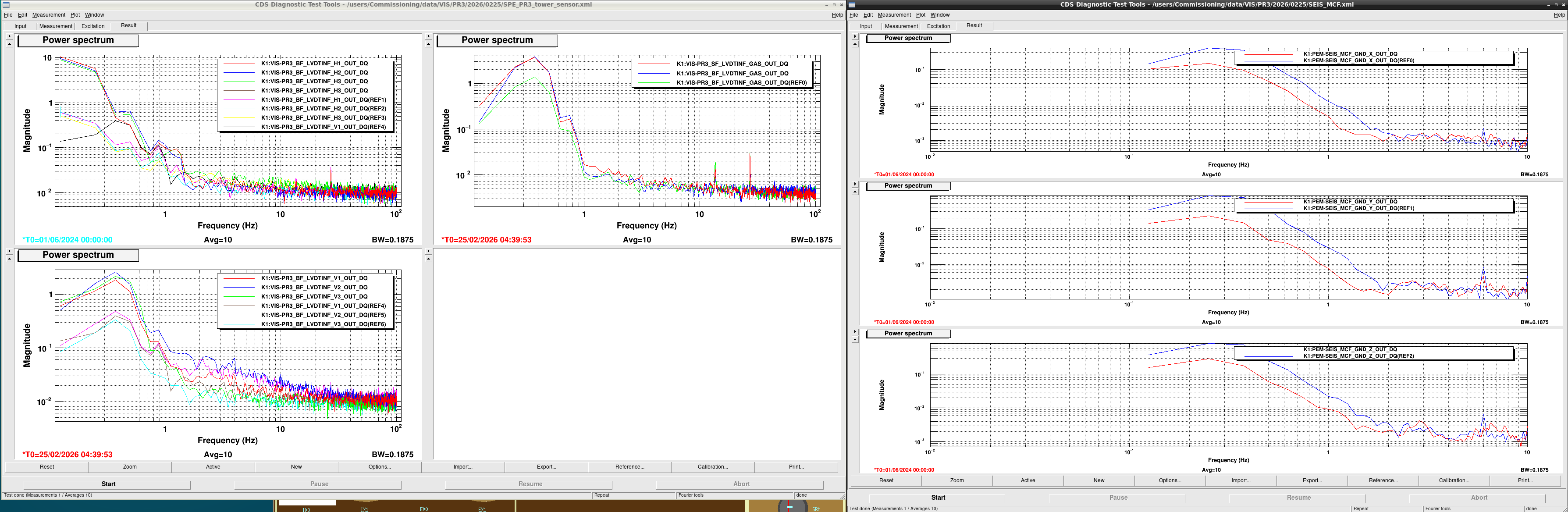
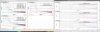
To investigate environmental vibrations around PR3, we checked the WIT sensor and accelerometer data at MCF and compared them with data taken during the health check on 2024/06/01. The comparison result files are saved at (figures attached. Refs in the fig are the data in thew past):

/users/Commissioning/data/VIS/PR3/2026/0225/

The comparison shows that the ground vibration level today is higher than that on 2024/06/01. However, since the observed PR3 motion appears and disappears intermittently, the relationship between the increased ground vibration and the PR3 motion remains unclear at this time.

Although the frequency of the large motion has decreased, it has not completely disappeared as of 16:00. The cause of the intermittent increase and decrease in the motion has not yet been identified.
Images attached to this report
Comments to this report:
kenta.tanaka - 0:52 Thursday 26 February 2026 (36443) Print this report

Fig.1 shows the time series of the oplev signals in the optical path from IMMT2 to X-arm when PR3 was glitchy. Glitch size seems to be 1.9 urad in P, 0.97 urad in Y, respectively. These sizes are much larger than the usual RMS.

Even though the glitch was occuring, HANDOVER from ALS to IR seems to be fine (but not easy). However, the fluctuation of POP90 was terrible. Fig.2 show the timeseries including to POP90, PRC and MICH error/feedback. Between the cursors, there seems to be no glitch in PR3 oplev. in the out of this region, POP90 dropped to the less than half of the maxlmun.

Images attached to this comment
dan.chen - 16:35 Thursday 26 February 2026 (36449) Print this report

[Kenta Tanaka, Dan Chen]

Follow-up Investigation of PR3 Glitches (2026/02/26)

Following the previous report on intermittent large motion of PR3, we performed an additional investigation today during a period when the interferometer was unavailable due to an earthquake.

Summary

  • We investigated the PR3 glitches, but the root cause has not been identified.
  • We suspected possible origins related to the oplev sensors and/or the oplev laser source; however, we found no evidence supporting these hypotheses.

Time-Series Observation

From the time-series data, the glitches appear to be correlated between the TM P and Y directions.

PR3 TM P and Y glitch correlation (overview)

In the figure below, the red circles indicate periods where glitches are present, while the blue circles indicate quieter periods.

PR3 TM P and Y glitch correlation (annotated)

Oplev QPD Signals

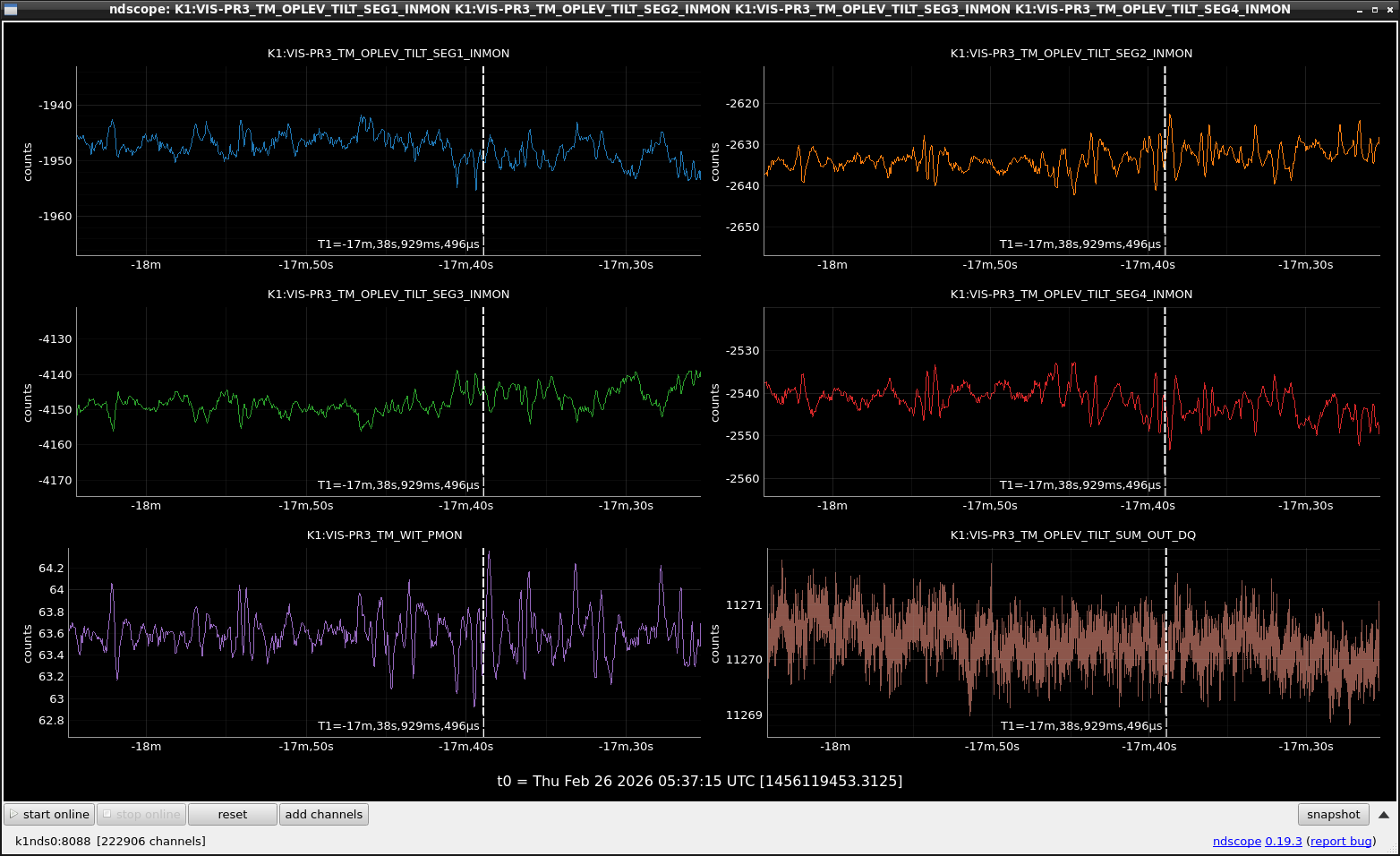
We examined the QPD segment signals:

PR3 TM oplev QPD segment signals

The glitches are visible in all four QPD segments and appear consistent across them. No abnormal behavior is observed in any single segment. Since the glitches do not appear in the SUM signal, they are unlikely to originate from the oplev laser source.

Spectral Comparison (PAY_FLOAT)

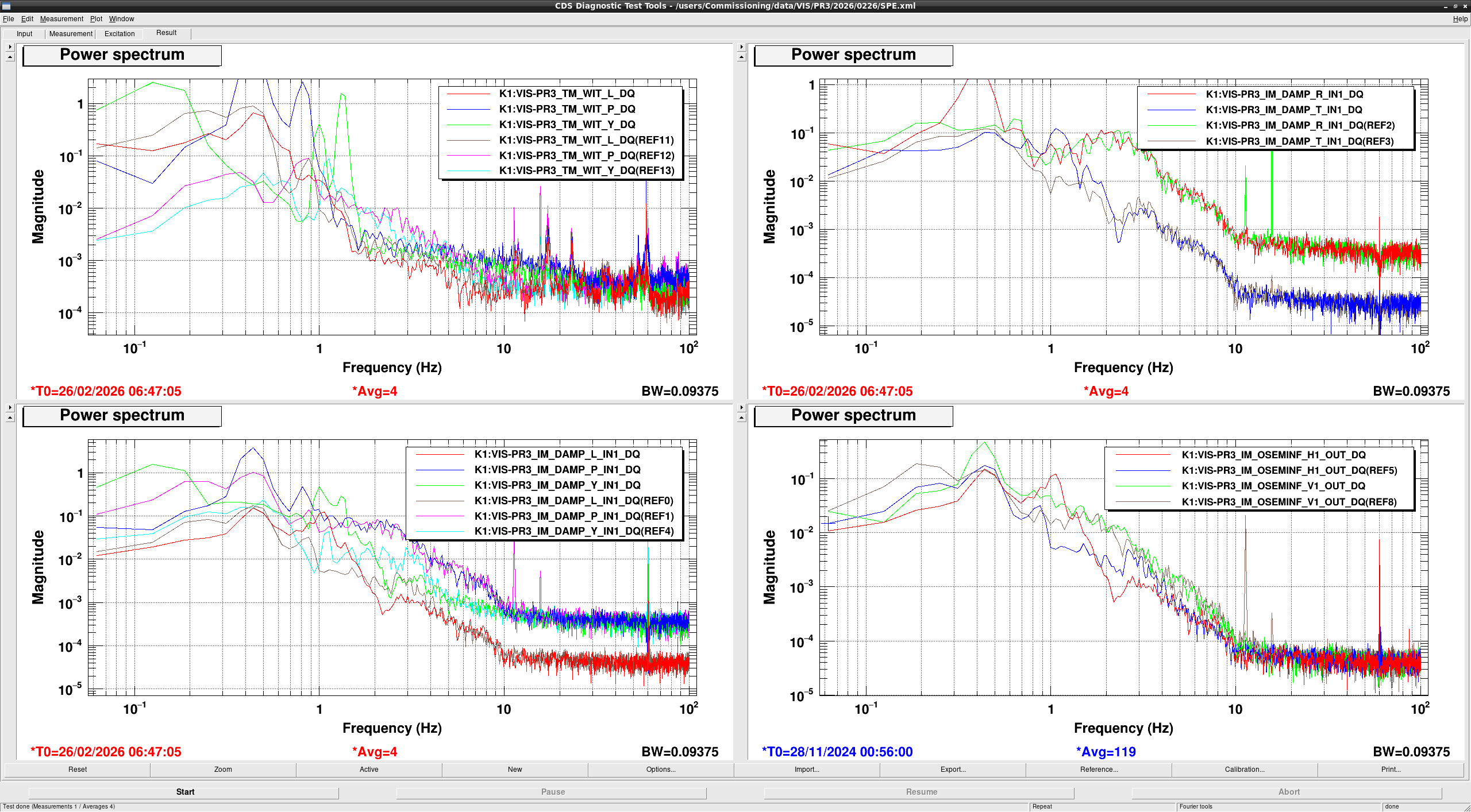
We compared the spectrum in PAY_FLOAT with data taken during a previously quiet period(2024/11/28):

PR3 spectrum comparison (PAY_FLOAT)

  • No significant spectral differences were observed compared to the earlier quiet dataset.
  • Although the previous dataset appears to have had the loop manually closed, the high-frequency region should still be comparable.
  • Note: during the present measurement the system was in PAY_FLOAT, so it is unclear whether glitches were actively occurring at that time.

Current Status

Despite these investigations, no clear cause of the PR3 glitches has been identified. The spectral shape is largely unchanged compared to the earlier quiet period, and the QPD behavior does not indicate a sensor- or laser-origin issue.

Images attached to this comment
Search Help
×

Warning

×