with takafumi.ushiba, takaaki.yokozawa, hirose.chiaki
Summary
We checked the effect of the SRCL resonant-gain (resG) filters at the ADS frequencies and measured the coupling from the LSC length error signals to AS RF34 and POP RF90. The SRCL resG filters suppressed the injected peaks in the RF signals. For MICH, no resG filter is currently used.
Measurement
The interferometer was brought to ALIGNING_DRMI. The IMMT2 and PRM ADS loops were kept on, while the BS and SRM ADS loops and the SRM BPC loop were off. The BS/SRM ADS CLK_GAINs were set to zero to avoid angular excitation from the ADS itself.
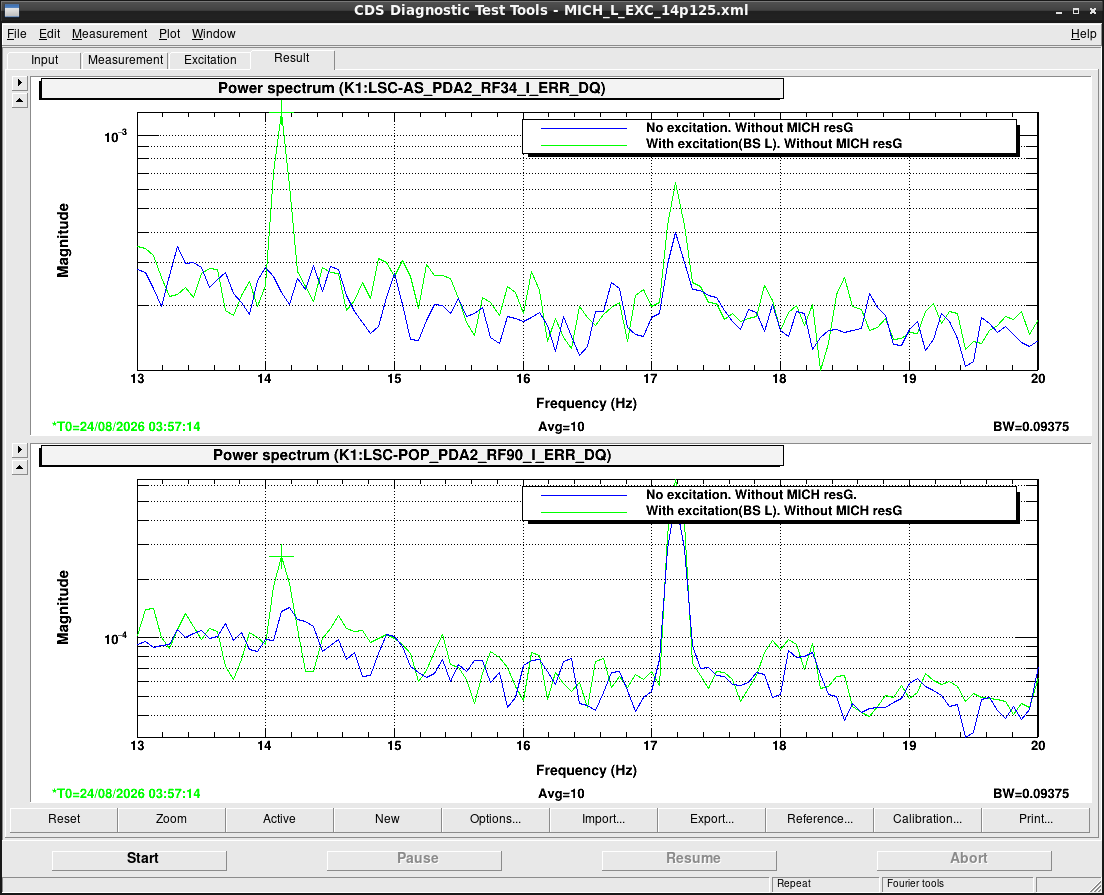
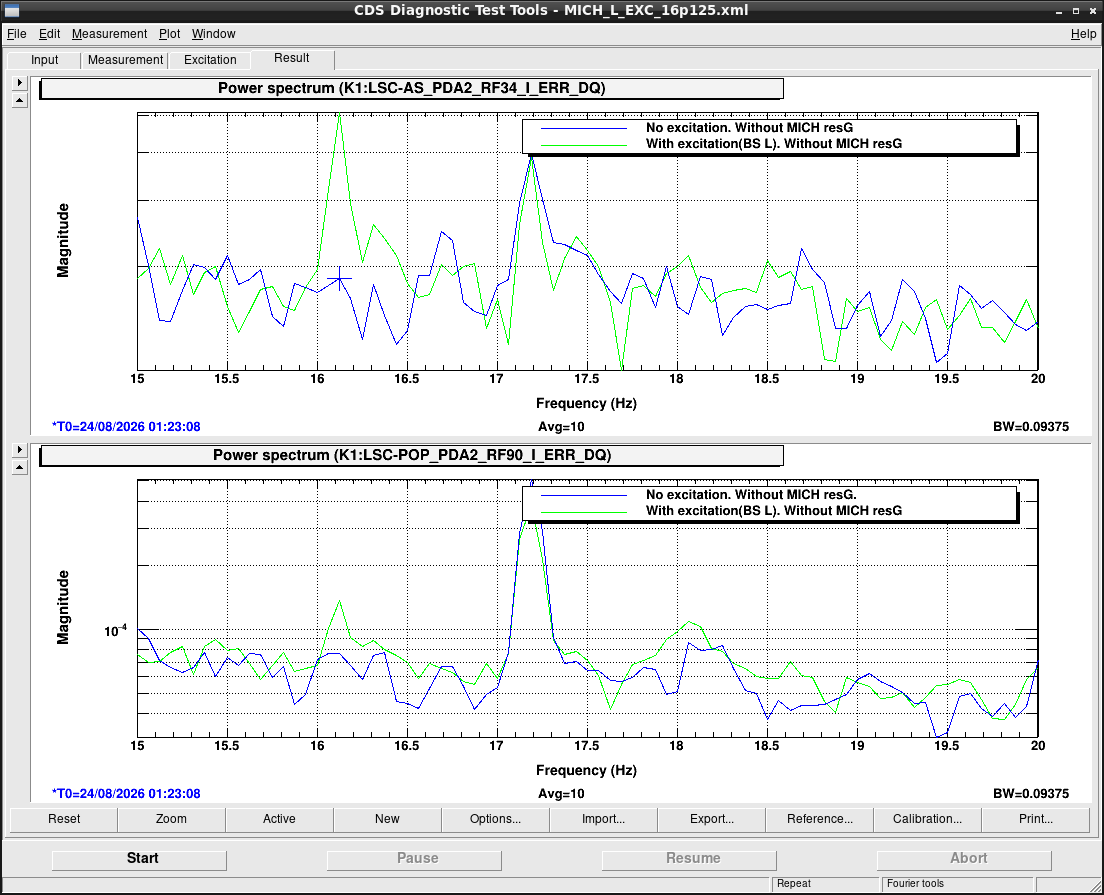
For the SRCL measurements, longitudinal excitation was applied to the SRM TM TEST L at 22.125 Hz and 24.125 Hz. For the MICH measurements, longitudinal excitation was applied to the BS TM TEST L at 14.125 Hz and 16.125 Hz.
Date directory: /users/Commissioning/data/DRMI/2026/0824
SRCL resG check
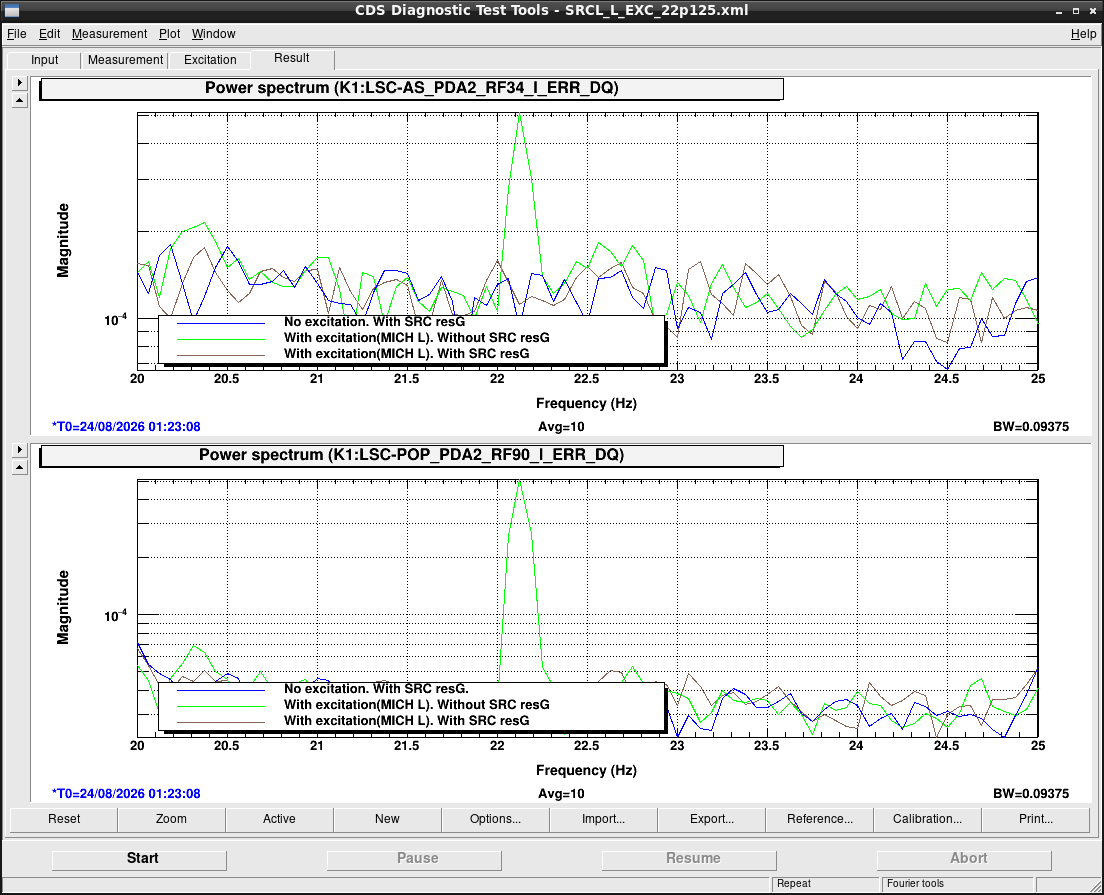
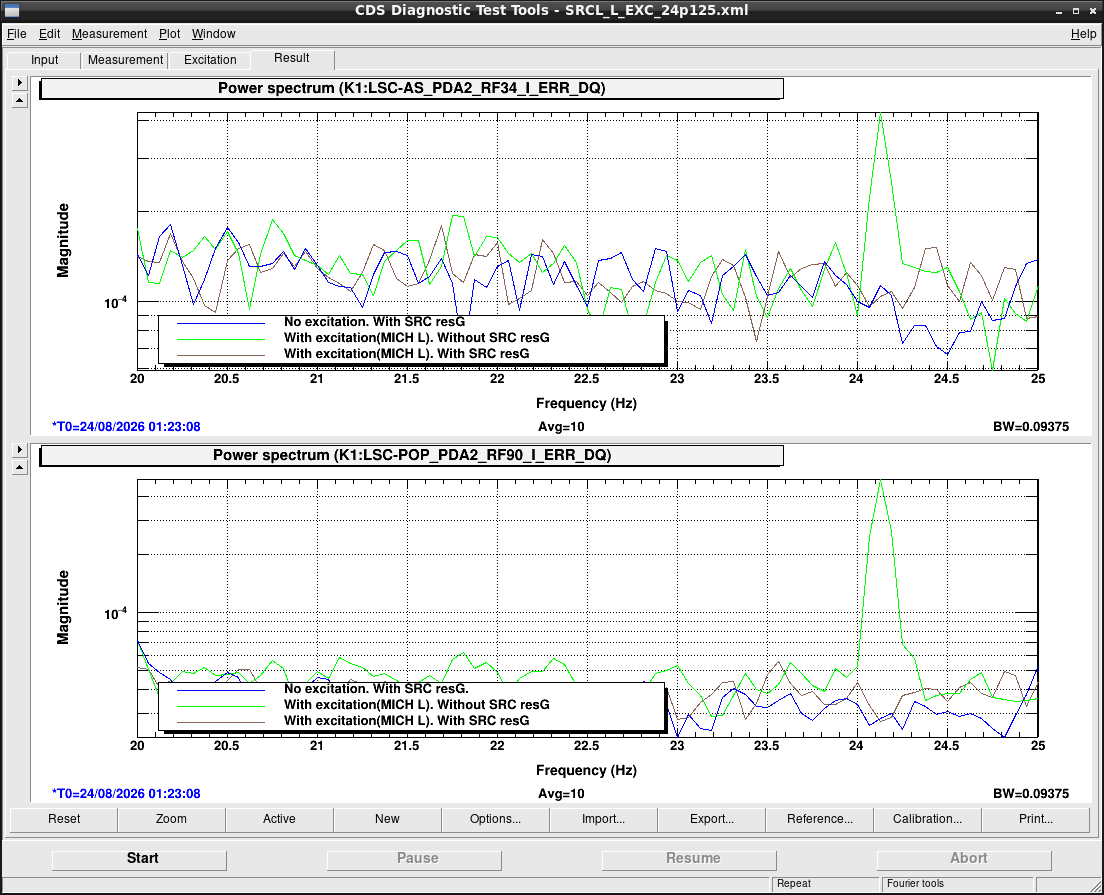
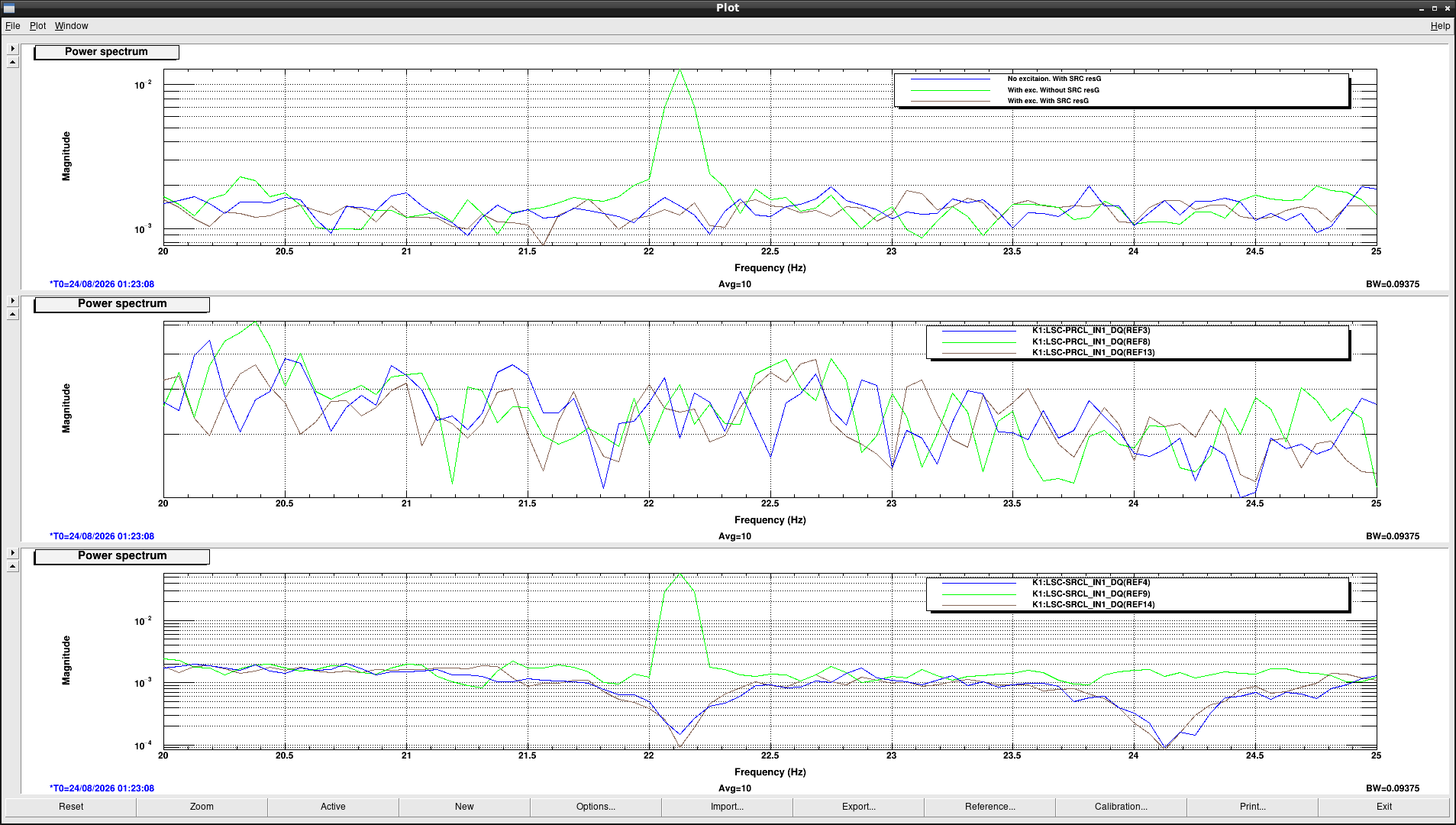
At both 22.125 Hz and 24.125 Hz, the excitation peaks seen in AS RF34 and POP RF90 were strongly suppressed when the SRCL resG filter was enabled.
Figures: SRCL_22p125.png, SRCL_24p125.png
Length-signal spectra: SRCL_peak_22p125.png, SRCL_peak_24p125.png
MICH measurement
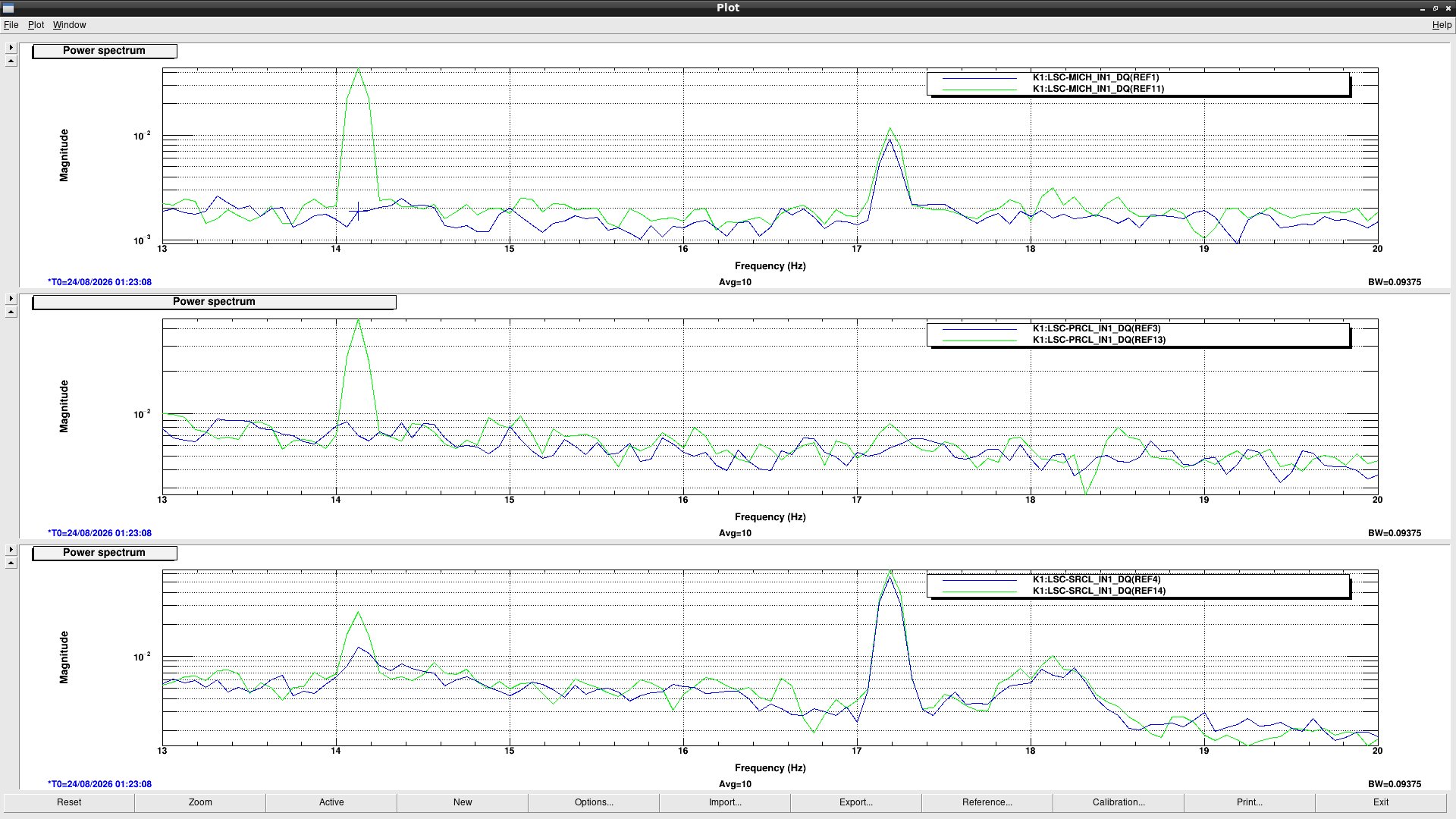
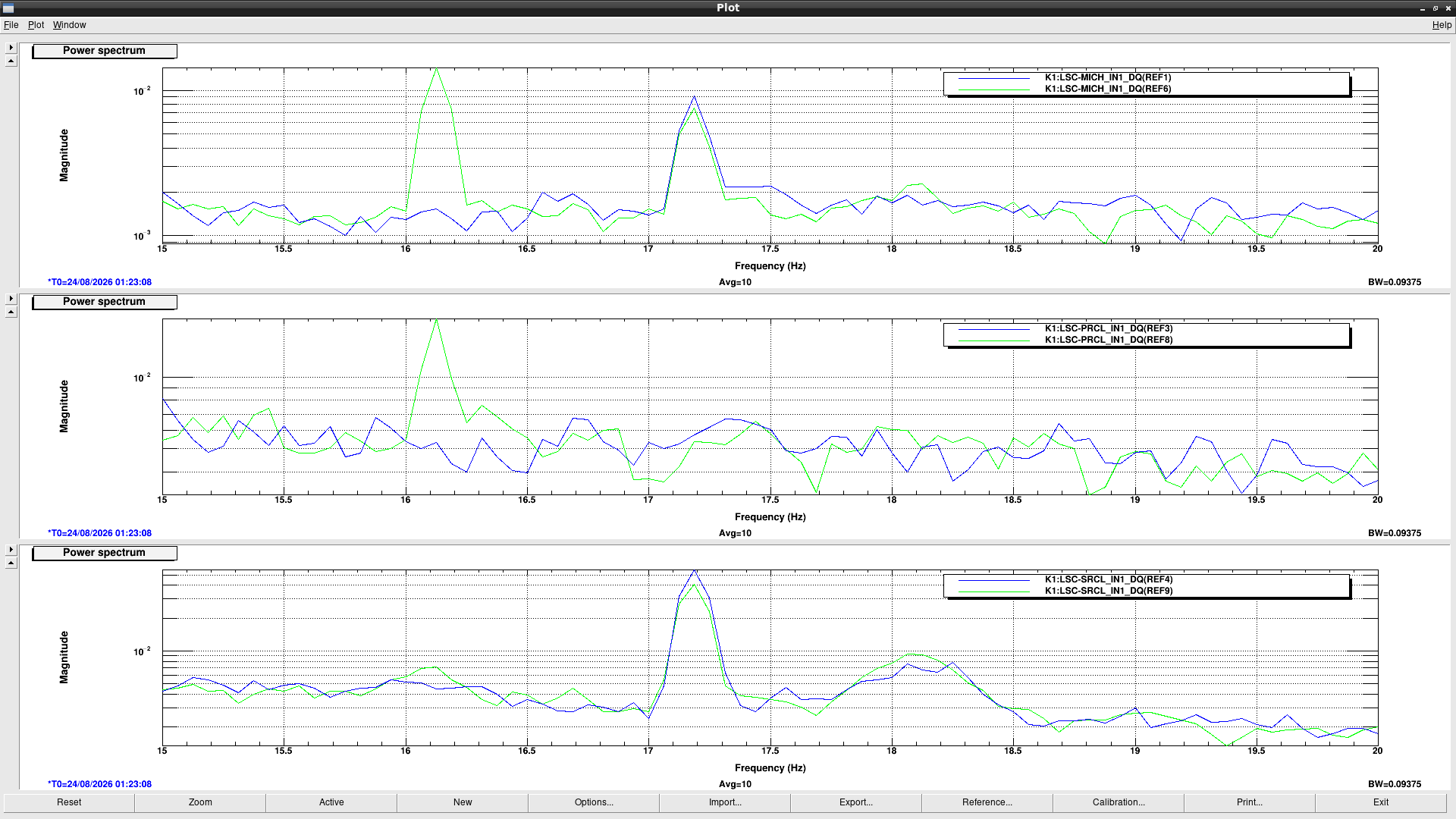
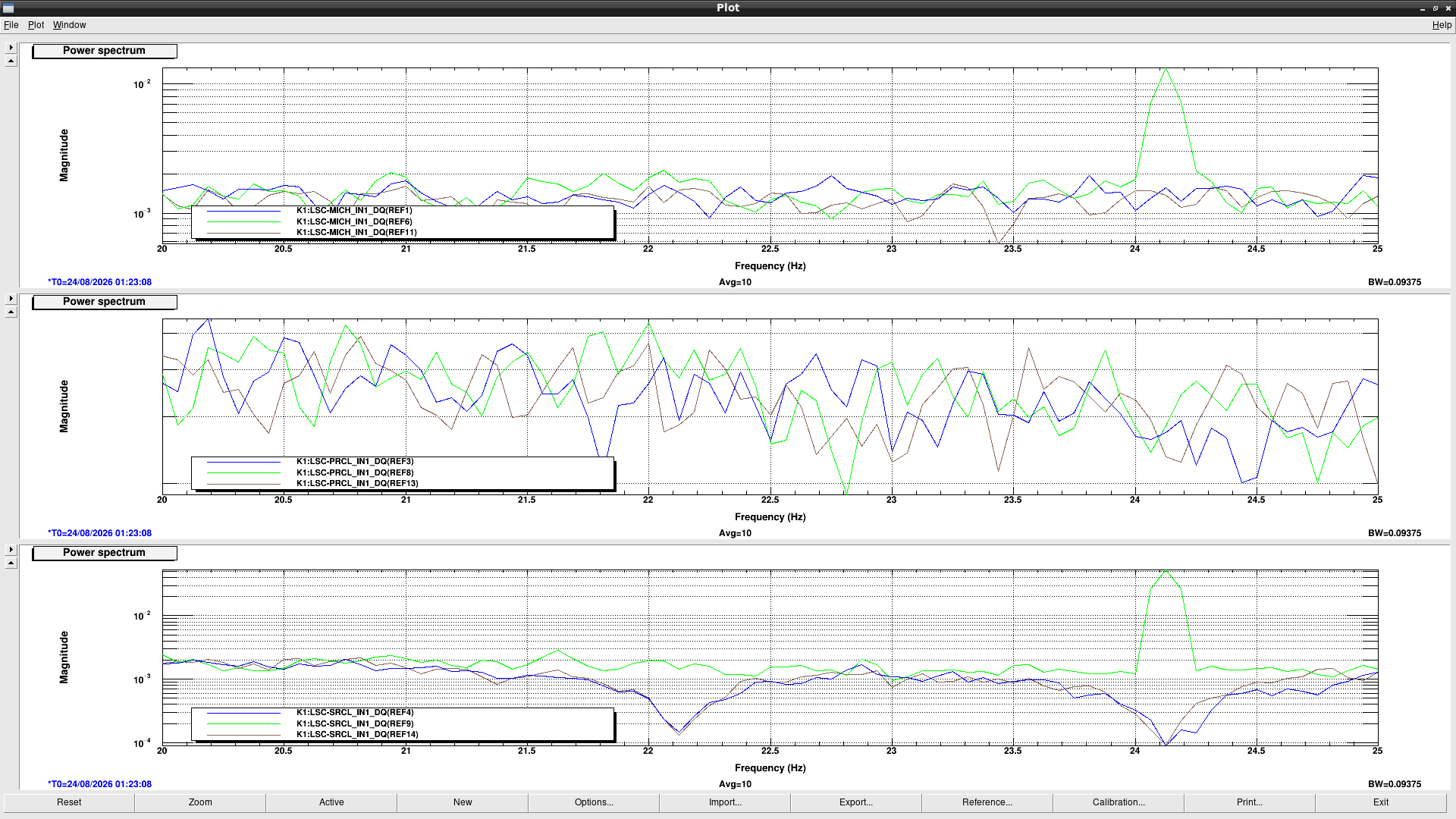
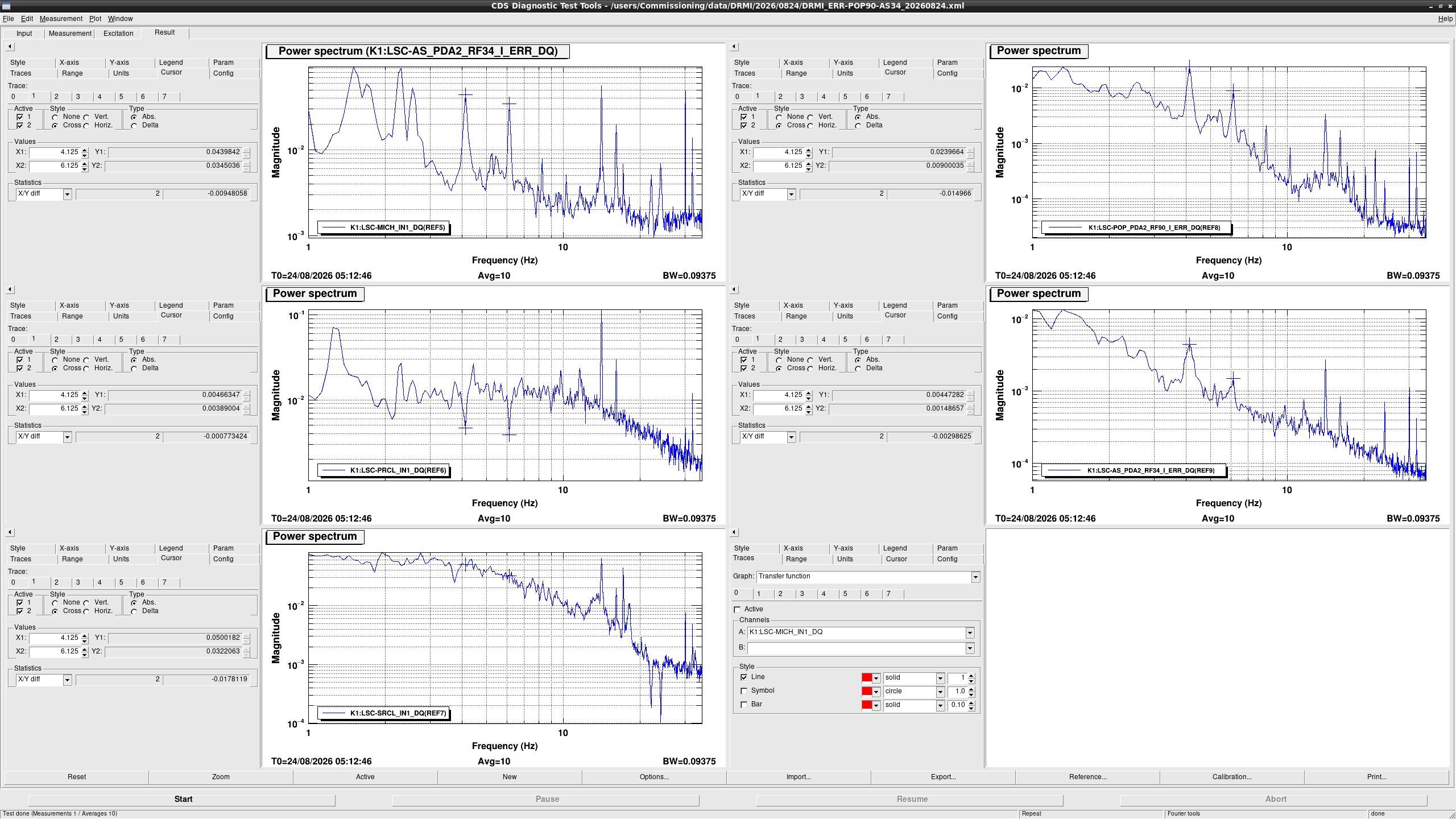
MICH currently has no resG filter at these ADS frequencies, so the spectra were measured without resG. Clear excitation peaks were observed in the MICH length signal and in the RF signals.
Figures: MICH_14p125.png, MICH_16p125.png
Length-signal spectra: MICH_peak_14p125.png, MICH_peak_16p125.png
L-to-AS34/POP90 coupling
Using the measured LSC length-error amplitude and the corresponding RF peak amplitude, we estimated the conversion from the measured MICH/SRCL length error to AS RF34 and POP RF90.
| Excitation | LSC error [nm/rtHz] | RF34 [cnt/rtHz] | RF34 / L [cnt/nm] | RF90 [cnt/rtHz] | RF90 / L [cnt/nm] |
|---|---|---|---|---|---|
| MICH 14.125 Hz | 0.04416 | 0.001238 | 0.02803 | 0.0002600 | 0.005887 |
| MICH 16.125 Hz | 0.01430 | 0.0005095 | 0.03563 | 0.0001368 | 0.009564 |
| SRCL 22.125 Hz | 0.05841 | 0.0005105 | 0.008741 | 0.0005092 | 0.008719 |
| SRCL 24.125 Hz | 0.05326 | 0.0004240 | 0.007960 | 0.0004863 | 0.009131 |
These measurements will be used for evaluating how longitudinal motion excited by ADS can couple back into the angular control signals.