[Takano, Tanaka, Fujimoto, Saito]
The beam profiles of the main laser beam and the sub-laser beam incident on the RFPD were measured and fitted. The resulting mode-matching ratio was approximately 5%.
-
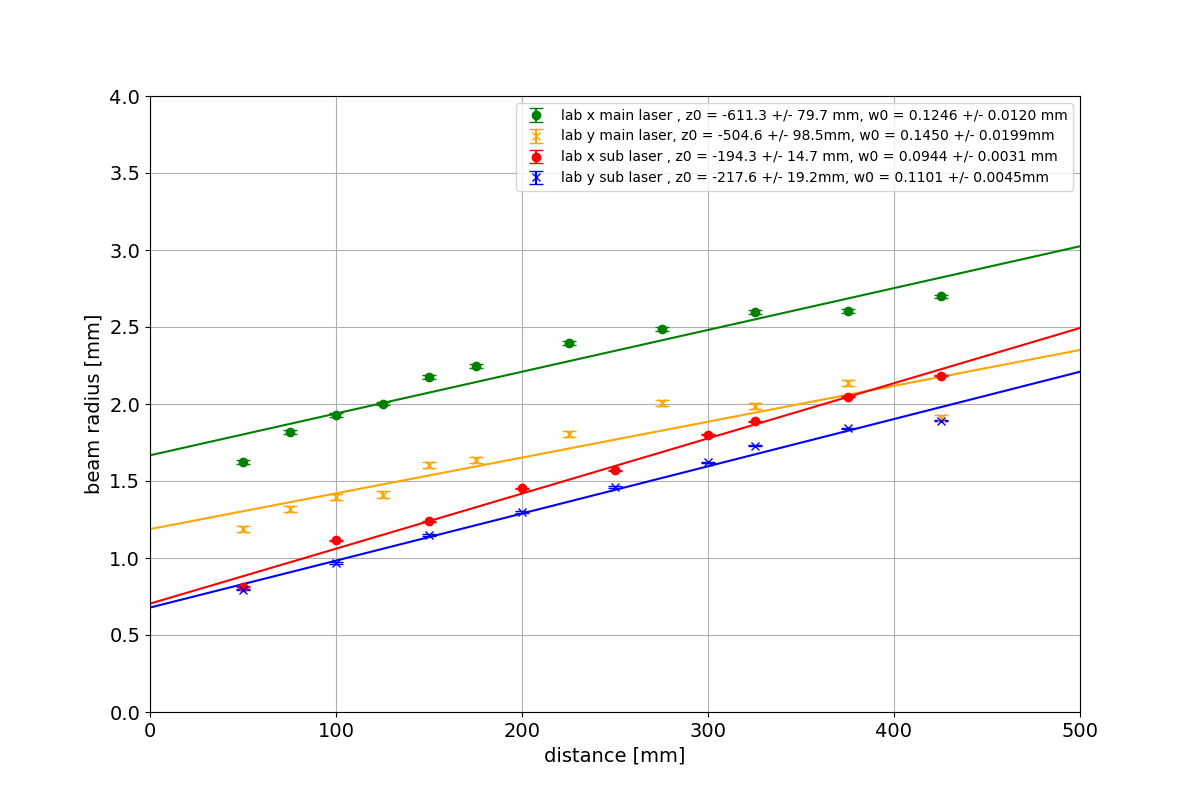
The RFPD and the 50 mm focal-length lens placed immediately before it were removed. The beam profiles of both the main laser beam and the sub-laser beam were then measured downstream of the beam sampler where the two beams are combined. The fitting results are shown in Figure 1. The green and orange curves represent the fitting results for the main laser beam, while the red and blue curves represent those for the sub-laser beam. The origin of the coordinate system is defined at the beam sampler where the two beams are combined.
The waist positions and waist radii obtained from the fitting are summarized below.
Main Laser
x-direction: Waist position = -611.3 ± 79.7 mm, Waist radius = 0.1246 ± 0.0120 mm
y-direction: Waist position = -504.6 ± 98.5 mm, Waist radius = 0.1450 ± 0.0199 mm
→ Average: Waist position = -558.0 mm, Waist radius = 0.1348 mmSub-Laser
x-direction: Waist position = -194.3 ± 14.7 mm, Waist radius = 0.0944 ± 0.0031 mm
y-direction: Waist position = -217.6 ± 19.2 mm, Waist radius = 0.1101 ± 0.0045 mm
→ Average: Waist position = -206.0 mm, Waist radius = 0.1023 mmThe mode-matching ratio between the two beams is given by 4×R_1×R_2/((Z_1-Z_2)^2+(R_1+R_2)^2), where Z_x and R_x (x=1,2) are the waist position and Rayleigh range of each beam, respectively. Using the average waist positions and waist radii obtained from the fitting, the mode-matching ratio was calculated to be approximately 5%.