[Tanaka, Fujimoto, Saito, Dan]
Summary
We checked the SRM OPLEV QPD signals after yesterday's centering work. The OPLEV beam was incident on both the TILT and LEN QPDs, but the environmental light and IR contribution were relatively large. We installed an IR filter also in front of the LEN QPD, centered both QPDs, and confirmed that the LEN OPLEV mainly responds to SRM longitudinal motion.
What we did
We first checked whether the OPLEV beam was incident on the QPDs. The environmental light level was large, so we reduced it as much as possible during the measurements.
For the TILT QPD, the sum signal was about 90 counts with the OPLEV beam and about 10 counts when the beam was blocked. Removing the IR filter increased the sum from about 90 to 230 counts, corresponding to an attenuation factor of about 2.6.
For the LEN QPD, no IR filter was installed at first. The sum signal was about 317 counts with the OPLEV beam and about 307 counts when the beam shutter was closed. After inserting an IR filter, the sum decreased to about 130 counts, corresponding to an attenuation factor of about 2.4. Opening the green shutter did not significantly change either QPD signal.
These checks showed that the OPLEV beam was already incident on both QPDs, but the IR contribution was non-negligible. Therefore, we decided to install/keep IR filters in front of both the TILT and LEN QPDs.
IR filter installation and QPD centering
We installed an IR filter in front of the LEN QPD using a right-angle clamp because of the limited space around the QPD.
After reducing the environmental light, with the OPLEV beam on, the IR shutter closed, (and the green shutter open,) the final sum values were:
- TILT sum: 90.5 counts
- LEN sum: 130 counts
We then centered both QPDs using the micrometer stages while monitoring the QPD signals.
LEN OPLEV response check
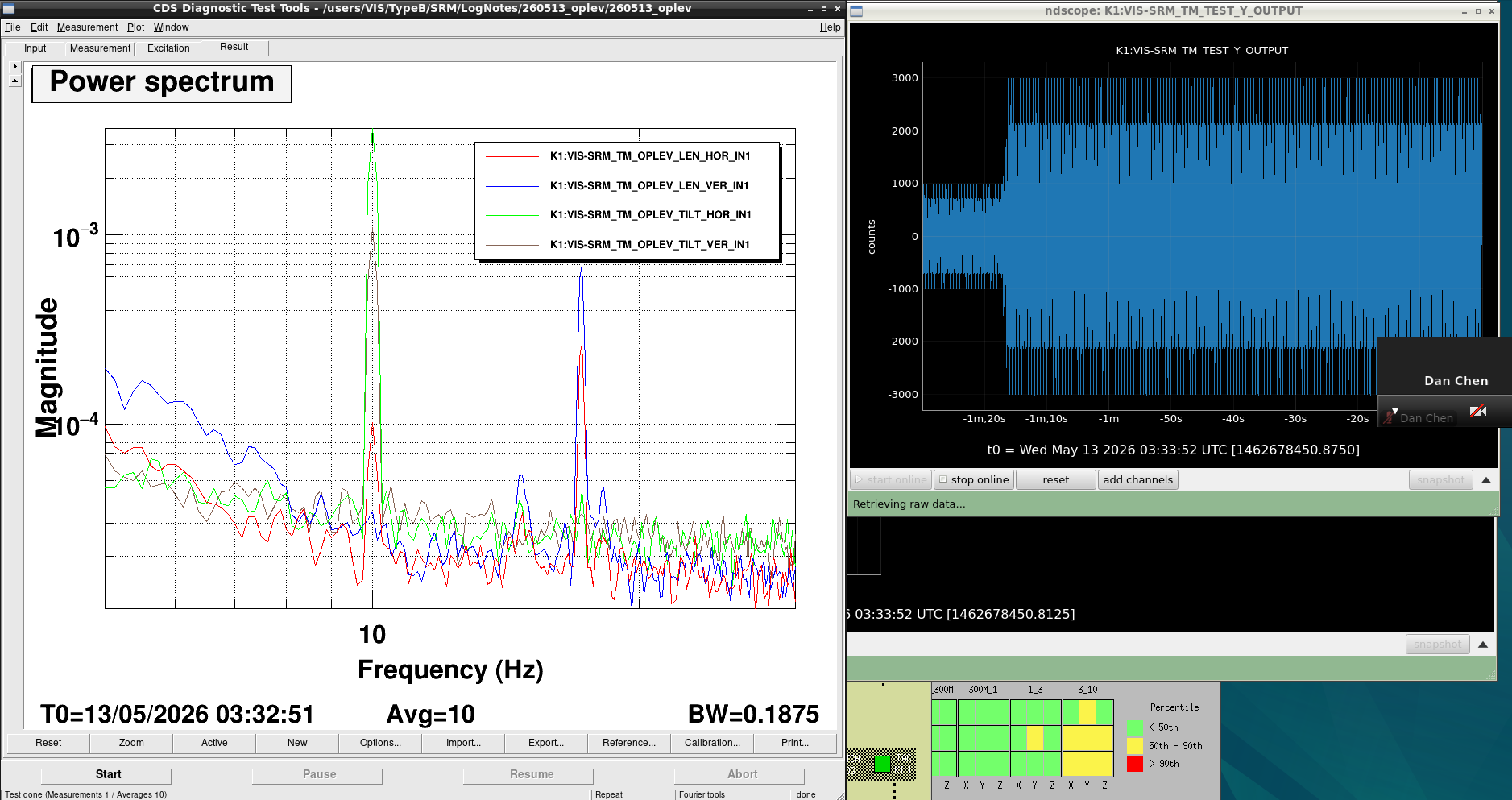
Finally, we excited the SRM in longitudinal and yaw at 10 Hz and checked the LEN OPLEV response. (Attached)
When the SRM was excited in the longitudinal direction, the response appeared in the LEN OPLEV signal. When the SRM was excited in yaw, the response clearly appeared in the TILT OPLEV signal. Therefore, we judged that the present oplev position is acceptable.
Files: `/users/VIS/TypeB/SRM/LogNotes/260513_oplev/`