[Kimura, Yasui and H. Sawada]
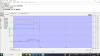
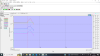
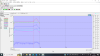
This document records the vacuum evacuation of the SRM and the opening of the gate valve between the SRM and SR2.
[SRM Vacuum Evacuation]
Vacuum pressure inside the SRM and valve operations
2026/4/14
13:09 9. 8 x 10^4 Pa
13:12 Dry Pump Turned ON, Angle valve opening: 270 degrees
13:23 9.6 x 10^4 Pa
13:31 9.6 x 10^4 Pa -----> Angle valve opening: 90 degrees + 360 degrees
13:40 7.8 x 10^4 Pa
13:50 5.0 x 10^4 Pa
14:00 2.9 x 10^4 Pa
14:11 1.5 x 10^4 Pa
14:13 9.3 x 10^3 Pa
14:20 Angle valve opening: Fully open
14:30 4.5 x 10^3 Pa
14:40 2.3 x 10^3 Pa
14:50 1.3 x 10^3 Pa
15:00 6.8 x 10^2 Pa
15:10 4.1 x 10^2 Pa
15:20 2.7 x 10^2 Pa
15:30 1.9 x 10^2 Pa
15:50 1.1 x 10^2 Pa
16:00 8.8 x 10^1 Pa
16:10 7.5 x 10^1 Pa
2026/4/15
9:35 1.9 Pa [OMMT 1.1 Pa]
9:32? GVommt Open ---> 2.1 Pa [OMMT 7.1 x 10^-1 Pa]
9:44 TMP Turned ON
9:54 9.4 x 10^-3 Pa [TMP in Normal Operation]
10:15 1.8 x 10^-3 Pa
10:32 1.3 x 10^-3 Pa
10:50 1.1 x 10^-3 Pa
11:13 9.7 x 10^-4 Pa
12:11 7.8 x 10^-4 Pa
2026/4/16
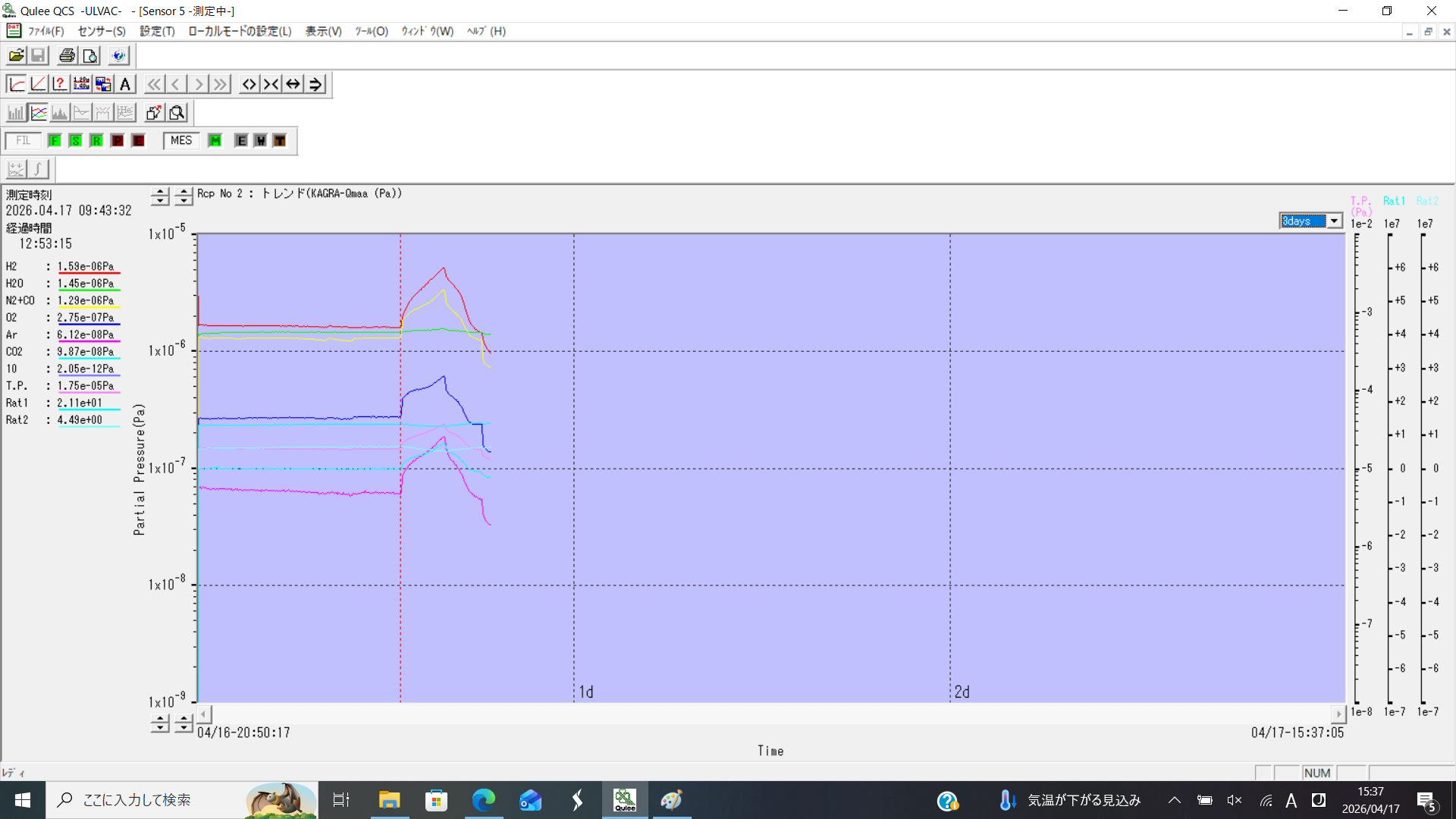
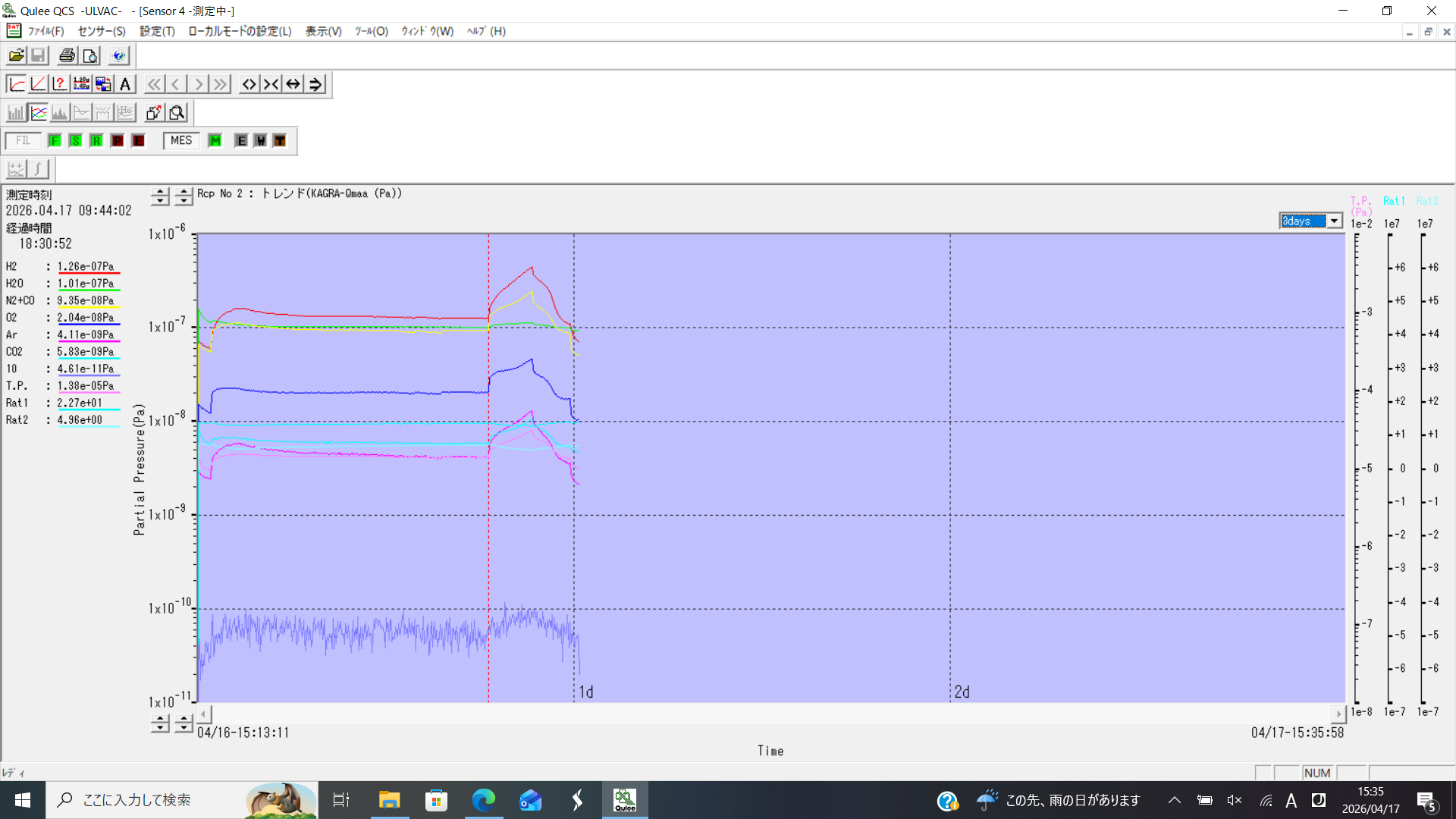
16:00 GVsrm Open
[About ion pump operation]
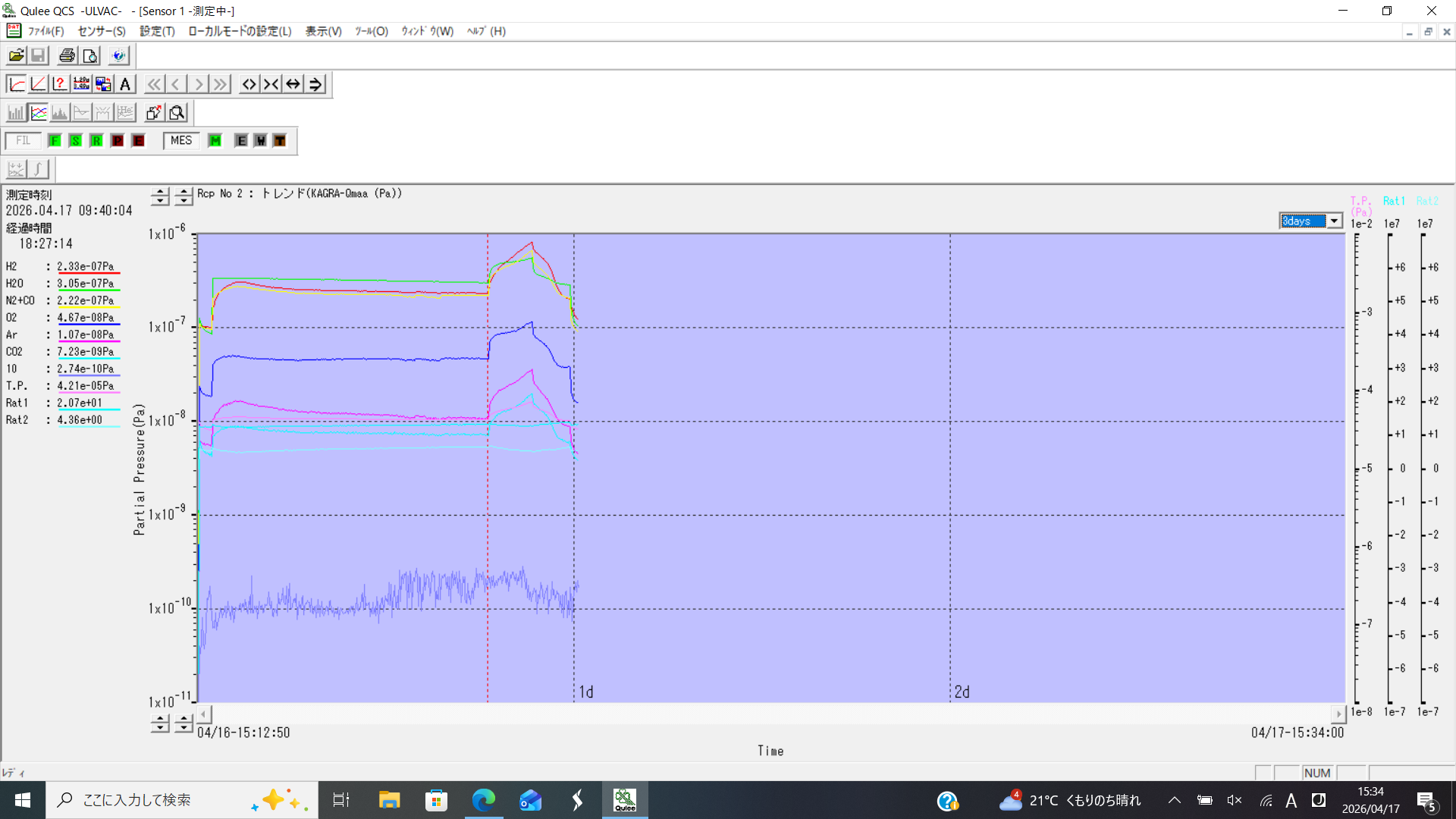
Approximately 2:50 PM, we turned on the ion pump power to activate the ion pump, at which point the SRM pressure rose to the 10^-3 Pa range.
We waited until 3:30 PM for the pressure to begin declining, but since it did not, I turned off the ion pump power.
The SRM pressure returned to the 10^-4 Pa range.
Although this is a qualitative explanation, ion pumps near the cryostat tend to have higher outgassing rates compared to those near the ambient-temperature vacuum chamber.
Since the cryostat’s low-temperature pumping effect is orders of magnitude greater, we speculate that the amount of gas adsorbed by the internal getter in the ion pump near the cryostat is smaller.
In contrast, we estimate that it takes 5 to 6 hours to activate the ion pump near the ambient-temperature chamber.