[Tanaka,Saito]
To resolve the issue of an excessively large beam size identified in klog:36731, we recalculated the positions of two lenses for mode matching.
The large loss in the FI reported in klog:36731 was caused by misalignment of the output polarization and contamination inside the FI.
-
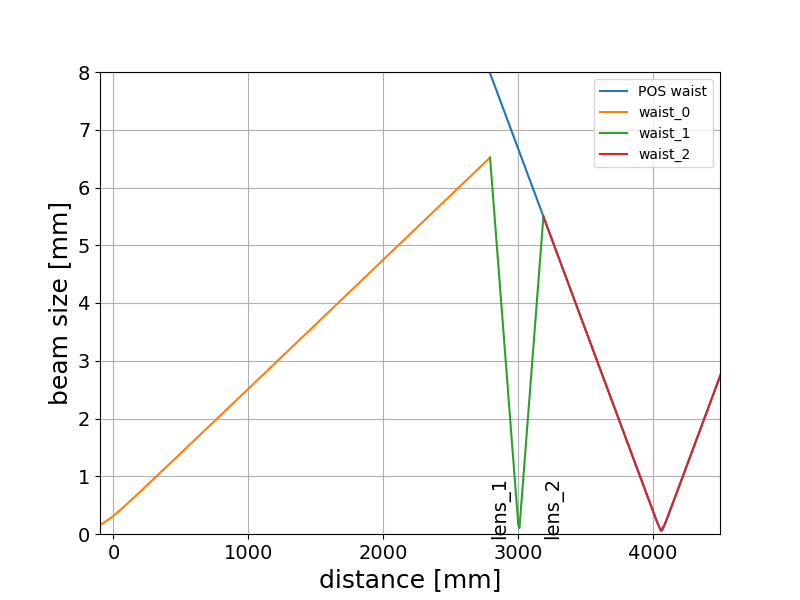
To resolve the issue of an excessively large beam size identified in klog:36731, we recalculated the positions of two lenses for mode matching (Fig. 1). The origin is defined as the point where the laser is emitted. The orange line represents the beam profile of the laser, the green line represents the beam profile after passing through the first lens, the red line represents the beam profile after passing through the second lens, and the blue line represents the target beam profile of the IR laser on the POS optical table.
The focal lengths and positions of the two lenses are as follows:
Lens 1: focal length = 200 mm, position = 2794 mm
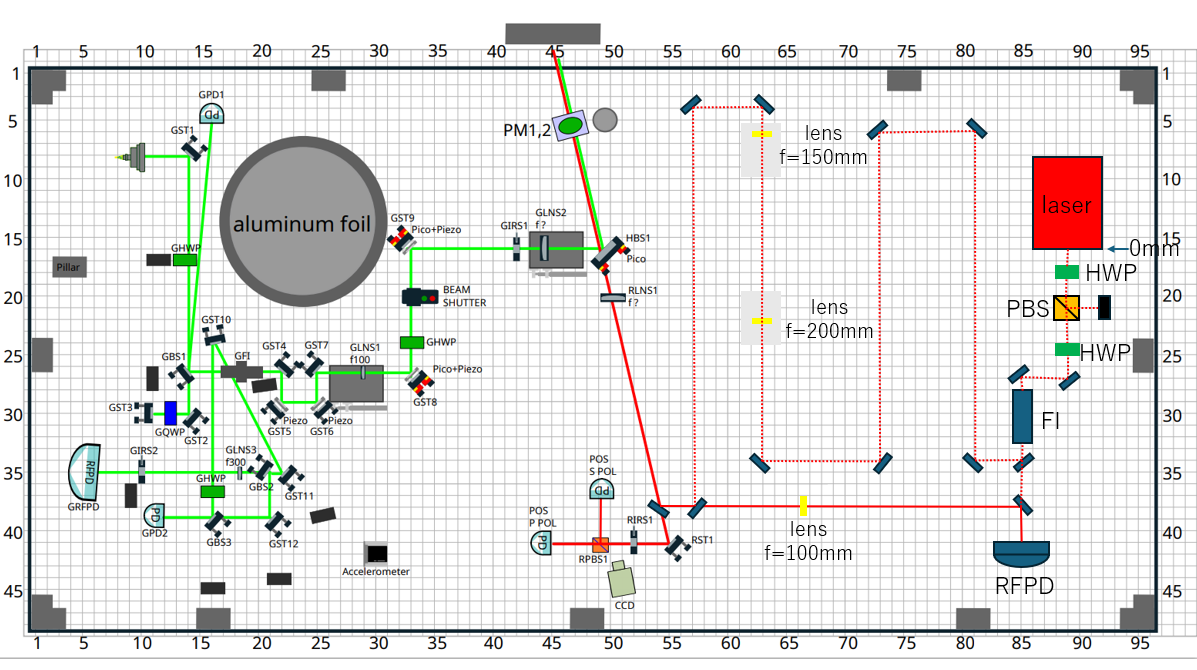
Lens 2: focal length = 150 mm, position = 3190 mmThe beam size at these lens positions is acceptable when using 2-inch lenses. Based on the calculated lens positions, we redesigned the optical layout for PRCL and SRCL measurements (Fig. 2).
-
Although the FI exhibited large losses in klog:36731, aligning the output polarization improved the transmitted power: the input power was approximately 27 mW, while the output power increased to about 20 mW, corresponding to a transmission of 74%. However, since no further improvement was observed, we inspected the interior of the FI by illumination and found contamination (Photo 1). Therefore, we decided to use a newly purchased FI instead.