The ETMX have tripped around 3:50 on Jan 18.
It seemed MN H3 triged the tripped.
As the value was much lower than the trigged point, I reseted the WD.
There was not any earthquakes on the time?
The ETMX have tripped around 3:50 on Jan 18.
It seemed MN H3 triged the tripped.
As the value was much lower than the trigged point, I reseted the WD.
There was not any earthquakes on the time?
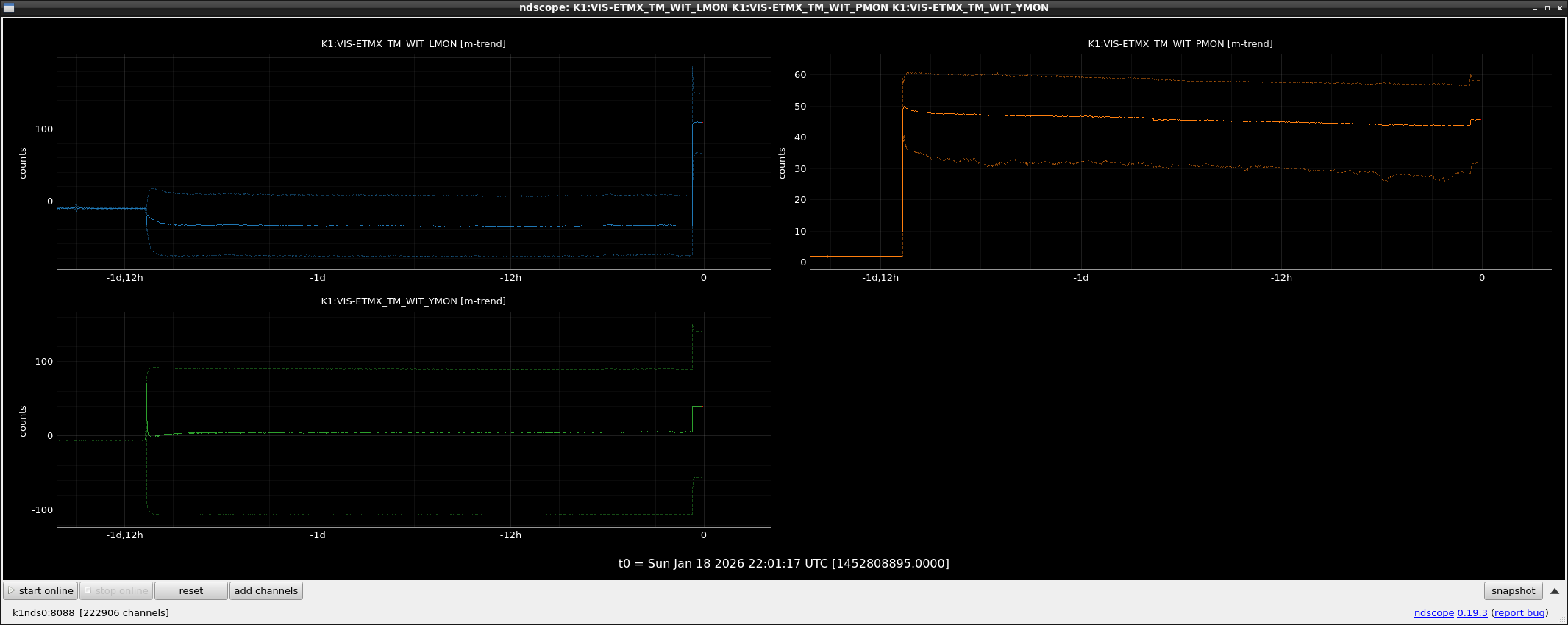
After that, the suspension can not reach SAFE state as the guardian gives errors saying BF_COILOUTFs have outputs. (fig1)
It seems they have provided the very hight values from around 1/17 20:20. (They are still high values now.)
The TM oplev values are still oscilating.(fig2)
The error was at the CLOSE_MASTERSWITCH state.
While investigating the system in the situation, I found the NBDAMP L5 was ON.
After manually turing it OFF, the suspension was able to reach the SAFE state.
We need to check why the L5 was turned ON (while the state transition?).
I found this L5 filter which is not used in the main pass was set to be ON in ENGAGE_RAPIDDAMP state.
So I comment-outed this line in the guardian.
Then, the ETMX suspension could reach the LOCK_AQUISITION state.
We are checking why the ETMX suspsneion went to TRIPPED stat.
We found that the MN COILOUTF outputs gave high signal just before the state change.
(There was not earthquack observed.)
After the modification, I found that ETMX cannot be damped well for a long time when the suspension was kicked due to the lockloss (fig1).
Figure 2 shows the enlarged view of oscillation, which is at 1.67 Hz.
Since 1.67 Hz is close to 2nd mode of yaw and NBDAMP_L5 frequency, I checked both of them.
First, I checked MN_MNOLDAMP_Y loop to confirm the yaw loop is fine.
Figure 3 shows the OLTF of MN_MNOLDAMP_Y loop with Y1 and Y2 NBDAMP, which seems fine.
Note that MNOLDAMP_Y is designed to damp only 1st (0.3Hz) and 2nd (1.7Hz) resonances, so NBDAMP for 3rd (3.1Hz) and MNR(4.1Hz) should be turned on during the measurement to avoid kicking the resonance at high frequency.
Then, I measured OLTF of NBDAMP_L5 (fig4), which damps 1.67Hz longitudinal mode of Type-A tower.
During the measurement, I turned on MN_MNOLDAMP_Y and NBDAMP_{Y1,Y2} to avoid kicking the yaw resonances.
Since the resonant frequency of 2nd mode of yaw and tower longitudinal mode are very close, the yaw resonance is growing up during the measurement if there is no yaw damping.
This might be the reason of large peaking reported in klog36109.
Anyway, the OLTF of NBDAMP_L5 also seems fine, so I modified the ETMX guardian so that NBDAMP_L5 is engaged at LOCK_ACQUISITION state and disengaged at CARM_DOWN state (fig5 and fig6).