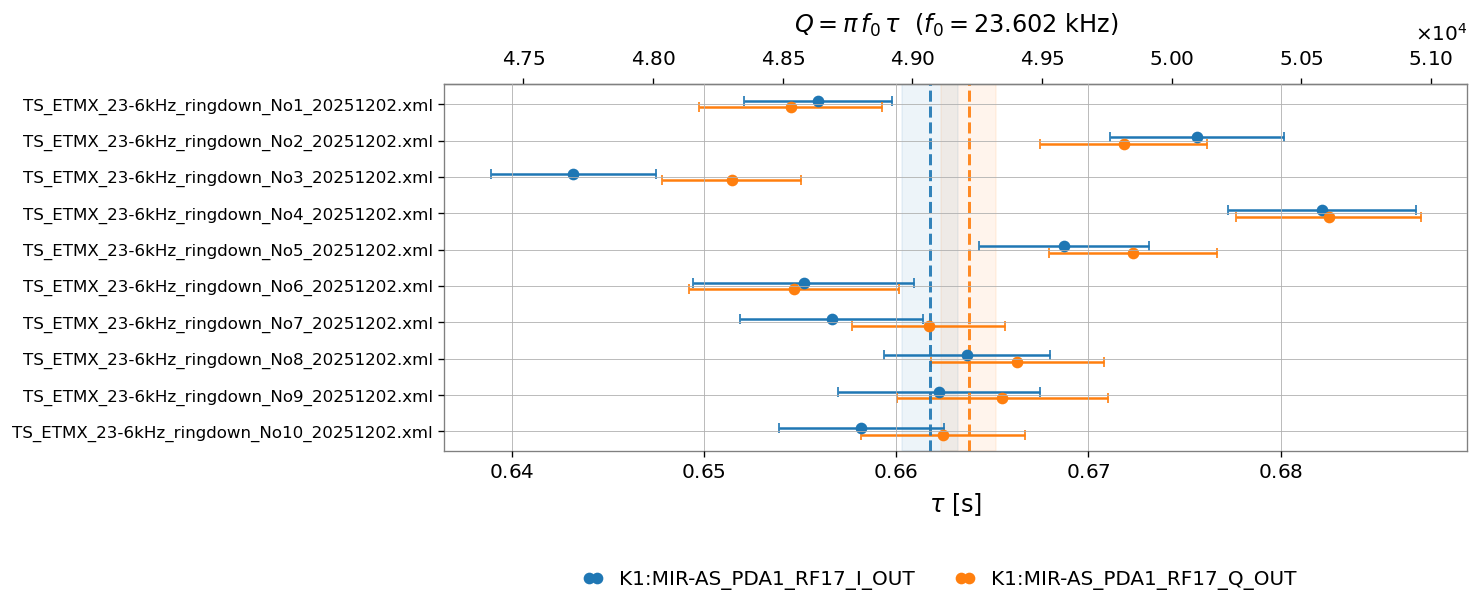
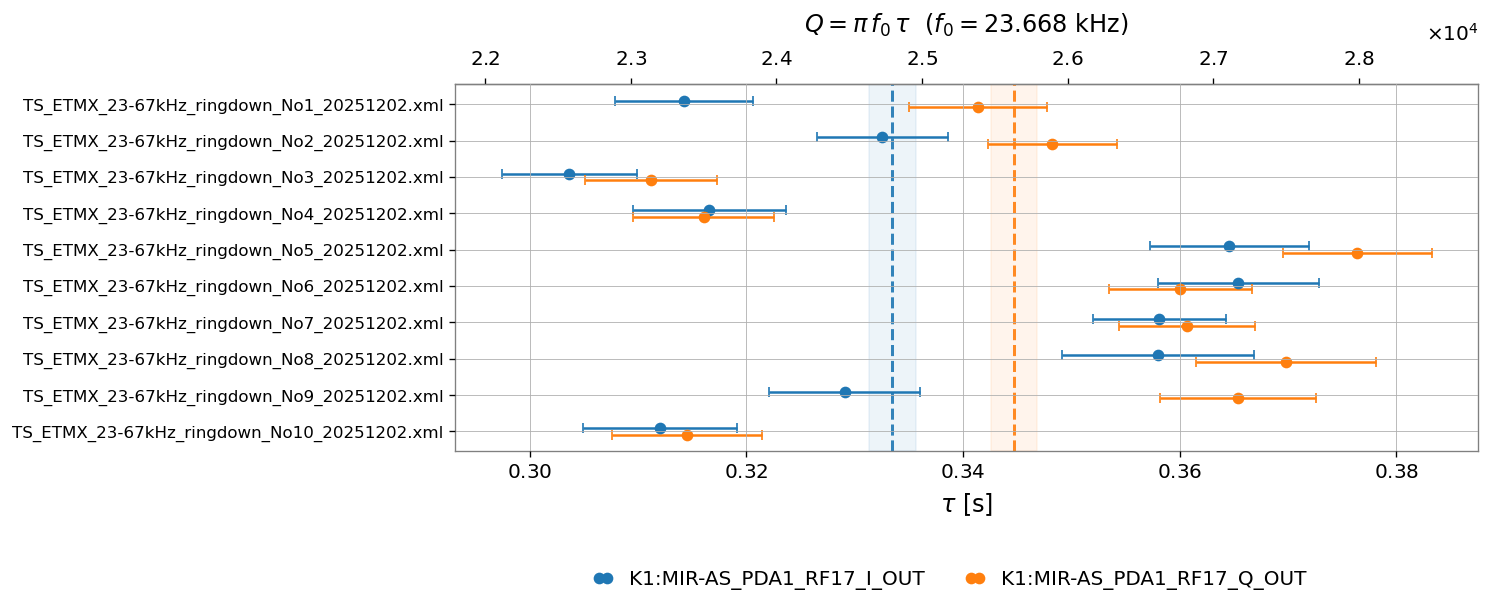
I evaluated the decay time of the ringdown data. After taking an RMS with 32 Hz sampling and assigning an error bar with a constant and a scaling term, I fitted to the following function:
![\begin{align*}f(t) = \sqrt{\left(A\cdot \left[ \theta(t_0-t) +\theta(t-t_0)\cdot e^{-\frac{t-t_0}{\tau}}\right]\right)^2 + B^2 }\end{align*}](https://texclip.marutank.net/render.php/texclip20251204230405.png?s=%5Cbegin%7Balign*%7D%0Af(t)%20%3D%20%5Csqrt%7B%5Cleft(A%5Ccdot%20%5Cleft%5B%20%5Ctheta(t_0-t)%20%2B%5Ctheta(t-t_0)%5Ccdot%20e%5E%7B-%5Cfrac%7Bt-t_0%7D%7B%5Ctau%7D%7D%5Cright%5D%5Cright)%5E2%20%2B%20B%5E2%20%7D%0A%5Cend%7Balign*%7D&f=c&r=150&m=p&b=f&k=f)
where A, B, τ, and t0 are constants, and θ(*) is the step function. Please see the plots.
K1:MIR-AS_PDA1_RF17_I_OUT
[[Model]]
Model(func_decay)
[[Fit Statistics]]
# fitting method = Nelder-Mead
# function evals = 133
# data points = 640
# variables = 4
chi-square = 660.350845
reduced chi-square = 1.03828749
Akaike info crit = 28.0339840
Bayesian info crit = 45.8798567
R-squared = 0.99916586
[[Variables]]
A: 2.59276015 +/- 0.00338079 (0.13%) (init = 2.592923)
tau: 0.64615455 +/- 0.00523546 (0.81%) (init = 0.7)
t0: 4.35480628 +/- 0.00405929 (0.09%) (init = 4.34)
B: 0.30116280 +/- 0.00109288 (0.36%) (init = 0.3021896)
[[Correlations]] (unreported correlations are < 0.100)
C(tau, t0) = -0.7520
C(A, t0) = -0.2076
C(tau, B) = -0.1463


.png)
.png)
.png)
.png)
.png)
.png)




.png)
.png)
.png)
.png)
.png)
.png)