Reports 1-1 of 1 Clear search Modify search
MIF (General)
takafumi.ushiba - 19:32 Tuesday 28 October 2025 (35426) Print this report
Investigation for increasing laser power

[Michimura, Ushiba]

We investigated why lockloss happened during increasing laser power by checking following conditions:
1. Increasing laser power only locking IMC: OK
2. Increasing laser power with IRX locked: lockloss
3. Reducing IMC CMS IN1 gain manually: lockloss
4. Reducing IMC CMS IN1/IN2 gains at the same time: OK

We will investigate more tomorrow.

Comments to this report:
takafumi.ushiba - 19:04 Thursday 30 October 2025 (35443) Print this report

I checked the signals while increasing the laser power in the IRX LOCKED state (Fig. 1).
The laser power increase finished well ahead of the lockloss, so the glitch due to the gain switching doesn't seem the trigger of the lockloss.
In addition, we can see the slow drift of CARM FAST and IMC FAST signals just before the lockloss, which might cause the lockloss.

Since high-pass filter was engaged before the FAST DAQ (2nd-order 5Hz for CARM and 1st-order 2kHz for IMC), I have no idea why this kind of slow drift can be seen in these channels.
One possibility is saturation of opamp inside the circuit, so I would like to check if the same phenomena can be seen even swapping IMC CMS to the old one tomorrow.

Images attached to this comment
shinji.miyoki - 19:52 Thursday 30 October 2025 (35444) Print this report

Also, is there any PD satulation? Actually, one story is as follows,

: If satulation happens in anywhere (circuit, PD, etc), the low frequency signals will be lost firstly, I think. Then, the loop gain for low rfrequencies will be lost, then ithe system starts drifting, and finally reaches lockloss.

dan.chen - 15:42 Friday 31 October 2025 (35449) Print this report

With Takafumi Ushiba

We replaced the IMC CMS circuit with the old one (S1605810).
And adjusted the IMC-SERVO_IN1GAIN (4dB -> 24dB) and IMC-SERVO_IN2GAIN (-13dB -> 7dB) to make the UGF of this IMC control loop to be same as before.
After the adjustment, we measured the OLTF and checked the crossover frequency. (Attached figures.)

When installing the CMS circuit, we noticed that the ports on the back of the circuit chassis (Com/Fast Mon and Slow Mon) were reversed compared to the previous chassis, so we carefully checked which cables should be connected while installing it.
In the end, the connections according to the labels turned out to be correct.

The CMS which was installed before the replacement today, was moved back to Mozumi and is being inspected.

Images attached to this comment
dan.chen - 16:48 Friday 31 October 2025 (35453) Print this report

With Taaki Yokozawa, Takafumi Ushiba

After replacing the IMC CMS, we needed to retune the system-side offset compensation parameters because the analog circuit characteristics changed. In particular, we adjusted the offsets associated with IMC CMS gain changes.

Procedure

  1. Closed the IR laser shutter.
  2. Set gains to 24 dB (IN1) and 7 dB (IN2), then checked the offset of the signal before the filter (K1:IMC_SERVO_MIXER_DAQ_OUT_DQ): about 0.498376 V.
  3. Opened SERVO_IN1_GAIN_OFS_COMP.
  4. Decreased the IN1 gain step by step and, for each step, tuned the corresponding value in SERVO_IN1_GAIN_OFS_COMP so that the measured offset remained at 0.498376 V. This was carried out from 24 dB down to −32 dB. During the process, a script was written to partially automate the adjustments.
  5. For IN2, first disconnected the CARM CMS input so no signal would be sent to the IMC CMS from CARM. Then passed only IN2 and adjusted the corresponding entry (7 dB) in SERVO_IN2_GAIN_OFS_COMP while monitoring the same pre-filter signal.

Result

  • IN1: Offsets were adjusted for all gains ≤ 24 dB.
  • IN2: Offset was adjusted for the 7 dB setting.

Reference signal: K1:IMC_SERVO_MIXER_DAQ_OUT_DQ

Images attached to this comment
takafumi.ushiba - 18:56 Friday 31 October 2025 (35455) Print this report

I confirmed that the cause of the lock loss was the instability of the CARM loop.
The CARM loop has very sharp peaks and deep notches around 25 kHz; even a small increase in gain causes oscillation.
So, I checked the structure of the CARM OLTF between 10 kHz and 100 kHz.

Figures 1 through 5 show the OLTF measurements of the CARM with a single X-arm lock at 25 kHz, 50 kHz, 74 kHz, 76 kHz, and 100 kHz, respectively.

When the CARM UGF is around 10 kHz (the configuration of a single-arm lock), the peak at 24 kHz in Fig. 1 is very close to 0 dB.
So, even a small increase in optical gain, caused by increasing laser power, can lead to oscillation.
This would be the main cause of instability when increasing laser power with a single-arm lock.

If the CARM UGF is above 50 kHz, as it is when the laser power is increased, the 50 kHz notch can introduce instability to the CARM loop.
This might be the reason for instability when increasing the laser power with PRFPMI.

I'm not sure where these peaks and notches come from, but one possibility is the PZT of the new seed laser.
So, It would be helpful to check the resonance of the new seed laser.

Note:

These peaks and notches cannot be seen well if we measured the broad frequency band, such as from 1kHz to 100kHz, because data point is not dense enough.
So, we need to reduce the measurement band for checking these peaks and notches.

Images attached to this comment
shinji.miyoki - 23:22 Friday 31 October 2025 (35458) Print this report

In the case of only X IR resnance, Ushiba-kun succeeded in icreasing the laser power by the following cycles,

  1. decrease the loop gain for the IR X lock by rotating the  1/2 wave plate for the REFL PD,
  2. increase the laser power by rotating  the  1/2 wave plate for the IMC ,

Before, the cycle was 

  1. increase the laser power by rotating  the  1/2 wave plate for the IMC ,
  2. decrease the loop gain for the IR X lock by rotating teh 1/2 wave plate for the REFL PD,

However, before reaching 2, IR lock was lost because of the reason thata was explained by Ushiba-kun.

shinji.miyoki - 7:41 Saturday 01 November 2025 (35457) Print this report

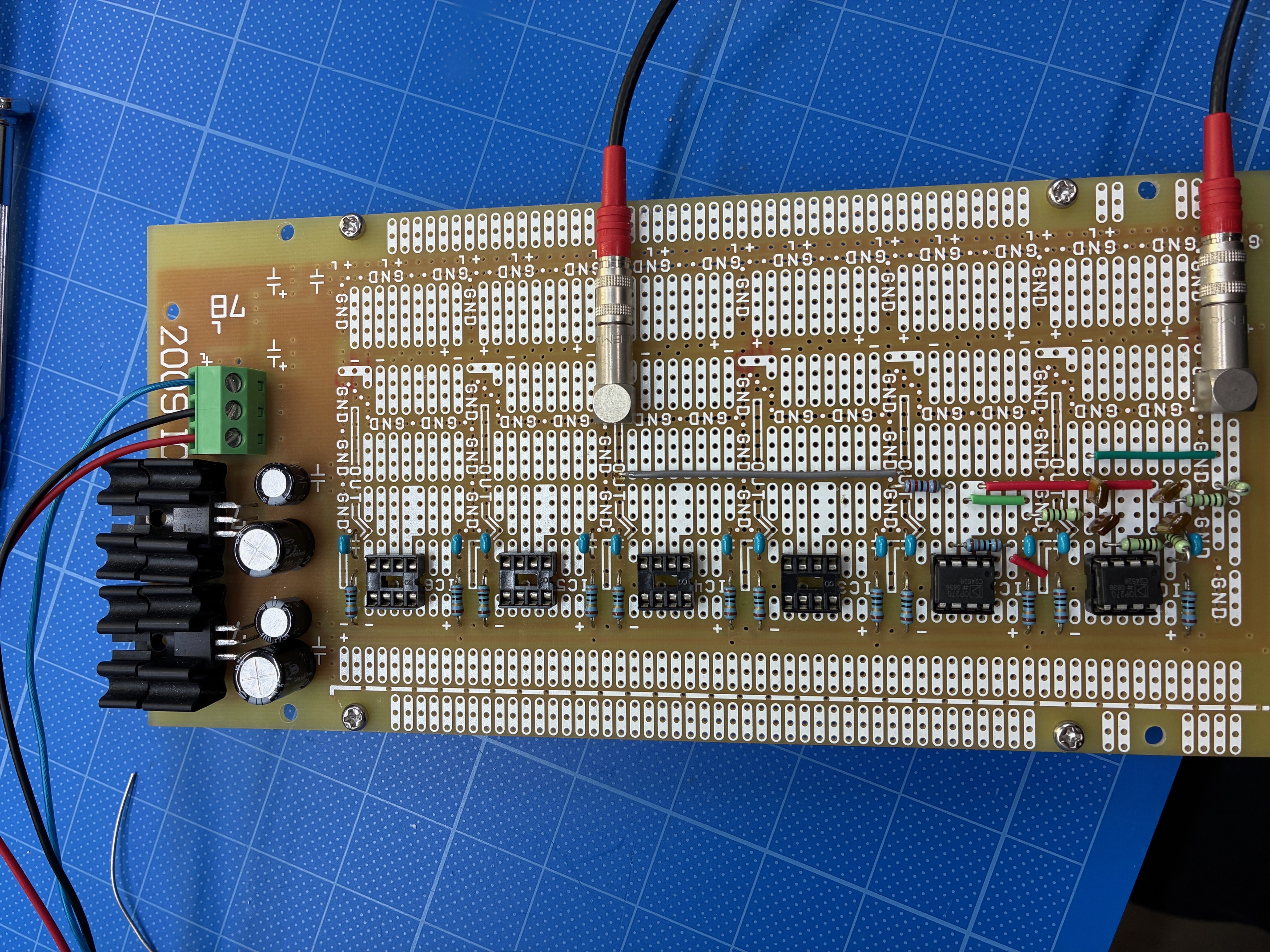
Anyway, I made a sample active Twin-T type notch filter by using an universal circuit PCB plate for 24.4kHz. Q can be adjusted. It worked.

So if the frequencies are fixed, I can make more. However, I need variable  resistance to tune the frequency.

shinji.miyoki - 14:00 Tuesday 04 November 2025 (35476) Print this report

If 24.1kHz resonance is terminated, other harmonics like resonances, such as 50.0, 24.0, 75.8, 99.9 kHz can also be mitigated?? In addition, 150kHz passive notch is still necessary, even if the master laser was replaced? or do we need other notch?

Anyway, the followings are the RC parameters,

Frequency [kHz] 24.1 50.0 74.0 75.8 99.9 150
R ohm 2000 2100 2160 2110 2360 3200
C nF 3.33 1.52 1 1 0.68 0.33

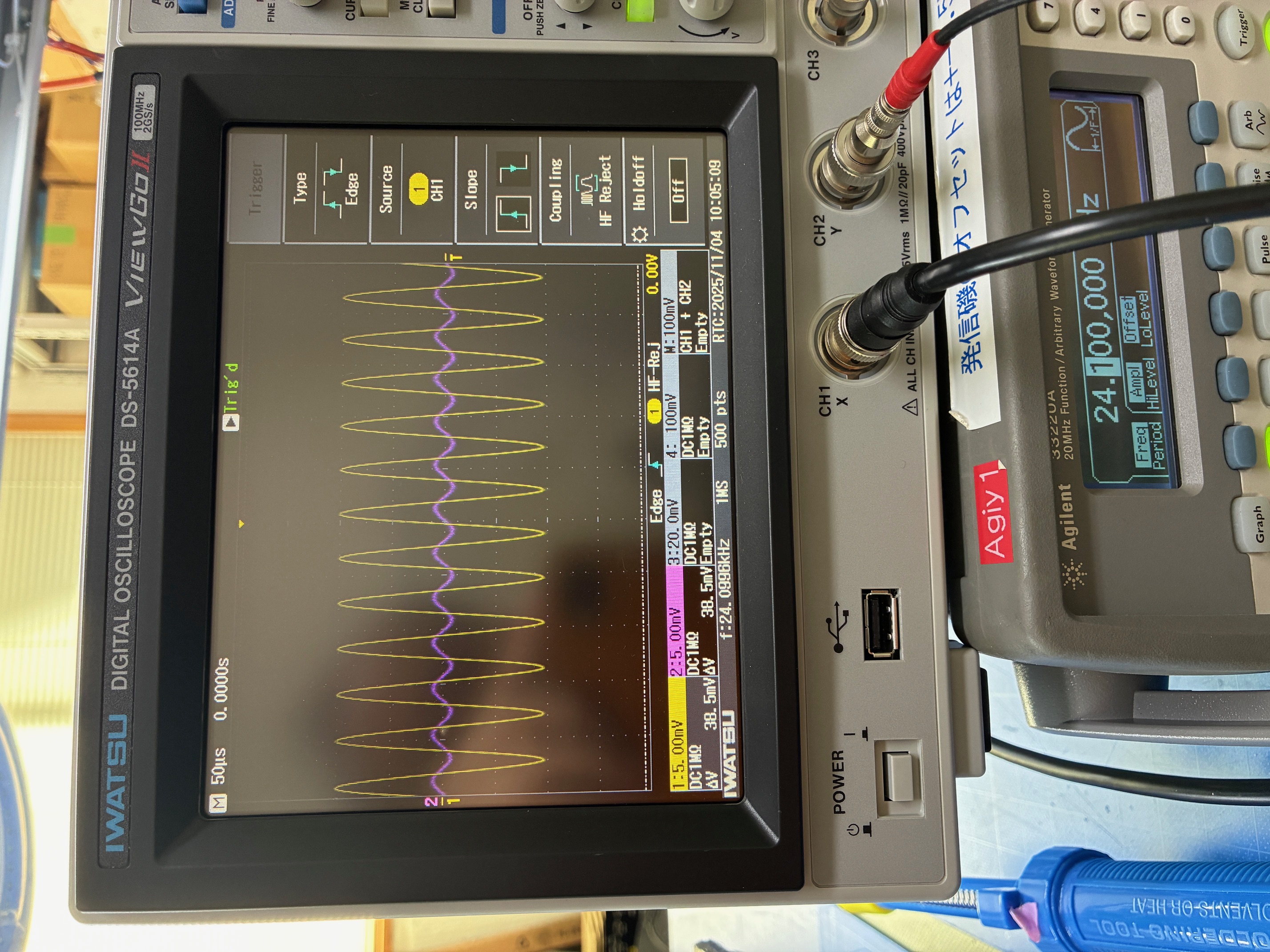
Photos show 24.1kHz TwinT notch circuit and 1/6 reduction.

Images attached to this comment
takafumi.ushiba - 12:03 Wednesday 05 November 2025 (35489) Print this report

I set all IN2 gain offset compensation matrix elements except for the one for GAIN7 to zero because these values are not tuned for the current CMS servo.
Figure 1 shows the current matrix.

Images attached to this comment
Search Help
×

Warning

×