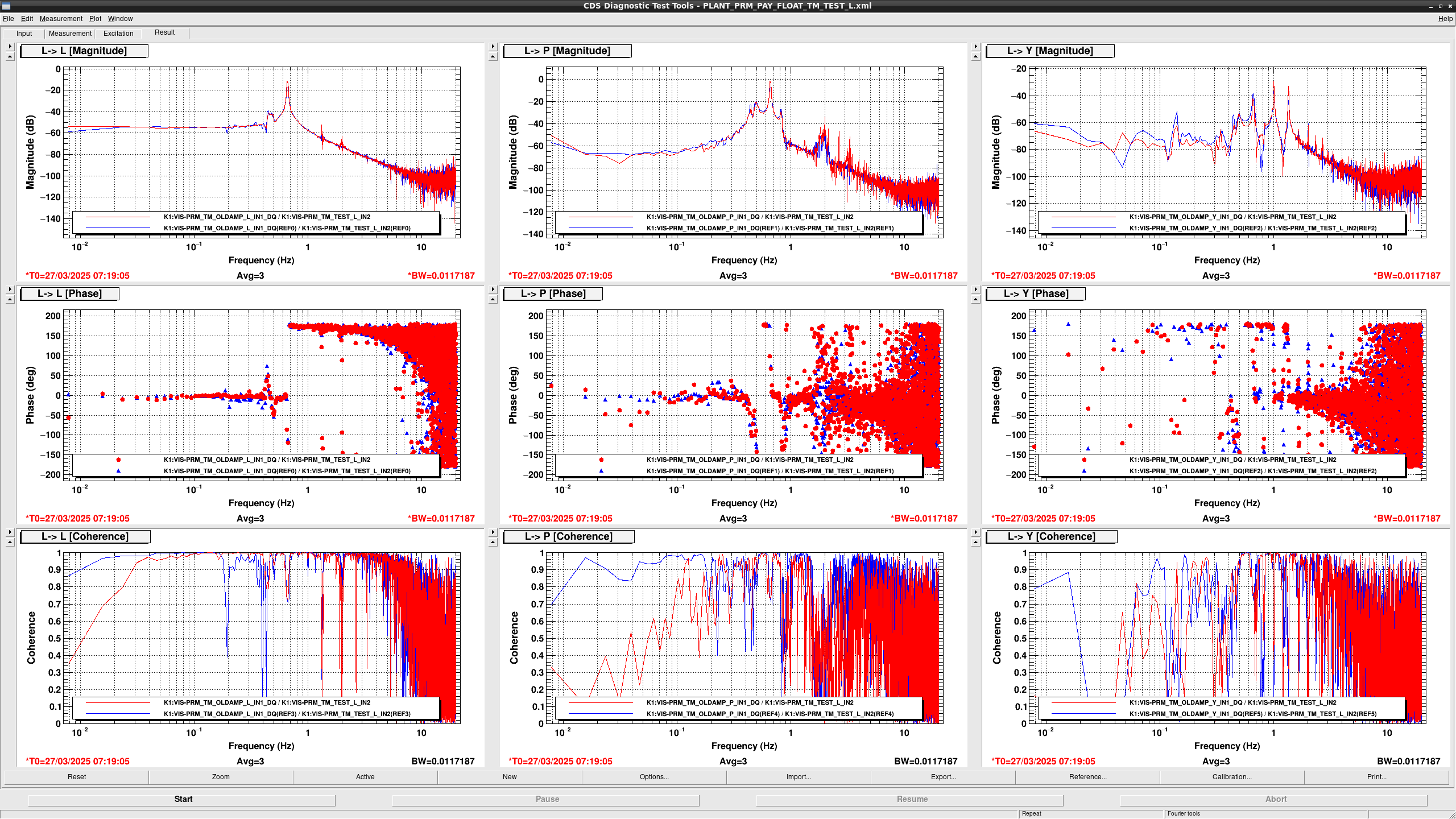
PLANT_PRM_READY_BF_COILOUTF_H{1,2,3}.xml
We can see the large excess in H{1,2,3} -> V{1,2,3} in ~100 mHz range.
First, we suspected BF touched somewhere, but we cannot see strange point in the measurement of the GAS filters (BF,SF)
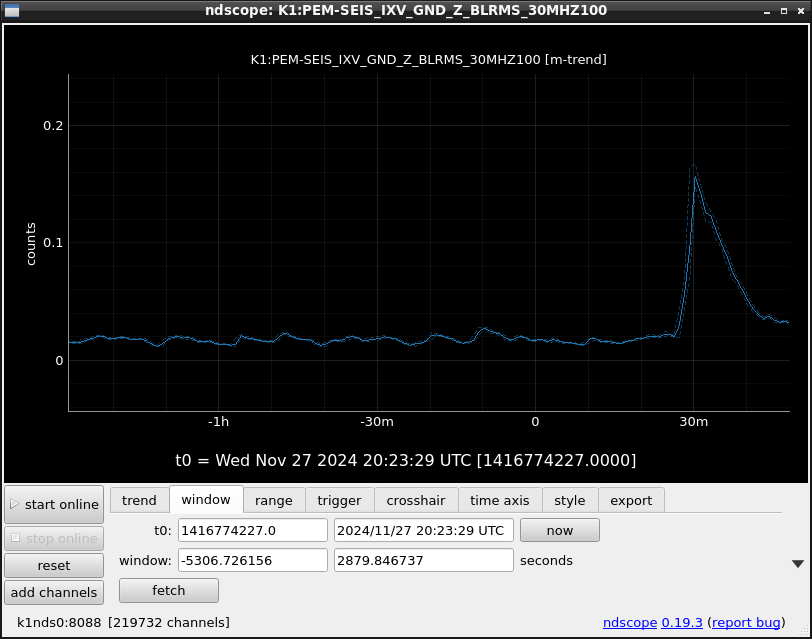
Second, we suspected the earthquake during this measurement, but we cannot see the earthquake signal as shown in Fig.1.
Third, we checked the time series of the LVDT INF signal, then we can find some larger RMS value in V monitor even we excited the H signals(Fig.2. and Fig.3.).
The main frequency would be about 0.3 Hz, so we checked the amplitude of the seismometer and
my consideration is that those excess may come from the larger microseismic as shown in Fig.4. (Red : health check time this time, Blue : health check time reference June 2024)
But, we need the confirmation for 0.1 Hz excess was really for the microseismic.


I checked the spectra of BF vertical LVDTs with and without H1 excitation.
Figure 1 shows the results (Red: with excitation, blue: without excitation).
Since the spectrum between 0.2 and 0.5 Hz didn't change, the low coherence around 0.3 Hz in TF from BF horeizontal coil excitation to vertical BF LVDTs seems due to the large microseismic noise.
However, 0.1 Hz peak can be seen only with excitation, so the peak around 0.1 Hz is not likely to come from the microseismic noise.
Then, I chcked BF vertical LVDT signals and found that the vertical position of BF is far from the previous measurement.
So, I added the offset from K1:VIS-PRM_{SF,BF}_TEST_GAS_OFFSET so that the GAS filter position is close to the setpoint.
Figure 2 shows the TF from BF H1 coil to each LVDT (Red: with GAS offset, Blue:without GAS offset).
The peak height on V1 and V2 were reduced while V3 was slightly increased, which is the same trend as the previous health check in June.
So, the peak at 0.1 Hz seems to come from horizontal to vertical coupling, and the coupling ratio is changed by the BF position.
The other Type-Bp suspensions have a similar change of TFs, they would be also happened with the same reason.


I performed a health check of PRM.
Figure 1-33 show the results and they seem healthy.
Note:
Some TF gains from IM EXC to IM sensors are increased from the previous measurement.
This is because the previous measurement was done when the IM OSEM position was close to the linear range (fig34: Y cursors show the OSEM values in the previous measurement).
This time, health check was done with the good position of OSEM thanks to the offload work before the health check (klog33123).
So, this changes are not problematic.


I checked the TF measurement results for the health check (fig1 - fig33).
Although the IM OSEM H1 and V2 have smaller gains because the OSEM positions are close to the edge of the linear range, this does not seem to be due to the power outage.
As the OSEM positions have not been changed since the last vacuum evacuation, these results may be acceptable.
Other than that the suspension seems healthy.